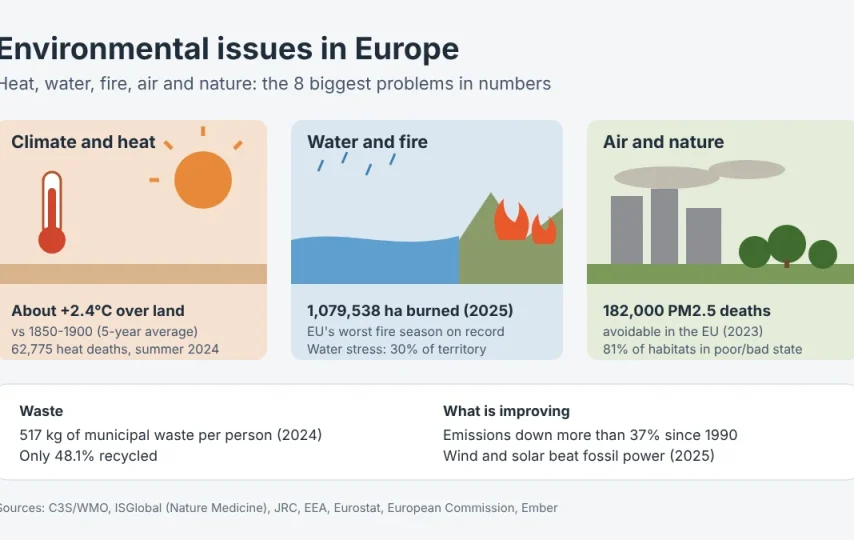

The biggest environmental issues in Europe are a fast-warming climate, deadly heat waves, floods, drought and water stress, record wildfires, air pollution, the loss of nature and healthy soil, and the waste that comes with high consumption. Europe is the fastest-warming continent, heating up about twice as fast as the global average since the 1980s, according to the European State of the Climate 2024 report by the Copernicus Climate Change Service (C3S) and the World Meteorological Organization (WMO).
The European Union alone had 452.0 million people on January 1, 2026, according to Eurostat. Some figures below cover the whole continent and some only the 27 EU countries; each one says which. Below are the eight main problems, a summary table, what is being done and what you can do.
Top 8 Environmental Issues in Europe
1. Fast Warming
Europe’s latest five-year average temperature over land was about 2.4°C (4.3°F) above the 1850–1900 level, according to the European State of the Climate 2025, and 2024 was Europe’s warmest year on record, according to the WMO. European glaciers have lost 915 km³ of ice since 1976, according to the 2024 edition of the C3S and WMO report.
The warming continued in 2025. At least 95% of Europe had above-average temperatures, the UK, Norway and Iceland had their warmest year on record, and Europe’s sea surface temperature set a record for the fourth year in a row, according to C3S. A record three-week heat wave hit sub-Arctic Norway, Sweden and Finland, with temperatures above 30°C (86°F) inside the Arctic Circle.
2. Deadly Heat Waves
A study in Nature Medicine estimated 62,775 heat-related deaths in 32 European countries in summer 2024, with the most in Italy (more than 19,000), Spain (more than 6,700) and Germany (about 6,300), according to the research institute ISGlobal, which led it. Using reprocessed data, the same study put 2022 at nearly 67,900 and 2023 at about 50,800 heat deaths, for a total of more than 181,000 in three summers.
Researchers at Imperial College London estimated about 50,000 heat deaths in 854 European cities in June–August 2026 and attributed nearly two-thirds of them to human-caused climate change, in a study due in the journal Nature Health, AP reported. It covers cities only, so it cannot be compared directly with the national totals above.
3. Floods and Storms
Storms and floods affected about 413,000 people in Europe in 2024 and killed at least 335, according to the European State of the Climate 2024 summary. Storm Boris in September 2024 caused flooding in eight countries in central and eastern Europe. In October 2024, extreme rain in Spain reached 771.8 mm (30.4 inches) in 24 hours, and at least 232 people died in the province of Valencia alone, according to the same report.
The costs are rising. Weather and climate-related extremes caused €822 billion in losses in the EU from 1980 to 2024, more than a quarter of it (over €208 billion) in 2021–2024 alone, according to the European Environment Agency (EEA). Floods caused 47% of all losses, and less than 20% of the losses were insured.
4. Drought and Water Stress
Water stress affects 30% of Europe’s territory and 34% of its population, according to the EEA’s Europe’s environment 2025 report. In 2025, 70% of Europe’s rivers had below-average annual flow, according to the European State of the Climate 2025.
Water quality is a problem too. Only 37% of the EU’s surface water bodies had good or high ecological status in 2015–2021, according to the EEA’s state of water assessment. In 2016–2019, 14.1% of groundwater monitoring stations exceeded the EU limit of 50 mg of nitrate per liter, according to the EEA nitrate indicator.
5. Record Wildfires
2025 was the EU’s most destructive wildfire season on record: fires burned 1,079,538 hectares (about 2.67 million acres), an area about the size of Cyprus and nearly double the 2006–2024 average, according to the EU’s Joint Research Centre (JRC). Germany, Spain, Cyprus and Slovakia each set national records. In August alone, 22 very large fires in Spain and Portugal burned 460,585 hectares (about 1.14 million acres), 43% of the EU total.
Fires are also burning protected nature: 424,023 hectares (about 1.05 million acres) burned inside Natura 2000 sites, the EU’s network of protected areas, according to the JRC.
6. Air Pollution
Air quality has improved, but it still kills. In 2023, 182,000 deaths in the EU could have been avoided if fine particle pollution (PM2.5) had met the World Health Organization guideline level, according to the EEA. The EEA also attributes 34,000 deaths to nitrogen dioxide and 63,000 to ozone; these estimates overlap and should not be added together.
The good news is the trend: deaths linked to PM2.5 fell 57% from 2005 to 2023, which already meets the 55% reduction target of the EU’s zero pollution action plan. Still, the EEA says 95% of people living in European cities are exposed to air pollution well above WHO guideline levels.
7. Loss of Nature and Healthy Soil
Only 15% of the EU’s protected habitats are in good condition, while 81% are in poor or bad condition, and 63% of protected species have poor or bad status, according to the EEA’s State of Nature assessment, which is based on 2013–2018 reporting by EU countries.
Below ground, an estimated 60–70% of EU soils are unhealthy, and soil degradation costs the EU at least €50 billion a year, according to the European Parliament.
8. Waste and Overconsumption
Each EU resident produced 517 kg (about 1,140 pounds) of municipal waste in 2024, 8% more than in 2014, and only 48.1% of it was recycled, according to Eurostat. Packaging is a big part of the problem: the EU generated 181.0 kg (about 399 pounds) of packaging waste per person in 2024, including 35.9 kg (about 79 pounds) of plastic packaging, according to Eurostat.
Most materials are still used once. The EU’s circular material use rate, the share of materials that come from recycled waste, reached a record 12.2% in 2024, against a 2030 goal of 23.2%, according to the EU Circular Economy platform.
Europe’s Environmental Issues at a Glance
| Issue | Key figure | Source | Trend |
|---|---|---|---|
| Warming | About 2.4°C (4.3°F) above pre-industrial (5-year average) | C3S / WMO | Fastest-warming continent |
| Heat deaths | 62,775 in summer 2024 (32 countries) | Nature Medicine / ISGlobal | About 50,000 in 854 cities in 2026 |
| Floods and storms | €822 billion in EU losses, 1980–2024 | EEA | Over a quarter in 2021–2024 |
| Water stress | 30% of territory, 34% of people | EEA | Below-average flow in 70% of rivers (2025) |
| Wildfires | 1,079,538 ha burned in the EU (2025) | JRC | Worst season on record |
| Air pollution | 182,000 avoidable PM2.5 deaths in the EU (2023) | EEA | Down 57% since 2005 |
| Nature | 81% of protected habitats in poor or bad condition | EEA | Restoration law in force since 2024 |
| Waste | 517 kg of municipal waste per person (2024) | Eurostat | Up 8% since 2014 |
What Is Being Done
- Cutting emissions. EU greenhouse gas emissions in 2024 were more than 37% below 1990 levels, while the economy grew 71%, according to the European Commission. The legal target is a 55% cut by 2030, and in March 2026 the EU wrote a 90% cut by 2040 into law, with up to 5 percentage points allowed from international carbon credits.
- Clean electricity. In 2025, wind and solar generated 30.1% of EU electricity, more than fossil fuels (29.0%) for the first time, and all renewables 47.7%, according to the energy think tank Ember. For how this compares at home, see our guide to wind power pros and cons.
- Restoring nature. The Nature Restoration Law, in force since August 2024, requires restoration measures on at least 20% of the EU’s land and sea by 2030 and on all ecosystems that need it by 2050. A new Soil Monitoring Law, approved by the European Parliament in October 2025, aims for healthy soils by 2050.
- Saving water. The European Water Resilience Strategy, adopted in June 2025, aims to improve water efficiency by at least 10% by 2030. Depending on the country, 8% to 57% of water is lost to leaks.
- Less packaging. The Packaging and Packaging Waste Regulation has applied since August 12, 2026, and its requirement that all packaging be recyclable applies from 2030, according to the European Commission.
EU laws set targets, but each country decides how to meet them, and progress varies widely. Check the EEA and Eurostat for the latest country data.
What You Can Do
If you travel to Europe or follow its news, these steps connect the problems above to your own choices:
- Plan summer trips around heat and fire. The deadliest heat and the largest fires described above came in summer. Check national weather warnings and wildfire alerts before you go, and travel in spring or fall if you can.
- Fly less, ride trains more. Where a train route exists, it can replace a short flight.
- Save water where it is scarce. In water-stressed regions, short showers and reused towels in hotels make a difference.
- Compare with home. Our article on environmental issues in Florida shows how heat, rising seas and polluted water play out in one U.S. state, and our overview of global environmental issues puts Europe in world context. For a school project, our guide to human-environment interaction explains how people depend on, adapt to and modify their environment.
Frequently Asked Questions
What is the biggest environmental issue in Europe?
There is no official ranking, but climate change ties most of the problems together. Europe is the fastest-warming continent, and heat waves killed an estimated 62,775 people in summer 2024 alone.
Why is Europe warming faster than the rest of the world?
C3S and the WMO partly explain it by the share of European land in the Arctic, the fastest-warming region on Earth, and by more frequent summer heat waves. Europe’s latest five-year average is about 2.4°C (4.3°F) above pre-industrial levels.
Is air pollution in Europe getting better?
Yes. Deaths linked to fine particle pollution in the EU fell 57% from 2005 to 2023. But about 182,000 deaths in 2023 could still have been avoided if pollution had met WHO guideline levels.
What is the EU doing about climate change?
The EU cut greenhouse gas emissions by more than 37% from 1990 to 2024 and aims for 55% by 2030 and 90% by 2040. In 2025, wind and solar produced more of its electricity than fossil fuels for the first time.


