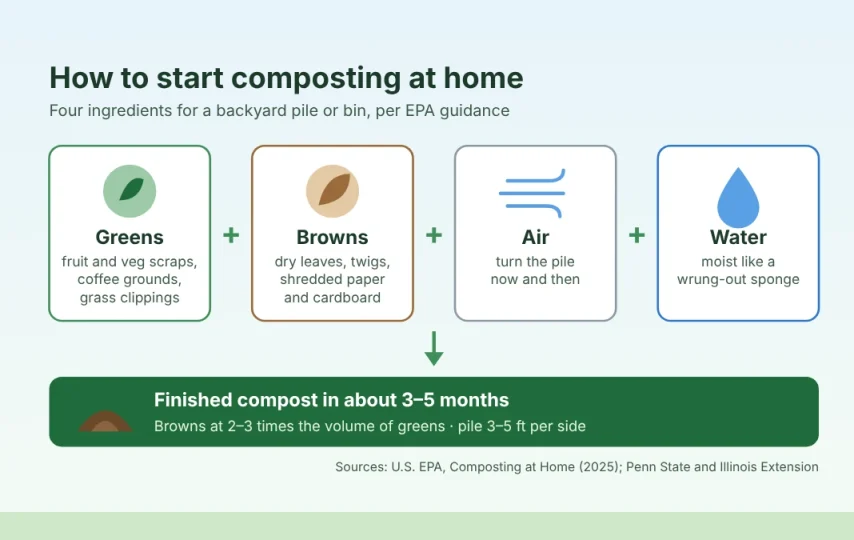

How to start composting at home: pick a spot and a method (an open pile, a bin, a tumbler or a worm bin), then mix nitrogen-rich “greens” such as fruit and vegetable scraps with carbon-rich “browns” such as dry leaves, keep the pile as damp as a wrung-out sponge and turn it now and then. The EPA’s home composting guide says a well-maintained pile is ready in about three to five months; a neglected one can take a year.
Below: why it is worth doing, which method fits your home, a step-by-step setup, what can and cannot go in, and how to fix common problems.
Why Compost at Home?
Food and yard waste are a big slice of what Americans throw out. In 2018, the latest year in EPA’s national data, food made up 21.6% of municipal solid waste generation and yard trimmings another 12.1%, according to EPA Facts and Figures. Together that is about a third of household and business trash (our own sum). The same report says only 4.1% of wasted food was composted that year.
What happens in the landfill matters for the climate. EPA estimates that about 58% of the methane escaping from municipal solid waste landfills comes from landfilled food waste (EPA, October 2023). Composting turns the same scraps into a soil amendment instead. It complements recycling at home: bins take packaging, compost takes the food and yard waste.
Before You Start: Choose a Composting Method
| Method | Best for | Time to finished compost | Main limitation |
|---|---|---|---|
| Open pile or homemade bin (wire, wood, cinder block) | Yards with leaves and grass clippings | 3–5 months well kept, up to a year neglected (EPA) | Needs space; best at 3–5 ft per side |
| Compost tumbler | Small yards, keeping scraps off the ground | Some compost in about 3–6 months (Univ. of Saskatchewan) | Small capacity; contents can freeze in winter |
| Worm bin (vermicomposting) | Apartments, indoor composting | Castings harvested after 3–6 months (EPA) | Worms need 59–77°F; no citrus, onions or meat |
| Bokashi bucket | Small kitchens, meat and dairy scraps | About 2 weeks to ferment, then 2–4 weeks in soil (WSU) | Output is “pre-compost” that must be buried |
| City curbside or drop-off | No yard, or materials a home pile can’t take | Handled by the program | Only where offered |
Sources: EPA; University of Saskatchewan; WSU Extension.
Backyard composting in an open pile or a simple compost bin is the cheapest route and handles the most volume.
Tumblers are enclosed drums you rotate to mix the contents. Oregon State University Extension notes that small models may not hold heat in winter unless double-walled, and raised tumblers keep animals out but not insects.
Indoor composting with worms, or vermicomposting, uses red wigglers (Eisenia fetida) in a bin under a sink, in a closet or in a basement. EPA suggests starting with about one pound of worms (roughly 1,000), soaked and wrung-out shredded paper as bedding, and keeping the bin between 59 and 77°F (15–25°C).
Bokashi is a sealed-bucket fermentation system using inoculated bran. WSU Extension says it can take meat, dairy and cooked food, but the result is not finished compost: you bury it 8 to 12 inches deep, mixed with at least two to three times its volume of soil, and wait two to four weeks before planting.
Curbside or drop-off collection is the option when you have no yard. EPA notes that some cities collect food scraps or yard trimmings with trash and recycling (same EPA overview). New York City’s mandatory program, for example, accepts meat, bones and dairy that a backyard pile should not get (NYC Department of Sanitation).
How to Start Composting at Home: Step by Step
These steps cover a backyard pile or bin, the usual starting point in composting for beginners; tumblers follow the same rules.
1. Pick a well-drained spot
EPA recommends a spot with good drainage that is easy to reach year-round, with a water source nearby, so carrying scraps out and watering the pile are not a chore. If you use a bin, EPA’s guidance on keeping rodents out says it should have no holes or gaps larger than 1/4 inch.
2. Make the pile big enough to heat up
Size matters: Penn State Extension recommends a pile about 3 feet tall, wide and deep, and up to 5 feet. University of Illinois Extension suggests 3 to 5 feet on each side, and no more than 5 feet high or deep, so you can still turn it. Illinois Extension says that size lets the center heat up; smaller piles take longer.
3. Collect greens and browns
Keep scraps in a closed container under the sink or in the freezer, and stockpile browns such as fall leaves outside. Chop tough scraps so they break down faster.
4. Layer browns and greens in the right mix
Sources describe the mix in different ways, so here is what each one says:
- EPA (by volume): browns at “at least two to three times” the volume of greens.
- University of Illinois Extension (by volume): about 1 part green to 1 part brown.
- Penn State Extension (by chemistry): a carbon-to-nitrogen (C:N) ratio of 25–30 to 1.
In our reading, the figures do not conflict as much as they look: dry leaves and food scraps differ a lot in weight and water content, so a C:N target can be hit with different volume mixes. Start with EPA’s base of 4 to 6 inches of bulky browns, then alternate layers, and cover each batch of food scraps with 4 to 8 inches of browns to keep flies and animals away.
5. Keep it moist, not soggy
Illinois Extension and EPA both describe the right moisture as a wrung-out sponge. Too much water starves the microbes of oxygen (Penn State), so add browns if the pile gets wet.
6. Turn the pile to add air
Turning feeds oxygen to the microbes. Penn State suggests turning often during the first 3 to 4 weeks and once or twice after that, while University of Minnesota Extension suggests once or twice a month as the center cools. Illinois Extension says turning every 2 to 4 weeks speeds things up.
A well-managed pile heats up on its own. EPA says it can reach 130 to 160°F (54–71°C), which helps kill pathogens and weed seeds; for pathogen reduction, EPA’s overview of composting approaches says temperatures must stay at 131°F or above for several days.
If you do not want to manage temperatures, you can still compost. A “cold” pile that you simply add to and rarely turn works, it just takes longer: UMN Extension says an untended pile can take a year or more.
What Can You Compost? What Not to Compost
The lists below follow EPA’s home composting guide, with additions from Penn State and UMN Extension.
| Greens (nitrogen-rich) | Browns (carbon-rich) | Don’t compost at home |
|---|---|---|
| Fruit and vegetable scraps | Dry leaves | Meat, fish and bones |
| Coffee grounds and paper filters | Plant stalks and twigs | Dairy, cheese, fats, oils and grease |
| Paper tea bags (no staples) | Shredded non-glossy paper and brown bags | Pet waste and cat litter |
| Crushed eggshells | Shredded plain cardboard (no wax, tape or glue) | Diseased or pest-infested plants |
| Grass clippings | Untreated wood chips | Weeds with seeds, herbicide-treated plants and grass |
| Treated or painted wood, glossy paper, produce stickers | ||
| “Compostable” bags and foodservice ware |
Source: EPA, Composting at Home (updated December 2025).
EPA explains why some items stay out: meat, dairy, oils and fats attract animals, and backyard piles usually do not get hot enough to break them down; the same goes for compostable cups and bags. Penn State adds weeds that root easily from cuttings. Clippings from a lawn sprayed with weed killer are out too, one more reason low-input lawns such as a clover lawn pair well with a compost pile.
Common beginner mistakes: adding meat or dairy “just this once,” leaving food scraps uncovered on top, building a pile too small to heat, and letting it get waterlogged. Each one leads to smells, pests or a pile that stalls.
How Long Does Composting Take?
Timelines vary with method, season and effort:
- Hot, actively turned pile: 2–4 months in the warm season (UMN Extension); about 3–4 months (Penn State); about 3 months with frequent turning (Illinois Extension).
- Well-maintained pile, EPA estimate: about 3–5 months, plus curing.
- Neglected or cold pile: up to a year (EPA) or a year or more (UMN).
- Worm bin: harvest castings after 3–6 months (EPA).
Compost is done when the pile stops heating and you cannot see food scraps. EPA recommends letting it cure for at least four more weeks; by then the pile shrinks to about a third of its original size.
Troubleshooting Common Compost Problems
| Problem | Likely cause | Fix |
|---|---|---|
| Rotten, sour smell | Too wet, too little air or too many greens | Turn the pile; mix in dry browns such as straw, wood chips or leaves |
| Ammonia smell | Too much nitrogen, compacted material | Add high-carbon browns; turn the pile or make it smaller |
| Pile won’t heat up | Too small or too dry | Make it bigger or insulate it; add water while turning |
| Damp, sweet-smelling, but cold | Not enough nitrogen | Mix in greens such as grass clippings or food scraps |
| Dry throughout | Too little water, too much woody material | Turn and moisten; add fresh material |
| Animals or pests | Meat or animal products, exposed food | Keep animal products out; bury scraps in the center; cover with leaves or finished compost; use a rodent-proof bin |
Sources: Cornell Waste Management Institute; UC Marin Master Gardeners.
How to Use Finished Compost
EPA says finished compost looks dark, loose and crumbly and smells like fresh soil. It suggests screening it through 1/4-inch hardware cloth to separate unfinished pieces, which can go back into the pile.
- Garden beds: EPA suggests mixing 2 to 4 inches of compost into the top 6 to 9 inches of soil; Penn State suggests 1 to 2 inches into the top 6 to 8 inches. Penn State also recommends a soil test first.
- Mulch: EPA suggests a 3-inch layer after loosening the top 2 to 3 inches of soil; Penn State suggests 1 to 2 inches to suppress weeds and conserve water.
- Potting mixes: Penn State says compost can replace peat moss; age it an extra month or two for seed starting.
UMN Extension notes that compost helps light, sandy soil hold moisture and nutrients and improves drainage in heavy soil. That is the same soil-building logic behind regenerative agriculture, applied at backyard scale. For more ways to use the space around your house, see our sustainable backyard ideas.
Which Composting Option Fits You?
- House with a yard and fall leaves: a 3-by-3-foot pile or bin is the simplest and handles the most material.
- Small yard or worried about animals: a raised tumbler, ideally with two chambers so one batch can finish while you fill the other.
- Apartment: a worm bin for vegetable scraps, plus city curbside or drop-off collection for the rest if your city offers it.
- Lots of meat and dairy scraps: municipal collection, or bokashi if you have soil to bury the fermented scraps in.
Whichever you pick, the basics of how to compost stay the same: balance greens and browns, keep it moist, give it air and time. It is also one of the easier eco-friendly house ideas.
Frequently Asked Questions
What is the easiest way to start composting?
For most homes with a yard, a simple pile or bin of leaves and vegetable scraps is the easiest way to start. Keep browns at about two to three times the volume of greens, as EPA suggests, keep it damp and turn it occasionally. Without a yard, check whether your city offers curbside or drop-off food scrap collection.
Can you compost without a yard?
Yes. Worm bins can be kept indoors under a sink, in a closet or in a basement, according to EPA, and WSU Extension describes bokashi as suited to apartments and indoor use. Its output still has to be buried in soil or added to a compost pile.
Does a compost pile smell?
A balanced pile should smell earthy. A rotten smell usually means it is too wet or short of air, and an ammonia smell means too many greens. Turning and adding dry browns fixes both, per Cornell and UC Master Gardener guidance.
Do I need to turn compost?
Turning is not required, but it speeds things up. University of Illinois Extension says turning every 2 to 4 weeks can bring compost to finish in about 3 months, while UMN Extension says an untended pile takes a year or more.
Can I compost in winter?
Yes, but decomposition slows in cold weather, as Illinois Extension notes. Keep adding scraps and covering them with browns. Tumbler contents can freeze (University of Saskatchewan), so an indoor worm bin is an alternative.

We send one email a week. No spam. Unsubscribe anytime. See our Privacy Policy.