
Regenerative agriculture is a way of farming that aims to rebuild the soil, not just slow its decline. Farmers who practice it plow less or not at all, keep the ground covered with plants year-round, grow a wider mix of crops and often bring grazing animals back onto cropland. A corn farmer who plants a cereal rye and clover mix after harvest, or a rancher who moves cattle to a fresh paddock every few days, is using regenerative practices.
The term is everywhere now, from cereal boxes to a new federal program, yet it has no legal definition. Below you will find where it came from, its core principles, the practices behind it, what the science says about its benefits, its limits, and how it differs from sustainable and organic farming.
Regenerative Agriculture Definition
The idea grew out of the organic movement. The Rodale Institute in Pennsylvania credits Robert Rodale with coining the term “regenerative organic” and says regenerative organic agriculture “not only maintains resources but improves them,” with soil health as “the number one priority.”
There is no official definition. A 2020 review in Frontiers in Sustainable Food Systems by Newton and colleagues looked at 229 journal articles and 25 practitioner websites and found that no legal or regulatory definition exists and no widely accepted definition has emerged. Some sources define regenerative agriculture by processes (what the farmer does, such as no-till or cover crops), others by outcomes (what happens to the land, such as more soil carbon or more biodiversity), and many by both. The authors recommend that anyone using the term say exactly what they mean by it.
In simple terms: “sustainable” means keeping the land in the same condition. “Regenerative” means leaving it in better condition than you found it, starting with the soil.
The Core Principles of Regenerative Agriculture
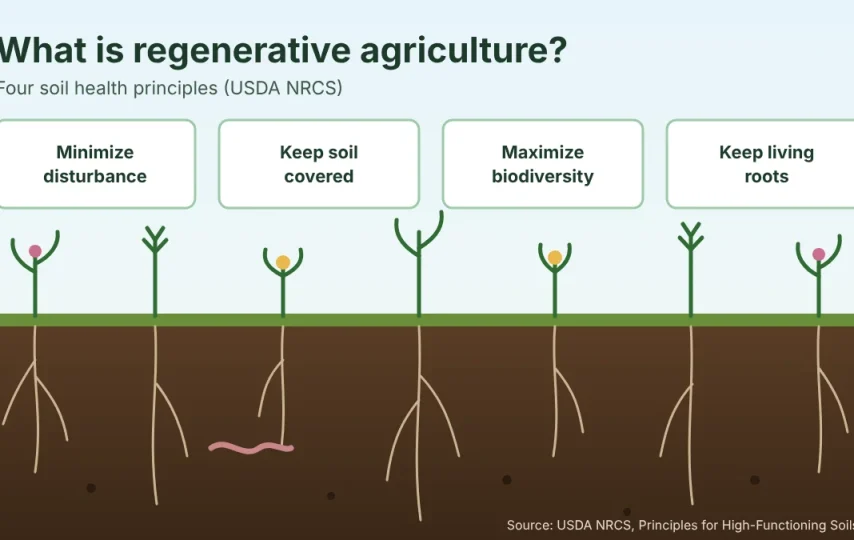
Most regenerative programs build on the soil health principles of the USDA Natural Resources Conservation Service (NRCS). Its factsheet on high-functioning soils lists four:
| Principle | What it means | Typical practices |
|---|---|---|
| Minimize disturbance | Disturb the soil as little as possible, physically and chemically | No-till, strip-till, fewer and better-timed inputs |
| Maximize soil cover | Never leave soil bare | Cover crops, crop residue, mulch |
| Maximize biodiversity | Grow many kinds of plants and support soil life | Long rotations, multi-species cover crops, hedgerows |
| Maximize presence of living roots | Keep something growing as many months as possible | Cover crops, perennials, double cropping |
The same factsheet lists integrating grazing animals, such as livestock, into the system as one way to increase biodiversity.
Regenerative Agriculture Practices
These are the practices you will see most often on regenerative farms. Our guide to sustainable agriculture explains the same toolbox from the sustainability angle.
1. No-till and reduced tillage
Instead of plowing, the farmer plants seed directly into last year’s crop residue. That keeps soil structure, fungi and earthworm channels intact and reduces erosion. U.S. farmers used no-till on about 105.2 million acres in 2022, according to the Census of Agriculture.
2. Cover crops
Cereal rye, clover, radish and other cover crops grow between cash crops, so the field is never bare. Cover crops reached about 18.0 million acres in 2022, up 17% from 2017, but that is still only 4.7% of U.S. cropland.
3. Diverse crop rotations
A field that grows corn and soybeans in alternating years is replaced by a longer rotation with small grains, legumes or forage. More diversity breaks pest cycles and feeds a wider range of soil organisms.
4. Managed grazing
Ranchers move livestock often between small paddocks so grass can recover before it is grazed again. This is called rotational, adaptive or holistic grazing, depending on the system.
5. Fewer synthetic inputs
Regenerative farms try to replace part of their synthetic fertilizer and pesticides with legumes, compost, manure and natural pest control. Unless a farm is certified organic, it may still use some synthetic inputs.
6. Compost and organic amendments
Compost, manure and crop residues return organic matter to the soil and feed soil microbes.
Benefits of Regenerative Agriculture: What the Evidence Says
The strongest evidence is for soil health. Claims about climate and profits are more mixed.
Soil health
Keeping soil covered and undisturbed reduces erosion and builds organic matter near the surface. Researchers at the World Resources Institute (WRI) conclude that regenerative agriculture is good for soil health but has limited potential to mitigate climate change.
Fewer pests and higher profits on some farms
A 2018 study in PeerJ by LaCanne and Lundgren compared 10 regenerative and 8 conventional corn farms in North Dakota, South Dakota, Nebraska and Minnesota. The regenerative farms produced 29% less corn, but insect pest populations were more than 10 times higher on the insecticide-treated conventional farms. The regenerative farms were also more profitable, mainly because they spent less on seed and fertilizer, and some earned organic premiums or income from grazing. It was a small study of farms in one region, so it shows what is possible, not what every farm will get.
Climate: carbon in the soil
This is the most debated claim. WRI estimates that an unprecedented expansion of cover crops to 85% of U.S. annually planted cropland could sequester around 100 million tons of CO2 a year, offsetting about 18% of U.S. agricultural production emissions. Even that best case covers less than a fifth of those emissions, and WRI calls the realistic soil carbon potential of cover crops uncertain.
No-till is more contested. A 2014 study in Nature Climate Change by Powlson and colleagues found that its role in climate mitigation is widely overstated: apparent carbon gains largely reflect carbon moved closer to the surface, and on fields that are plowed every few years any soil carbon benefit is lost. The IPCC’s 2022 chapter on land-based mitigation names uncertain permanence as a barrier and says robust measurement, reporting and verification are essential.
Grazing
Results depend heavily on the site. A 2020 study by Rowntree and colleagues at White Oak Pastures, a multi-species grazing farm in Georgia, reported soil carbon gains averaging 2.29 metric tons of carbon per hectare per year across a 20-year sequence of pastures, but the system required 2.5 times more land than conventional commodity beef to produce the same amount of meat. A 2014 article in Rangelands by Briske and colleagues said experimental evidence supports rotational grazing as a viable strategy, but called Allan Savory’s claims for his grazing method, such as reversing desertification and climate change, unsubstantiated.
Watch out for vague labels. Because regenerative agriculture has no legal definition, a “regenerative” claim on a food package can mean very different things. Look for specifics: which practices, on how many acres, and who checked.
Regenerative vs. Sustainable vs. Organic Agriculture
| Sustainable agriculture | Organic agriculture | Regenerative agriculture | |
|---|---|---|---|
| Goal | Keep land, farms and communities productive over the long term | Grow food without synthetic pesticides and fertilizers | Improve soil and ecosystems over time |
| Legal definition in the U.S. | Yes, in federal law since the 1977 and 1990 farm bills | Yes, the USDA Organic standard | No |
| Synthetic inputs | Allowed, used efficiently | Mostly banned | Reduced; allowed unless certified organic |
| Certification | None | USDA Organic | Private labels, such as Regenerative Organic Certified |
The best-known label is Regenerative Organic Certified (ROC), established in 2017 by the Regenerative Organic Alliance. It uses USDA Organic certification as a baseline and adds requirements for soil health, animal welfare and social fairness. In September 2025 the alliance reported that 67,000 smallholder farms across 46 countries were using regenerative organic practices on nearly 20 million acres.
Who Is Backing Regenerative Agriculture
Food companies. Several large food and agribusiness companies have set acreage or sourcing goals:
| Company | Goal | Latest reported progress |
|---|---|---|
| General Mills | 1 million acres by 2030 | More than 800,000 acres enrolled by the end of fiscal 2025 |
| PepsiCo | Regenerative, restorative or protective practices on 10 million acres by 2030 | 3.5 million acres in 2024 |
| Cargill | 10 million North American acres by 2030 | More than 1 million acres enrolled in its RegenConnect program for the 2025 U.S. planting season |
| Nestlé | 50% of key ingredients from regenerative practices by 2030 | 21.3% in 2024 |
These are each company’s own figures and definitions, which differ from one another.
The federal government. In December 2025, USDA launched a Regenerative Pilot Program with $700 million for fiscal 2026, run by NRCS with $400 million through EQIP and $300 million through CSP, with whole-farm planning and a single application. In September 2026, USDA raised funding to $1 billion for fiscal 2027 and reported more than 5,100 contracts worth over $851 million in fiscal 2026. The December announcement did not give a formal definition of “regenerative.”
What Regenerative Agriculture Means for You
For farmers, regenerative agriculture is mainly a soil health strategy that can lower input costs, with cost-share money now available from NRCS. For shoppers, it is a promising direction but a loose label, so specific practices and third-party certification matter more than the word on the box. For students, the key idea is the shift from “do less harm” to “make it better,” and the honest answer to “does it fix climate change?” is: it helps a little, while soil health is where it clearly helps. To see how it fits with other green solutions, read our lists of environmental technology examples and agricultural technology examples.
Frequently Asked Questions
What is regenerative agriculture in simple terms?
It is farming that tries to leave the soil and land healthier every year, mainly by plowing less, keeping the ground covered with plants, growing more kinds of crops and using grazing animals wisely.
What are the main principles of regenerative agriculture?
The four USDA NRCS soil health principles: minimize soil disturbance, maximize soil cover, maximize biodiversity and keep living roots in the soil as long as possible. NRCS also lists integrating grazing animals as one way to increase biodiversity.
What is the difference between regenerative and sustainable agriculture?
Sustainable agriculture aims to keep resources in good condition and has a legal definition in U.S. law. Regenerative agriculture aims to improve them, with soil health first, and has no legal definition.
Is regenerative agriculture the same as organic?
No. Organic is a certification that bans most synthetic inputs. Regenerative farms that are not certified organic can use some synthetic fertilizer or herbicide, while the Regenerative Organic Certified label requires organic certification as well.
Does regenerative agriculture help with climate change?
Somewhat. Cover crops can store carbon in the soil, but researchers say the climate benefit is modest, hard to measure and can be reversed by plowing.
Who coined the term regenerative agriculture?
The Rodale Institute credits Robert Rodale with coining the term “regenerative organic.” He led the institute after his father, J.I. Rodale, died in 1971.