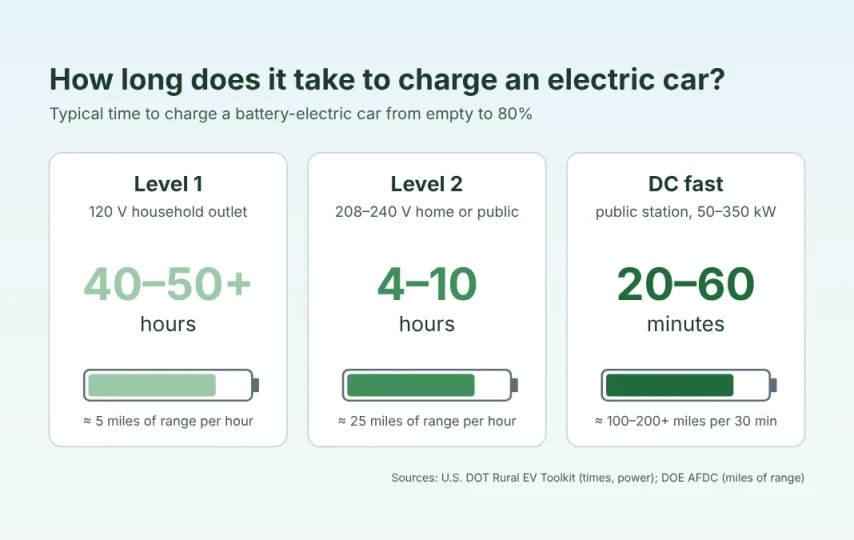

How long does it take to charge an electric car? It depends mostly on the charger. The U.S. Department of Transportation says a Level 1 outlet (120 V) needs 40-50+ hours to charge a battery-electric car from empty to 80%, Level 2 (208-240 V) needs 4-10 hours, and a DC fast charger needs 20 minutes to 1 hour. In range terms, the DOE’s Alternative Fuels Data Center (AFDC) puts it at about 5 miles per hour of charging on Level 1, about 25 miles per hour on Level 2 and roughly 100 to 200+ miles per 30 minutes on a DC fast charger.
A battery that is not empty needs less time. Below we show how the times are calculated, official figures for four models as of November 2026, what slows charging down, and how to charge an electric car at home and on the road.
How Long to Charge an Electric Car at Each Level
The table uses an 84 kWh battery, the size of the larger pack in the Hyundai Ioniq 5 (Hyundai press release, November 2024), as a typical modern EV.
| Charging level | Voltage / power | Range added (AFDC average) | 10-80% (58.8 kWh) | Full, 0-100% (84 kWh) |
|---|---|---|---|---|
| Level 1 | 120 V AC, ~1.9 kW | ~5 miles per hour | ~34 hours | ~49 hours |
| Level 2, typical home unit | 240 V AC, 7.2 kW | ~25 miles per hour | ~9 hours | ~13 hours |
| Level 2, 11 kW | 240 V AC, 11 kW | more than average | ~6 hours | ~8.5 hours |
| Level 2, maximum | 240 V AC, 19.2 kW | more than average | ~3.4 hours | ~5 hours |
| DC fast, 50 kW | DC, 50 kW | 100-200+ miles per 30 min | ~78 min | not practical (see below) |
| DC fast, 150 kW | DC, 150 kW | 100-200+ miles per 30 min | ~26 min | not practical |
Formula (our own estimate): hours = energy needed (kWh) ÷ charger power (kW) ÷ 0.9. The 0.9 accounts for charging losses: a 2015 DOE analysis of Argonne National Laboratory data found about 16% of energy is lost from the wall to the battery, and Idaho National Laboratory measured 88.8% overall efficiency on Level 1 and 90.8% on Level 2 in a 2012 Chevrolet Volt. Example: 58.8 kWh ÷ 7.2 kW ÷ 0.9 = 9.1 hours.
Sources: power levels from the AFDC (1.9 kW Level 1 assumption; 7.2 kW typical home unit; Level 2 range of 2.9 to 19.2 kW) and the EPA; range added from the AFDC; charging times are our own calculation.
The DC rows are a best case. DC charging is fastest near empty and slows as the battery fills, so real sessions run longer, and the EPA says stopping around 80% generally saves time. Hyundai’s own figure for the 84 kWh Ioniq 5 on a 50 kW charger is 1 hour 21 minutes for 10-80%, close to our estimate.
Charging Times for Popular EVs
Official figures for four U.S. models. The 240 V times are EPA figures published on ENERGY STAR; DC figures are manufacturer claims, not independent tests.
| Model | Battery | Onboard AC charger | Level 2 (240 V), EPA | DC fast charging, manufacturer claim |
|---|---|---|---|---|
| Tesla Model Y Long Range (2026) | not published by Tesla | — | 10 h (RWD), 8 h (AWD) | up to 162 miles in 15 min; up to 250 kW peak |
| Chevrolet Equinox EV (2026) | not published by GM | 11.5 kW standard; 19.2 kW optional | 10 h (FWD); 6 h (AWD, 19 kW charger) | about 70 miles in 10 min (GM estimate) |
| Ford Mustang Mach-E Extended Range (2025) | 88 kWh usable | — | — | up to 150 kW peak |
| Hyundai Ioniq 5, 84 kWh (2025) | 84 kWh | 10.9 kW | 7 h 20 min, 10-100% (Hyundai) | 10-80% in about 20 min (350 kW CCS charger) or 30 min (Tesla Supercharger) |
Sources: ENERGY STAR for Model Y RWD and AWD, Equinox EV FWD and AWD; Tesla; GM spec guide; Ford spec sheet; Hyundai. A dash means no official figure.
Ford does not publish a 10-80% time in its spec sheet, so here is our estimate for the Mach-E: 61.6 kWh (70% of 88 kWh) ÷ 7.2 kW ÷ 0.9 ≈ 9.5 hours on a typical home charger, and about 27 minutes at a constant 150 kW, which the car will not hold all the way to 80%. Ford’s everyday charging advice is in our article on Mach-E battery health.
What Changes How Long It Takes an Electric Car to Charge
Battery size and state of charge. The AFDC notes that charging time depends on how depleted the battery is, its capacity and the vehicle’s internal charger. A car that comes home at 60% needs a fraction of the times above.
The taper above 80%. The EPA says DC fast charging is fastest when the battery is closer to empty and slows down as it gets closer to full. Above about 80%, charging “tends to be significantly slower” and can sometimes double the time it takes to reach 100%. Tesla says the same: reaching 100% typically takes significantly longer than reaching 80%. That is also why Tesla advises owners whose car shows an 80% recommended daily limit to keep it at 80% for daily use and raise it to 100% only when necessary, such as before a long road trip.
The onboard charger. On Level 2, AC power is converted to DC inside the car, so the slower of the wall unit and the onboard charger sets the speed. The Equinox EV’s standard 11.5 kW charger and optional 19.2 kW charger help explain why the EPA lists 10 hours for one version and 6 hours for the other. Level 2 speed varies from a few miles of range per hour to around 40, according to fueleconomy.gov.
Charger output. DC fast chargers deliver up to 500 kW, but the car takes only what it can accept: Superchargers give a Model Y up to 250 kW, a Mach-E at 150 kW.
Cold weather. In an Idaho National Laboratory study of Nissan Leaf taxis, a fast charger that could reach 80% in 30 minutes at 77°F (25°C) left the battery with 36% less charge after the same time at 32°F (0°C). Newer cars warm their batteries: a Recurrent analysis of 4,296 EVs (January 2024) found fast charging at 0°F took 9 minutes longer on average, but without preconditioning the first 30-45 minutes of a session may add no charge.
Connector. Level 1 and Level 2 use the J1772 plug; most EV models fast charge with CCS (the “J1772 combo”). The industry is moving to Tesla’s NACS design, the basis of the SAE J3400 standard: the DOE’s Joint Office says most automakers committed to the J3400 connector beginning in 2025, with adapters for CCS cars. The Ioniq 5’s slower 30-minute Supercharger time shows that the station, not just the plug, affects the time.
Before a winter fast-charging stop, check your owner’s manual for how to precondition (warm) the battery on the way. Recurrent’s findings suggest that skipping it can turn a cold session from a few minutes slower into a long wait.
How to Charge an Electric Car (and How Many Kilowatts You Need)
How do you charge an electric car at home?
- Level 1: plug the cord that came with the car into a regular grounded 120 V outlet. It suits short daily drives: the AFDC says 8 hours at 120 V adds about 40 miles for a mid-size EV, while Tesla says a 120 V outlet supplies 2 to 3 miles of range per hour to its cars.
- Level 2: have an electrician install a wall unit or a 240 V outlet. The AFDC says most residential Level 2 chargers run at up to 30 amps (7.2 kW) and need a dedicated 40-amp circuit under the National Electrical Code.
- Set a schedule in the car or app so it charges overnight, ideally when your utility’s rates are lowest, and set a daily charge limit.
At a public station, you find a charger in an app or the AFDC station locator, check that the connector matches your car or adapter, start the session in the network’s app, by card or by plugging in, and unplug when you reach the charge you need.
How many kilowatts do you need to charge an electric car? The power (kW) sets the speed: about 1.9 kW on Level 1 and up to 7.2 kW for most home Level 2 units, per the AFDC, and 50-350 kW for DC fast charging, per the DOT. The energy (kWh) sets the bill: filling an 84 kWh battery from empty takes about 93 kWh from the wall at 90% efficiency (our own calculation). If you plan to cover that with rooftop panels, our guide on how many solar panels you need explains how to add an EV to the sizing.
Charging on Road Trips and With a Trailer
On a highway trip, the taper means several short stops that end around 80% are usually quicker than a few long ones that end at 100%. New federally funded stations add capacity: in Ohio’s latest round, each site will have at least four fast-charging ports of at least 150 kW.
Towing or driving a heavy van changes the math: extra weight and drag raise energy use per mile, so you stop more often, and a pull-in charging stall can be hard to use with a trailer attached. If you are planning trips in electric camper vans and RVs, look for pull-through stalls in the charging app and plan more stops than the advertised range suggests.
Fuel cell cars refuel at a pump instead, but stations are scarce; see how hydrogen cars work.
What It Means for You
With Level 2 at home, charging time rarely matters day to day: the car refills overnight. Level 1 works for short commutes. For trips, the useful number is the 10-80% fast-charging time, not a full charge. Before buying, compare the onboard charger rating and peak DC power along with range.
Frequently Asked Questions
Can you charge an EV with a regular outlet?
Yes. Every EV can charge from a standard 120 V household outlet (Level 1), but it is slow: about 5 miles of range per hour, according to the AFDC, or 2-3 miles per hour for a Tesla, according to Tesla. Charging a battery-electric car from empty to 80% this way takes 40-50+ hours, per the U.S. Department of Transportation.
Is it bad to charge to 100%?
Not occasionally, but it is slow, and automakers such as Tesla advise against it as a daily habit. Tesla tells owners whose car shows an 80% recommended daily limit to keep it there and raise it to 100% only when needed, such as before a long trip, and not to let the car sit near 0% or 100% for days. Some batteries differ: Ford says its newer LFP packs benefit from an occasional charge to 100%, so follow the limit your car recommends.
How long does a Tesla take to charge?
A 2026 Model Y Long Range takes about 8-10 hours on 240 V, according to EPA figures. At a Supercharger, Tesla says a Model Y can add up to 162 miles in 15 minutes and that V3 and V4 stations deliver up to 250 kW. On a 120 V outlet, Tesla says to expect only 2-3 miles of range per hour.
How long does it take to charge an electric car at a charging station?
At a public DC fast charger, a battery-electric car reaches 80% from empty in 20 minutes to 1 hour, according to the U.S. Department of Transportation. Public Level 2 stations add about 25 miles per hour on average, so they suit parking for several hours.

We send one email a week. No spam. Unsubscribe anytime. See our Privacy Policy.