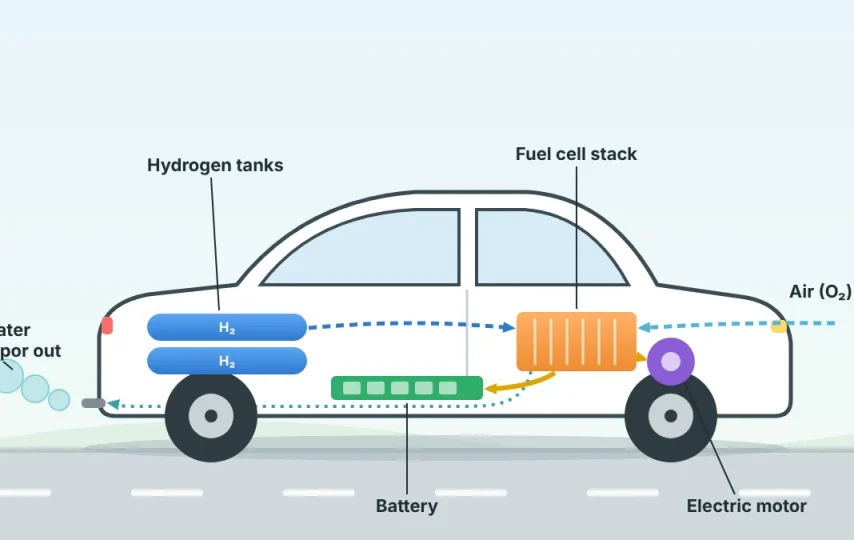

How do hydrogen cars work? In short, they are electric cars that make their own electricity. Instead of charging a large battery from the grid, a hydrogen car stores compressed hydrogen gas in a tank and feeds it to a fuel cell, which combines it with oxygen from the air to produce electricity for the motor. The only thing that comes out of the tailpipe is water vapor and warm air.
Below we walk through the main parts of a hydrogen car, what happens from the moment you press the accelerator, how refueling works, and how these cars compare with battery-electric and gasoline models.
How Do Hydrogen Cars Work, Step by Step?
The official name for a hydrogen car is a fuel cell electric vehicle, or FCEV. According to the Alternative Fuels Data Center (AFDC), it drives on an electric motor just like a battery-electric car. The difference is where the electricity comes from:
- Hydrogen flows from the tank. Compressed hydrogen gas is stored on board until the fuel cell needs it.
- The fuel cell makes electricity. Inside the fuel cell stack, hydrogen reacts with oxygen pulled in from the outside air. The reaction produces electricity, water, and heat.
- A battery helps out. A high-voltage battery stores energy recovered during braking and adds extra power when you accelerate hard.
- The motor turns the wheels. A power electronics controller manages how much electricity flows from the fuel cell and the battery to the electric motor.
- Water leaves the tailpipe. The by-product of the reaction exits the car as water vapor and warm air.
Nothing burns inside a hydrogen car. A fuel cell is not an engine: it converts the chemical energy of hydrogen directly into electricity, which is why there is no exhaust smoke and the car runs almost silently.
How Does a Hydrogen Fuel Cell Work?
The fuel cell is the heart of the car. The U.S. Department of Energy explains that each cell has two electrodes, a negative anode and a positive cathode, with an electrolyte in between:
- Hydrogen is fed to the anode, and air is fed to the cathode.
- A catalyst at the anode splits each hydrogen molecule into protons and electrons.
- The electrons cannot pass through the electrolyte, so they travel through an external circuit. That flow of electrons is the electric current that powers the car.
- The protons move through the electrolyte to the cathode, where they meet oxygen and the returning electrons. Together they form water and heat.
A single cell produces only a small amount of power, so carmakers combine many of them into a fuel cell stack. Unlike a battery, a fuel cell does not run down or need recharging: it keeps producing electricity as long as hydrogen is supplied. The DOE notes that fuel cells can convert fuel to electricity with efficiencies capable of exceeding 60%.
The Main Parts of a Hydrogen Car
| Part | What it does |
|---|---|
| Hydrogen fuel tank | Stores compressed hydrogen gas on board until the fuel cell needs it |
| Fuel filler | Receptacle where the station nozzle connects during refueling |
| Fuel cell stack | Combines hydrogen and oxygen to produce electricity |
| Traction battery pack | High-voltage battery that stores braking energy and adds power to the motor |
| Auxiliary battery | Low-voltage battery that starts the car and powers accessories |
| DC/DC converter | Steps down high-voltage power to run accessories and recharge the auxiliary battery |
| Power electronics controller | Manages the flow of electricity from the fuel cell and battery, and controls motor speed and torque |
| Electric traction motor | Drives the wheels |
| Thermal system | Keeps the fuel cell, motor, and electronics at the right temperature |
| Transmission | Transfers power from the motor to the wheels |
Component descriptions based on the Alternative Fuels Data Center.
Hydrogen holds a lot of energy per kilogram but very little per unit of volume. That is why the AFDC notes that fuel cell cars need a larger tank at higher pressure than other gaseous-fuel vehicles to reach more than 300 miles of range. In the Toyota Mirai, for example, the high-capacity hydrogen tanks sit under the rear seats.
How Do You Refuel a Hydrogen Car?
Refueling looks a lot like a visit to a gas station. You attach the dispenser nozzle to the car’s fuel filler, the station pumps compressed hydrogen into the tank, and you drive away. The AFDC says fuel cell cars can fuel in about 5 minutes and have a driving range of more than 300 miles. Retail stations accept payment at the pump and do not require special training.
The catch is where you can do it. The AFDC counted 54 open retail hydrogen stations in the United States as of 2024, almost all in California, with one in Hawaii. As of September 2025, the Hydrogen Fuel Cell Partnership listed 51 available stations in California. For a closer look at where they are, see our guide to how many hydrogen fuel stations there are in the US.
Fuel is expensive. Retail hydrogen in California averaged $34.55 per kilogram in October 2024, according to S&P Global Platts. That is why carmakers bundle large fuel credits with new hydrogen cars. Check what the credit covers before you sign.
Hydrogen Car vs. Electric Car vs. Gasoline Car
| Hydrogen fuel cell car | Battery-electric car | Gasoline car | |
|---|---|---|---|
| Source of power for the wheels | Electric motor, electricity made on board by a fuel cell | Electric motor, electricity stored in a battery | Internal combustion engine |
| What you put in | Compressed hydrogen gas | Electricity from a charger | Gasoline |
| Refueling or charging time | About 5 minutes | From under an hour at fast chargers to many hours at home | A few minutes |
| Tailpipe emissions | Water vapor and warm air | None | CO2 and air pollutants |
| Where you can refuel in the U.S. | About 50 retail stations, mostly in California | Home, work, and public chargers nationwide | Gas stations nationwide |
The table shows the trade-off clearly: a hydrogen car offers the quick refueling of a gasoline car without tailpipe emissions, but only where stations exist. Battery-electric cars can be charged almost anywhere, including at home, but take longer to recharge. For the full list of advantages and drawbacks, read our breakdown of hydrogen fuel cell pros and cons.
Which Hydrogen Cars Can You Buy?
Only a handful of hydrogen cars are offered in the U.S., all focused on California:
- Toyota Mirai. The 2026 Mirai has an EPA-estimated range of 402 miles, a 182-horsepower fuel cell electric powertrain, a lithium-ion battery, and a starting MSRP of $51,795. New buyers get complimentary hydrogen worth up to $15,000 or six years, whichever comes first.
- Honda CR-V e:FCEV. A plug-in fuel cell SUV with a 17.7 kWh battery that you can charge at home. Honda lists an EPA-estimated 270-mile total range, including 29 miles on electricity alone. The 2025 model launched in July 2024 as a lease-only model at select California dealers, with hydrogen fuel credits of $15,000 to $30,000 depending on the lease term.
- Hyundai Nexo. Hyundai’s fuel cell SUV has been sold in California. The second-generation 2026 Nexo was unveiled in 2025 with a targeted range of about 435 miles and a roughly 5-minute refill, though EPA figures and U.S. pricing had not been announced at launch.
Altogether, 18,772 fuel cell cars had been sold or leased in the U.S. as of September 2025, according to the Hydrogen Fuel Cell Partnership.
Is a Hydrogen Car Right for You?
A hydrogen car can work well if you live and drive near reliable stations in California, want long range with quick refueling, and the included fuel credit covers most of your driving. If you can charge at home or live outside California, a battery-electric car or a plug-in hybrid is far easier to own today. Hydrogen’s strengths, fast refueling and long range, matter most for buses and trucks that run all day, which is where much of the industry’s attention has shifted.
Frequently Asked Questions
Do hydrogen cars need to be plugged in?
Most do not. A fuel cell car makes its own electricity from hydrogen. The exception is the Honda CR-V e:FCEV, a plug-in fuel cell vehicle that can also charge its battery from an outlet for about 29 miles of electric-only driving.
How long does it take to refuel a hydrogen car?
About 5 minutes, according to the Alternative Fuels Data Center, which is similar to filling a gasoline car.
Are hydrogen cars safe?
Hydrogen cars are built and sold by major automakers, and the hydrogen is stored in purpose-built high-pressure tanks. Hydrogen is a flammable fuel, just like gasoline, so follow the manufacturer’s refueling and maintenance instructions.
What comes out of a hydrogen car's tailpipe?
Only water vapor and warm air. The fuel cell combines hydrogen with oxygen, and the by-product is water.
Is a hydrogen car an electric car?
Yes. A hydrogen car is driven by an electric motor. The difference from a battery-electric car is that it generates its electricity on board with a fuel cell instead of storing it all in a large battery charged from the grid.


