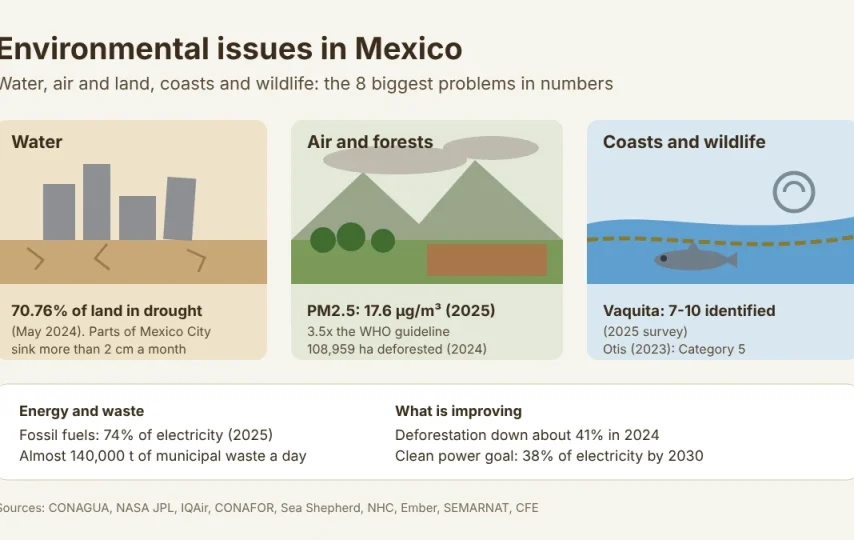

The biggest environmental issues in Mexico are water scarcity and drought, a capital city that is sinking as its aquifer is pumped dry, polluted air, deforestation and forest fires, the loss of unique wildlife such as the vaquita, mounting waste, a power system still dominated by fossil fuels and destructive hurricanes and heat. Mexico is one of the world’s most biodiverse countries, home to about 10–12% of the planet’s biodiversity, according to the Mexican foreign ministry.
Its population was projected at about 133.4 million in 2025, based on official CONAPO projections reported by Uno TV. Below are the eight main problems with the latest figures, a summary table, what is being done and what you can do.
Top 8 Environmental Issues in Mexico
1. Water Scarcity and Drought
At the peak of the 2024 drought, on May 15, 70.76% of the country was in drought and 2,105 municipalities were affected, according to the drought monitor of the national water commission CONAGUA, as reported by Uno TV. The rains of 2025 brought relief: by September 30, 2025, only 7.6% of the territory was in drought (Uno TV, citing CONAGUA’s drought monitor).
Mexico City felt the crisis directly. On January 15, 2024, the Cutzamala system of reservoirs, which supplies about a quarter of the metro area’s water, was at 40.7% of capacity, the lowest level ever recorded for that time of year, according to a CONAGUA press release. Underground, 114 aquifers were overexploited in 2023, up from 111 a year earlier, according to official figures reported by Expansión.
2. Mexico City Is Sinking
Mexico City is built atop an aquifer, and pumping groundwater compacts the ancient lakebed beneath it. Satellite data from October 2025 to January 2026 show parts of the city sinking more than 0.8 inch (2 cm) a month, mostly because of groundwater pumping, according to NASA’s Jet Propulsion Laboratory. In the 1990s and 2000s, parts of the metro area sank about 14 inches (35 cm) a year.
A peer-reviewed study published in Natural Hazards found the fastest sinking in an urban area, 17 inches (42.8 cm) a year, in Ciudad Nezahualcóyotl, part of the metro area, in 2018–2019. The same study notes that subsidence damages buildings, roads and underground water lines.
3. Air Pollution
Outdoor fine particle pollution (PM2.5) caused an estimated 43,064 deaths in Mexico in 2021, and smoke from cooking and heating with solid fuels another 6,506, according to a study in the Gaceta Médica de México based on Global Burden of Disease data. The national average PM2.5 level in 2025 was 17.6 µg/m³, about 3.5 times the WHO guideline, according to IQAir.
The Mexico City area regularly declares environmental contingencies, which trigger extra driving restrictions under the Doble Hoy No Circula program. By May 22, 2024, nine had already been declared that year, ADN40 reported.
4. Deforestation and Forest Fires
Mexico lost about 269,000 acres (108,959 hectares) of forest to gross deforestation in 2024, down 40.75% from about 454,000 acres (183,882 hectares) in 2023, according to the national forestry commission CONAFOR. Satellite data tell a harsher story for old-growth tropical forest: Mexico’s loss of tropical primary forest nearly doubled from 2023 to 2024, mostly because of fires, according to the World Resources Institute. Half of that loss was in Campeche and Quintana Roo on the Yucatán Peninsula.
Farming also clears forest. In Michoacán and Jalisco, investigators from Climate Rights International and Guardián Forestal estimate that the avocado industry caused as much as 70,000 acres (28,327 hectares) of deforestation over a decade, as reported by Mongabay.
5. Wildlife at Risk and the Vaquita
Mexico’s official list of species at risk, NOM-059-SEMARNAT-2010, covers more than 2,500 species, including 926 plants, 439 reptiles, 383 birds and 251 mammals, according to SEMARNAT.
The vaquita, a small porpoise found only in the northern Gulf of California, is on the brink of extinction. Its only known threat is fishing gear, especially gillnets, including nets set illegally for totoaba, a fish whose swim bladder is smuggled to China, according to NOAA Fisheries. The 2025 survey identified an estimated 7–10 individual vaquitas, including at least one or two calves, according to Sea Shepherd, which ran it with the Mexican Navy and the protected areas agency CONANP. The calves show that some vaquitas are still reproducing (IUCN Cetacean Specialist Group).
6. Waste and Plastic
Mexico generates almost 140,000 tonnes of municipal solid waste a day, or 2.4 pounds (1.076 kg) per person, according to a new SEMARNAT assessment presented in May 2026 and reported by N+. Most of it goes to final disposal sites, according to the same report.
7. Fossil Fuels and Emissions
Fossil fuels generated 74% of Mexico’s electricity in 2025, and solar and wind only 13%, according to the energy think tank Ember. Mexico is also one of nine countries that together produce more than four-fifths of the world’s gas flaring, the burning of unwanted gas at oil fields, according to the World Bank.
In November 2025, Mexico submitted a new climate target to the UN: emissions of 364–404 million tonnes of CO2-equivalent in 2035 without international support, and net zero by 2050, according to Climate Action Tracker.
8. Hurricanes, Heat and Sargassum
On October 25, 2023, Hurricane Otis made landfall at Acapulco as a Category 5 storm after strengthening by 90 knots (104 mph) in 21 hours, according to the U.S. National Hurricane Center. The Mexican government reported 52 deaths and 32 people missing, and the NHC’s damage estimate of $12–16 billion makes Otis the costliest tropical cyclone on record for Mexico.
Heat is a growing danger as well: the Ministry of Health counted 285 heat-related deaths from March to August 2024, El Imparcial reported. Sargassum seaweed reached historic highs in most monitored regions in June 2025, with amounts rising in the western Caribbean, according to the University of South Florida, and about 84,000 tonnes were collected in Quintana Roo that year, Por Esto reported.
Mexico’s Environmental Issues at a Glance
| Issue | Key figure | Source | Trend |
|---|---|---|---|
| Drought | 70.76% of territory in drought (May 2024) | CONAGUA | Varies by year: 7.6% in Sep 2025 |
| Subsidence | More than 0.8 inch (2 cm) a month in parts of Mexico City (2025–26) | NASA JPL | Ongoing |
| Air pollution | 43,064 deaths from PM2.5 (2021) | Gaceta Médica de México | Smog contingencies recur |
| Deforestation | 108,959 ha (2024) | CONAFOR | Down 41% from 2023 |
| Vaquita | 7–10 identified (2025) | Sea Shepherd survey | No sharp decline since 2023 |
| Waste | Almost 140,000 t a day (2026) | SEMARNAT | Mostly sent to disposal sites |
| Fossil power | 74% of electricity (2025) | Ember | Goal: 38% clean by 2030 |
| Hurricanes | Otis: at least 52 dead, $12–16 billion damage (2023) | NHC | Costliest on record for Mexico |
What Is Being Done
- Protected areas. Mexico has 203 federal protected areas covering 11.28% of its land and 22.05% of its marine territory as of 2023, according to CONANP.
- Clean power. The national goal is to raise the clean share of electricity from 21% in 2025 to 38% by 2030, according to the state utility CFE’s 2026–2030 development program, as Expansión reported. The 2025 power expansion plan includes about 2,470 MW of new CFE wind and 4,673 MW of solar, plus 6,400 MW of private clean capacity, according to a summary by Basham. For how wind compares, see our guide to wind power pros and cons.
- Less forest loss. CONAFOR’s figures show gross deforestation fell by about 41% in 2024, although fires still destroyed large areas of tropical forest.
- Vaquita protection. Vaquitas spend most of their time in a small sanctuary, where the Mexican Navy provides surveillance and enforcement, according to the 2025 survey report. New rules published in October 2026 ban fishing in this 87 sq mi (225 km²) Zero Tolerance Area (Diario Oficial), but the wider zone where gillnets are prohibited shrank by 86%, from about 4,290 to 600 sq mi (11,106 to 1,562 km²), N+ reported.
Some figures here come from Mexican media citing official agencies. Check CONAGUA, SEMARNAT and CONAFOR for the latest data.
What You Can Do
Many Mexican products end up in U.S. homes, so American choices reach Mexico directly:
- Ask where your avocados come from. Retailers that publish deforestation-free sourcing policies give you a way to choose.
- Never buy totoaba products. Trade in totoaba swim bladders drives the illegal fishing that kills vaquitas. When visiting Baja California, choose seafood caught without gillnets.
- Plan beach trips around sargassum. Check seaweed forecasts before booking a Caribbean trip, and choose hotels and tour operators that manage beaches and reefs responsibly.
- Compare countries. Our overview of global environmental issues puts Mexico in world context, and our articles on environmental issues in Australia and environmental issues in Brazil show how other countries compare. For a school project, our guide to human-environment interaction explains how people depend on, adapt to and modify their environment.
Frequently Asked Questions
What is the biggest environmental issue in Mexico?
Water. Drought covered more than 70% of the country in May 2024, more than a hundred aquifers are overexploited, and pumping groundwater is making parts of Mexico City sink by more than 0.8 inch (2 cm) a month.
Why is Mexico City sinking?
The city is built on an ancient lakebed above an aquifer. As groundwater is pumped out, the lakebed beneath the city compacts and the ground drops, by more than 0.8 inch (2 cm) a month in some areas, according to NASA satellite data.
How many vaquitas are left?
The 2025 survey identified an estimated 7–10 individual vaquitas, including at least one or two calves. They spend most of their time in a small sanctuary in the northern Gulf of California.
Is Mexico fighting climate change?
Partly. It has a 2035 emissions target and a net zero goal for 2050, and plans to raise clean electricity to 38% by 2030. But fossil fuels still produced 74% of its electricity in 2025.


