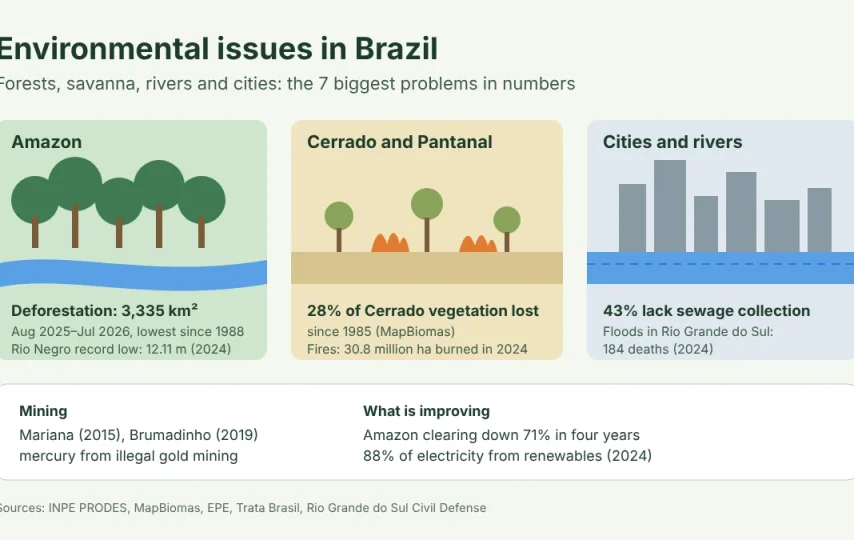

The biggest environmental issues in Brazil are deforestation in the Amazon and the Cerrado, wildfires, drought, floods, untreated sewage and the damage from mining. They matter far beyond Brazil: the country holds about 60% of the Amazon rainforest, according to UN News, and between 15% and 20% of the world’s biological diversity, according to its Convention on Biological Diversity country profile.
Brazil had 203 million people in its 2022 census (IBGE) and six biomes. The Amazon covers about 49.5% of the country, the Cerrado savanna 23.3%, the Atlantic Forest 13%, the Caatinga 10.1%, the Pampa 2.3% and the Pantanal wetland 1.8% (IBGE). Below are the seven main problems with the latest official data, and what is being done about them.
Top 7 Environmental Issues in Brazil
1. Amazon Deforestation
Clearing the rainforest for cattle pasture and crops is Brazil’s best-known environmental problem, and the trend has turned sharply. Brazil’s space agency INPE measures clear-cutting each year from August to July with its PRODES satellite system. For August 2025 to July 2026, the estimate is 3,335 km² (about 1,290 square miles), down 41.8% from 5,731 km² a year earlier and the lowest figure since the series began in 1988. Over four years the rate fell by 71.2%.
The government’s stated goal is zero deforestation by 2030. Even at a record low, 3,335 km² is more than 800,000 acres of rainforest a year, and clear-cutting is only part of the damage: fire and logging also degrade forest that remains standing.
2. Cerrado Clearing
The Cerrado, a vast tropical savanna south of the Amazon, now loses more native vegetation than the rainforest. INPE mapped 7,235 km² of clear-cutting in the Cerrado between August 2024 and July 2025, and the 2026 estimate fell to about 5,517 km², the lowest since 2001.
Over a longer period the losses are large. MapBiomas, a network of Brazilian universities and NGOs that maps land use, found that the Cerrado lost 40.5 million hectares (28%) of its native vegetation between 1985 and 2024, and only about half of the biome is still native. Across Brazil, MapBiomas attributes 99% of the clearing detected in 2025 to agriculture, mainly soy and cattle, and the Cerrado accounted for 54.9% of all native vegetation cleared nationwide that year.
3. Wildfires
Fire is used to clear land and burn pasture, and in drought years it escapes into forest and wetlands. In 2024, the burned area in Brazil reached 30.8 million hectares, up 79% from the year before, according to MapBiomas data reported by Agência Brasil; 58% of it was in the Amazon, and 1.9 million hectares burned in the Pantanal.
2025 was much calmer. MapBiomas counted 12.7 million hectares burned, 31% below the historical average, with the lowest Amazon figure in its 41-year series, as reported by Correio Braziliense. Fire seasons swing with rainfall, so one good year does not mean the risk is gone.
4. Drought in the Amazon
The droughts of 2023 and 2024 were the worst on record in parts of the Amazon. On October 9, 2024, the Rio Negro at the Port of Manaus dropped to 12.11 meters, its lowest level in 122 years of measurements. In a region where rivers are the roads, low water cut off river towns from food, fuel and medical supplies.
Drought is also an energy issue. Hydropower supplied 55.3% of Brazil’s electricity in 2024, and renewables 88.2% in total, according to the national energy balance by EPE, Brazil’s energy research agency. That makes the grid clean but dependent on rain; wind (14.1%) and solar (9.3%) are growing partly to reduce that risk. For the trade-offs of big dams, see our guide to hydropower pros and cons.
5. Floods in Southern Brazil
While the north dried out, the south flooded. Heavy rain in April and May 2024 flooded large parts of Rio Grande do Sul state, including its capital, Porto Alegre. The state’s Civil Defense counts 184 deaths and 25 people missing, with 478 municipalities and about 2.4 million people affected. At the peak, 581,638 people had left their homes, and 48,789 were in shelters.
6. Untreated Sewage and Water Pollution
Sanitation is the problem that affects the most Brazilians directly. About 90 million people, or 43.3% of the population, have no sewage collection, and only 51.8% of the country’s sewage is treated, according to the Trata Brasil Institute’s 2026 sanitation ranking, which is based on official 2024 data. Untreated sewage flows into rivers, bays and beaches. A 2020 sanitation law sets targets of drinking water for 99% of people and sewage collection and treatment for 90% by the end of 2033.
7. Mining Disasters and Mercury
Two tailings dam collapses in Minas Gerais state are among the worst mining disasters anywhere. The Fundão dam near Mariana failed in 2015, killing 19 people and sending mud down the Doce River to the Atlantic. In October 2024, the companies involved signed a R$170 billion (about $30 billion) settlement with the government. The 2019 collapse in Brumadinho killed 270 people.
In the Amazon, illegal gold mining releases mercury into rivers. A 2024 study led by Brazil’s Fiocruz health institute found mercury above 2.0 micrograms per gram in 84% of hair samples from Yanomami Indigenous villages it tested.
Brazil’s Environmental Issues at a Glance
| Issue | Key figure | Source | Trend |
|---|---|---|---|
| Amazon deforestation | 3,335 km² (Aug 2025–Jul 2026, estimate) | INPE PRODES | Falling |
| Cerrado clearing | 7,235 km² (2024–25); ~5,517 km² (2025–26 estimate) | INPE PRODES | Falling |
| Wildfires | 30.8 million ha (2024); 12.7 million ha (2025) | MapBiomas | Varies with drought |
| Drought | Rio Negro at Manaus: 12.11 m, lowest since 1902 (Oct 2024) | Port of Manaus | Recurring |
| Floods | 184 deaths in Rio Grande do Sul (2024) | RS Civil Defense | Recurring |
| Sewage | 43.3% of people without sewage collection | Trata Brasil | Slowly improving |
| Mining | 270 deaths in Brumadinho (2019) | Official counts | Ongoing risk |
What Is Being Done
- Enforcement against deforestation. Brazil enforces its forest laws with near-real-time satellite alerts from INPE’s DETER system, fines and federal operations against illegal clearing. Brazil’s own target is zero deforestation by 2030.
- Climate targets. Brazil’s gross greenhouse gas emissions fell 16.7% in 2024, to 2.145 billion tonnes of CO2-equivalent, according to the SEEG emissions estimate system; land-use change, mostly deforestation, was 42% of the total. Brazil’s 2035 climate pledge aims for 59–67% below 2005 levels.
- Forest finance. The Amazon Fund, run by the development bank BNDES, has received R$4.98 billion in donations since 2008 and approved a record R$2.2 billion in projects in 2025. At the COP30 climate conference in Belém in November 2025, Brazil launched the Tropical Forest Forever Facility, a fund that pays countries for keeping forests standing; more than $5.5 billion was pledged at launch.
- A step back on soy. The Amazon Soy Moratorium, under which major traders stopped buying soy from newly deforested Amazon land, lost the support of the industry association ABIOVE and its traders in early 2026, civil society groups say. Environmental groups warn this could reverse part of the progress.
Brazil’s deforestation figures come from INPE’s PRODES system, which covers August to July. The most recent number is always an estimate and is revised about a year later, usually by a few percent.
What You Can Do
From the U.S., the most direct link to Brazil’s forests runs through what you buy:
- Check the origin of beef, soy, coffee and wood. Look for credible certifications such as FSC for wood and paper and Rainforest Alliance for coffee and cocoa.
- Choose companies with deforestation-free supply chains and published sourcing policies.
- Learn the human side. Brazil is a strong case study of how people depend on, adapt to and modify their environment; our guide to human-environment interaction explains the framework, and our overview of global environmental issues puts Brazil’s problems in a world context.
Frequently Asked Questions
What is the biggest environmental issue in Brazil?
Deforestation, in both the Amazon and the Cerrado. It drives most of Brazil’s greenhouse gas emissions, destroys habitat and makes fires and droughts worse. Amazon clearing has fallen to its lowest level since 1988, but the Cerrado still loses thousands of square kilometers a year.
Is deforestation in Brazil getting better?
Yes, for now. INPE’s estimate for August 2025 to July 2026 is 3,335 km² in the Amazon, down 41.8% in a year and about 71% over four years. Cerrado clearing has fallen too.
Why is the Amazon important to the world?
It is the largest tropical rainforest on Earth, stores huge amounts of carbon, influences rainfall far beyond the forest and is home to a large share of the world’s species. Brazil alone holds about 60% of it.
What causes floods and droughts in Brazil?
Both are driven by extreme rainfall patterns. The 2023–2024 Amazon drought brought rivers to record lows, while extreme rain in 2024 flooded much of Rio Grande do Sul in the south.


