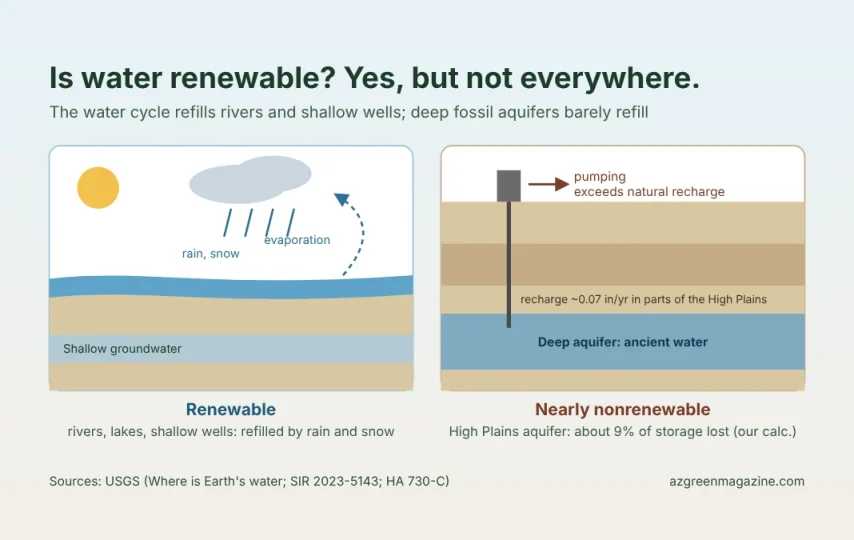

Is water a renewable resource? Yes, as a whole. Water is not used up the way coal or oil is: the water cycle keeps moving it from oceans to clouds, rain, rivers and back, and the U.S. Geological Survey (USGS) notes that “our planet’s water supply is constantly moving from one place to another and from one form to another.”
The catch is fresh water in a given place and time. Rivers refill with each year’s rain and snow, but some aquifers hold ancient “fossil” water that is effectively nonrenewable. Below we explain where Earth’s water is, which water is renewable or nonrenewable, and what that means in the U.S.
Why Water Counts as Renewable
A renewable resource is one that nature replaces about as fast as we use it, like sunlight or wind. Water passes that test on a global scale because it is recycled rather than destroyed. Water you drink, use on a field or run through a power plant evaporates or flows back to rivers and oceans, then falls again as rain or snow.
That is also why hydropower is renewable: the rain and snowmelt that fill a reservoir come back every year. Hydropower produced about 5.6% of U.S. utility-scale electricity in 2025, according to the U.S. Energy Information Administration (EIA).
Fossil fuels work differently. Oil and coal took millions of years to form, so once they are burned nothing replaces them on a human time scale (see is oil renewable and is coal renewable).
How Much of Earth’s Water Is Fresh?
Most of the planet’s water is not usable without treatment. Of about 332.5 million cubic miles of water on Earth, over 96% is saline, and only 2.5% is fresh water (USGS). And most of that fresh water is hard to reach:
| Where fresh water is | Share of fresh water |
|---|---|
| Ice caps and glaciers | Over 68% |
| Groundwater | About 30% |
| Surface water: lakes, rivers, swamps | A little over 1.2% |
Source: USGS.
So the water we use every day, from rivers, lakes and shallow wells, is a thin, fast-moving slice of the total. It is renewable as long as we take no more than rain and snow put back.
Is Water Renewable or Nonrenewable? When Groundwater Runs Out
Groundwater is where the answer “is water renewable or nonrenewable” gets complicated. A 2016 study in Nature Geoscience by Gleeson and colleagues estimated that less than 6% of the groundwater in the upper 2 km (1.2 miles) of Earth’s crust is “modern,” meaning less than 50 years old. The rest is older.
Some aquifers are fossil water in the strict sense. The Nubian Sandstone Aquifer under Chad, Egypt, Libya and Sudan is described by the International Atomic Energy Agency (IAEA) as the world’s largest fossil groundwater aquifer, and its water is “ancient and non-renewable.”
The U.S. has its own example. The High Plains aquifer lies under parts of eight states, from South Dakota and Wyoming to Texas. According to USGS, recoverable water in storage fell by about 286.4 million acre-feet from before large-scale pumping to 2019, about a 9% decline by our calculation, and water levels dropped 16.5 feet on average. An older USGS atlas found that before development, recharge of about 0.07 inch a year was common in much of the aquifer’s Colorado and New Mexico parts, and that annual pumping there has probably exceeded natural recharge since the mid-1960s.
Across the whole country, USGS estimated that groundwater depletion from 1900 to 2008 totaled about 1,000 cubic kilometers, and that the rate averaged almost 25 cubic kilometers a year in 2000–2008 (USGS).
How the U.S. Uses Its Water
The U.S. withdrew about 322 billion gallons of water a day in 2015, the latest national total in USGS Circular 1441. Of that, 87% was fresh water. Cooling thermoelectric power plants took 41% of all withdrawals, and irrigation took 42% of fresh water withdrawals.
With irrigation taking 42% of fresh water withdrawals, water-saving tools like drip irrigation and soil-moisture sensors are among the most useful agricultural technology examples today.
Rivers can run short too, even though they refill every year. On the Colorado River, the Bureau of Reclamation announced on August 21, 2026 that deliveries to the Lower Basin states of Arizona, California and Nevada will be reduced by 1.25 million acre-feet in 2027. The river still refills every year, but a renewable supply can still fall short of what users have been taking.
Is Fresh Water Running Out Worldwide?
Not in total, but in many places and seasons. About 4 billion people, nearly two-thirds of the world’s population, face severe water scarcity at least one month a year, according to UN-Water. And 2.1 billion people, or 1 in 4, still lack safely managed drinking water, according to a 2025 report by WHO and UNICEF.
Desalination turns seawater into fresh water. A 2019 study counted 15,906 operating desalination plants producing about 95 million cubic meters (25 billion gallons) of water a day, along with about 142 million cubic meters of salty brine that is costly to dispose of (Jones et al., Science of the Total Environment).
What It Means for You
Water is renewable, but your local supply has a budget: what rain, snow and recharge return each year. If your water comes from a river or reservoir, drought years matter most; if it comes from a deep well, long-term pumping matters most.
The average American family uses more than 300 gallons of water a day at home, about 70% of it indoors, according to the EPA WaterSense program.
Fixing leaks is the fastest saving. The EPA estimates that an average household’s leaks can waste nearly 10,000 gallons a year, and WaterSense-labeled products are certified to use at least 20% less water.
Frequently Asked Questions
Is water renewable or nonrenewable?
Water is a renewable resource because the water cycle constantly recycles it. However, fossil groundwater in some deep aquifers refills so slowly that it is effectively nonrenewable on a human time scale.
Why is water considered a renewable resource?
Water is not destroyed when we use it. It evaporates, falls as rain or snow and flows back into rivers, lakes and aquifers, so supplies refill naturally as long as use does not exceed that natural return.
Can we run out of fresh water?
The planet will not run out of water, but regions can run short of usable fresh water. Only 2.5% of Earth’s water is fresh, and aquifers like the High Plains aquifer in the U.S. have lost about 9% of their recoverable stored water since large-scale pumping began.
What is fossil water?
Fossil water is ancient groundwater that is effectively nonrenewable. The Nubian Sandstone Aquifer in northeast Africa is, according to the IAEA, the world’s largest fossil groundwater aquifer, and excessive pumping could eventually deplete it.
Is groundwater a renewable resource?
Groundwater is renewable only where pumping stays below recharge from rain and snowmelt; a 2016 study estimated that less than 6% of groundwater near the surface is less than 50 years old.

We send one email a week. No spam. Unsubscribe anytime. See our Privacy Policy.

