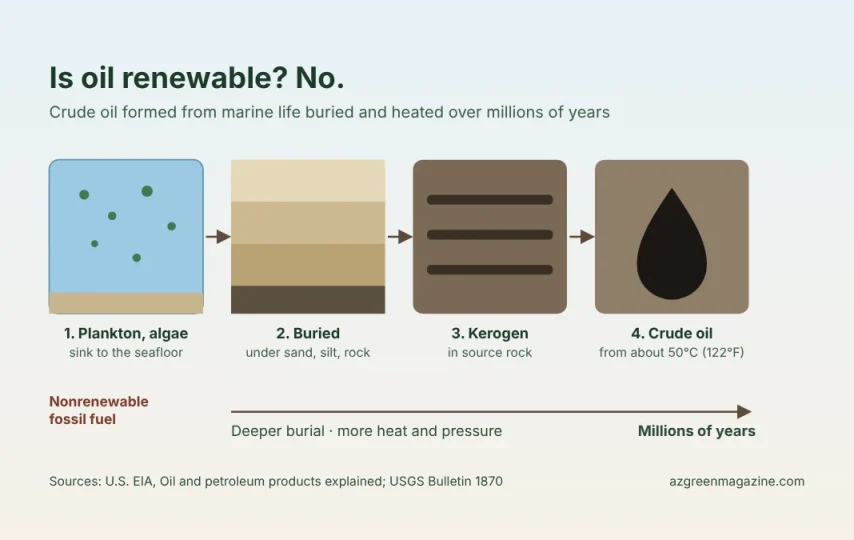

Is oil renewable? No. Crude oil, or petroleum, is a nonrenewable fossil fuel. The U.S. Energy Information Administration (EIA) lists petroleum as nonrenewable because its supply is limited to what we can extract from the earth and it takes a very long time to form: the oil we pump today comes from organisms that lived millions of years ago.
Below we explain how oil forms, how much the U.S. has and uses, why the answer is the same for natural gas, and which oils and liquid fuels really are renewable.
Why Is Oil a Nonrenewable Resource?
A resource is renewable when nature replaces it about as fast as we use it, like sunlight, wind or flowing water. Oil fails that test. According to EIA, crude oil and petroleum are fossil fuels because they “formed from the remains of animals and plants (diatoms) that lived millions of years ago in a marine environment.”
The time gap is enormous. Oil takes millions of years to form, while the U.S. alone consumed about 20.6 million barrels of petroleum a day in 2025 (EIA). Once a barrel is burned, nothing on a human time scale replaces it.
How Is Oil Formed?
Oil forms in four broad steps:
- Tiny marine life dies. Plankton and algae, such as diatoms, sink to the seafloor.
- It gets buried. Over millions of years, layers of sand, silt and rock cover the remains (EIA).
- It turns into kerogen. In the sediment, the organic matter becomes kerogen, the insoluble organic part of sedimentary rock, in what geologists call source rock (USGS).
- Heat cooks it into oil. As burial deepens, temperature rises. According to the U.S. Geological Survey, most petroleum is generated from the thermal breakdown of kerogen, starting at about 50°C (122°F); by about 200°C (392°F), oil generation ends and only dry gas forms.
The oil and gas then move out of the source rock; where they collect in porous rock, they form the reservoirs that companies drill into.
Not all oil in a reservoir can be pumped out. The Department of Energy says only about 10% of a reservoir’s original oil is typically produced by natural pressure. Injecting water or gas raises that to 20–40%, and enhanced recovery methods can reach 30–60% or more.
How Much Oil Does the U.S. Have and Use?
Nonrenewable does not mean about to run out. U.S. proved reserves of crude oil and lease condensate were 46.0 billion barrels at the end of 2024 (EIA). Proved reserves are the oil companies are reasonably certain they can produce with today’s technology and prices, so the number changes as technology and prices change.
The U.S. produced a record 13.6 million barrels of crude oil a day in 2025, more than any other country (EIA). Petroleum supplied about 38% of all U.S. energy that year, more than any other source (EIA).
| Where U.S. petroleum went in 2025 | Million barrels per day | Share |
|---|---|---|
| Transportation | 13.8 | 67% |
| Industry | 5.7 | 28% |
| Homes, businesses and power plants | 1.1 | 6% |
| Total | 20.6 | 100% |
Source: EIA, U.S. petroleum flow 2025. Shares do not add to 100% because of rounding.
The real limit on oil is less about supply than about emissions. Burning a gallon of gasoline without ethanol releases about 20.9 pounds of CO2, and a gallon of diesel about 22.5 pounds (EIA). Petroleum accounted for roughly 45% of U.S. energy-related CO2 emissions in 2025 (our calculation from EIA data).
Is Natural Gas Renewable?
No. Natural gas is also a fossil fuel formed from kerogen as it is heated, and EIA lists it next to petroleum and coal as a nonrenewable energy source (EIA). The exception is “renewable natural gas,” which the EPA describes as biogas from landfills, farms or wastewater “that has been upgraded for use in place of fossil natural gas.” Coal is nonrenewable for the same reason, as we explain in is coal renewable.
Which Oils and Fuels Are Renewable?
The word “oil” covers more than crude. What matters is whether the source can regrow on a human time scale.
| Fuel | Renewable? | Made from |
|---|---|---|
| Crude oil, gasoline, diesel, jet fuel | No | Fossil remains of marine organisms |
| Natural gas | No | Same source rocks as oil |
| Vegetable oils (soybean, rapeseed) | Yes | Crops grown each year |
| Biodiesel | Yes | Vegetable oils and animal fats |
| Renewable diesel | Yes | Same feedstocks, refined to match petroleum diesel |
| Ethanol | Yes | Crops such as corn |
Sources: EIA, renewable energy types, EIA, biodiesel and renewable diesel.
EIA groups ethanol, biodiesel and renewable diesel under biomass, which it defines as energy from “nonfossilized plant materials.” Renewable diesel is chemically equivalent to petroleum diesel, so it can replace it in engines, but it is made from plants and fats rather than crude. In 2022, the latest year on EIA’s overview page, the U.S. produced about 18.7 billion gallons of biofuels, mostly ethanol (EIA). Petroleum use is on a different scale: about 316 billion gallons in 2025 (our calculation from EIA’s 20.6 million barrels a day, at 42 gallons per barrel).
What It Means for You
If a quiz asks whether oil is renewable, the answer is “no, oil is a nonrenewable fossil fuel because it takes millions of years to form.” In daily life, most of the oil you use goes into your car: transportation burned two-thirds of U.S. petroleum in 2025. Driving less, choosing an efficient or electric car, or using fuels with a higher biofuel share are the main ways to cut it. For the bigger picture, see the real disadvantages of renewable energy and how they compare with fossil fuels.
Frequently Asked Questions
Is oil renewable or nonrenewable?
Oil is nonrenewable. It formed from marine organisms buried and heated for millions of years, so the oil we burn cannot be replaced on a human time scale. EIA classifies petroleum as a nonrenewable energy source, together with natural gas, coal and nuclear.
Is petroleum renewable?
No. Petroleum is another word for crude oil and the fuels refined from it, such as gasoline, diesel and jet fuel. All of them come from fossil oil, so none of them are renewable.
Will we run out of oil?
Not soon. U.S. proved reserves were 46.0 billion barrels at the end of 2024, and the estimate changes with technology and prices. But every barrel burned is gone for good, and the climate impact of burning it is a bigger limit than supply.
Is oil still forming today?
Even where organic matter is being buried in sediments now, turning it into oil takes millions of years of burial and heat. Nothing forming today will replace the oil we use this century.
Is vegetable oil renewable?
Yes. Vegetable oils come from crops such as soybeans and rapeseed that are grown again every year. In the U.S., soybean oil is the main feedstock for biodiesel, according to EIA.

We send one email a week. No spam. Unsubscribe anytime. See our Privacy Policy.

