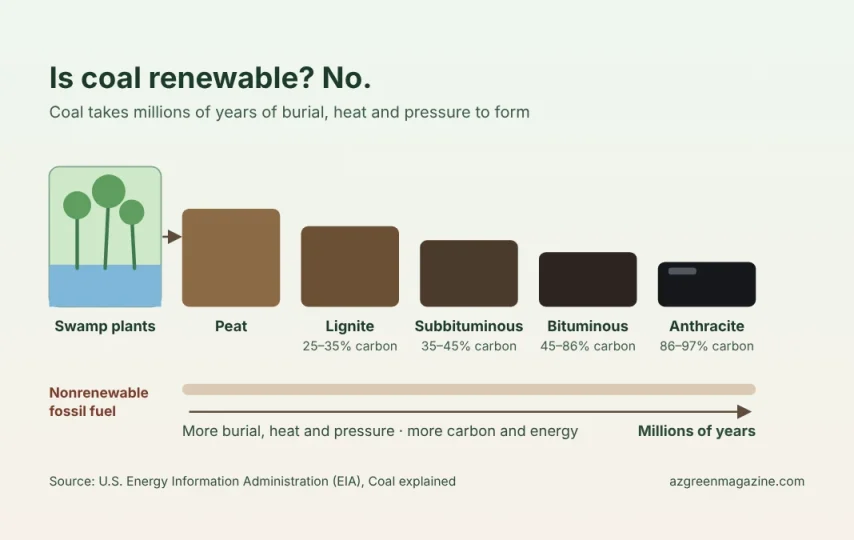

Is coal renewable? No. Coal is a nonrenewable fossil fuel because, in the words of the U.S. Energy Information Administration (EIA), “it takes millions of years to form.” Bituminous coal in the U.S. is 100 million to 300 million years old (EIA Energy Kids), so the coal we burn today will not be replaced on any human time scale.
Below we explain how coal forms, how much is left, why “clean coal” does not change the answer, and how coal compares with energy sources that really are renewable.
Why Is Coal Not a Renewable Resource?
A resource is renewable when nature replaces it about as fast as we use it. EIA defines renewable energy as coming from sources that are “naturally replenishing but flow-limited,” such as sunlight, wind and flowing water (EIA). Coal fails that test by a huge margin.
Coal holds energy from plants that lived in swampy forests hundreds of millions of years ago. The plants were buried under water and dirt, layers of soil and rock covered them, and over millions of years the pressure and heat turned them into coal (EIA).
On the way, the plant material passes through a peat stage and is squeezed enormously. In one coal bed in central Utah studied by the U.S. Geological Survey, the peat-to-coal thickness ratio was about 11:1, so roughly 11 feet of peat for every foot of bituminous coal. Peat itself builds up slowly: across northern peatlands, the average rate since the last ice age (the Holocene) has been about 23 grams of carbon per square meter per year, according to a synthesis of peatland data listed by USGS. A power plant burns the result of that slow process far faster than nature can replace it.
How Is Coal Formed? The Four Types of Coal
Coal is grouped into four ranks, depending on how much pressure and heat acted on the plant material over time. Higher ranks contain more carbon and generally more energy.
| Coal rank | Carbon content | Share of U.S. coal production (2022) |
|---|---|---|
| Lignite | 25–35% | 8% |
| Subbituminous | 35–45% | about 46% |
| Bituminous | 45–86% | about 46% |
| Anthracite | 86–97% | less than 1% |
Sources: EIA, Coal explained. Ages: EIA Energy Kids.
According to EIA, most U.S. subbituminous coal is at least 100 million years old, and U.S. bituminous coal is 100 million to 300 million years old.
How Much Coal Is Left?
Nonrenewable does not mean scarce. As of January 1, 2023, EIA estimated that the U.S. had about 250 billion short tons of recoverable coal reserves, enough for about 422 years at the 2022 production rate, out of a demonstrated reserve base of about 470 billion short tons (EIA). Mines that are already operating hold far less, about 20 years’ worth at that rate.
Worldwide, proved recoverable reserves were about 1.16 trillion short tons as of December 31, 2021. The U.S. holds the largest share (22%), followed by Russia (15%), Australia (14%), China (14%) and India (11%), according to the same EIA page.
The U.S. mined about 528 million short tons in 2025 (EIA), and coal produced about 17% of the country’s utility-scale electricity (EIA). The real limit on coal is not how much is in the ground but what burning it does: we cover that in our guide to the disadvantages of coal energy.
Renewable vs Nonrenewable: Where Coal Fits
| Energy source | Renewable? | Why |
|---|---|---|
| Solar, wind | Yes | Sunlight and wind keep flowing |
| Hydropower | Yes | Flowing water keeps coming |
| Geothermal | Yes | Earth’s internal heat |
| Biomass (wood, waste, biofuels) | Yes | Plant material can regrow |
| Peat | Own category (IPCC) | Builds up very slowly |
| Coal, oil, natural gas | No | Formed over millions of years |
| Nuclear (uranium) | No | Mined ore; not a fossil fuel |
Sources: EIA renewable energy, EIA coal, EIA Energy Kids, nonrenewable sources. Peat: IPCC 2006 inventory guidelines (see below).
Biomass and coal both come from plants, so why is one renewable and the other not? Time. EIA defines biomass as “organic nonfossil material of biological origin constituting a renewable energy source” (EIA glossary): plants can regrow on a human time scale. Coal is the fossil version of the same material.
Peat sits in between. The IPCC’s 2006 guidelines for national greenhouse gas inventories stopped classifying peat as a fossil fuel and gave it its own category, but its CO2 emissions are still counted the same way as those from fossil fuels (IPCC presentation hosted by the IEA). If you want an example of a source that does refill itself, see why hydropower is renewable.
Does “Clean Coal” Make Coal Renewable?
No. Whatever technology a plant uses to cut pollution or capture some of its carbon dioxide, the coal is still mined and burned once, so it remains nonrenewable. And coal power emits a lot: U.S. utility-scale coal plants emitted about 2.31 pounds of CO2 per kWh in 2023, versus 0.96 pounds for natural gas (EIA).
Why coal shows up in some state “alternative energy” rules. Pennsylvania’s Alternative Energy Portfolio Standards include waste coal and coal gasification (IGCC) plants in Tier II and coal-mine methane in Tier I (Pennsylvania AEPS, checked November 2026). That makes them eligible “alternative” sources under state law, not renewable ones. Bills to change the tiers have been proposed, so check the current rules.
What It Means for You
If you see coal listed as a renewable resource, it is wrong: EIA classifies coal as a nonrenewable energy source. For a school assignment, the short answer is “coal is a nonrenewable fossil fuel because it takes millions of years to form.” On the grid, renewables supplied about 24% of U.S. utility-scale electricity in 2025, compared with about 17% from coal (EIA).
Frequently Asked Questions
Is coal renewable or nonrenewable?
Coal is nonrenewable. It forms from plants buried for millions of years under heat and pressure, so once it is mined and burned, it cannot be replaced on a human time scale. The U.S. Energy Information Administration classifies it as a nonrenewable energy source.
Why is coal called a fossil fuel?
Because it formed from the buried remains of ancient plants, as oil and natural gas formed from buried plants and animals. According to EIA, U.S. bituminous coal is 100 million to 300 million years old.
Will we run out of coal?
Not soon. EIA estimates U.S. recoverable reserves at about 250 billion short tons, enough for about 422 years at the 2022 production rate. The bigger limits on coal use are its pollution and carbon emissions, not supply.
Is coal still forming today?
Peat, the first stage on the way to coal, has kept building up in northern peatlands since the last ice age, but only slowly. Turning plant material into coal takes millions of years, so new peat does nothing to replace the coal we burn now.
Is charcoal the same as coal?
No. Charcoal is the solid residue left when wood or other plant matter is heated slowly without burning (slow pyrolysis), according to the UN energy statistics definition. It is made from plants that can regrow, while coal is a fossil fuel mined from the ground.