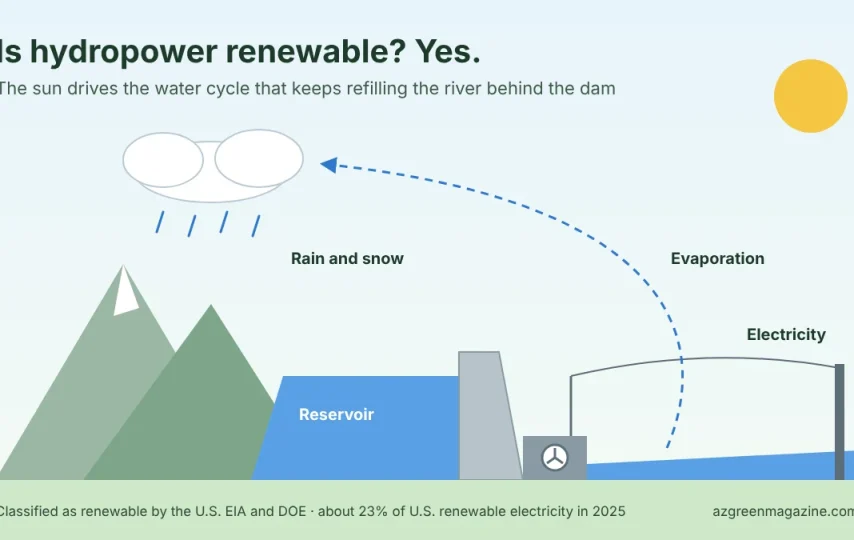

Is hydropower renewable? Yes. Hydroelectric plants run on flowing water, and the water cycle, driven by the sun, keeps refilling rivers and reservoirs with rain and snow. The U.S. Department of Energy and the U.S. Energy Information Administration both classify hydropower as a renewable energy source. In 2025, it supplied about 23% of all U.S. renewable electricity.
The catch is that “renewable” describes the fuel, not the impact. A dam can change a river for a century, a reservoir can emit greenhouse gases, and several U.S. states do not count large hydropower plants toward their renewable energy goals. Here is what that means.
Why Is Hydropower Renewable?
A resource is renewable if it is naturally replenished on a human time scale. Coal, oil and natural gas took millions of years to form, so every ton burned is gone. Water is different: the sun evaporates it from oceans and lakes, it falls back as rain and snow, and it runs downhill through rivers, where a dam can capture its energy.
A hydroelectric plant does not use up the water. According to the EIA, the water flows through a turbine that spins a generator and then continues downstream. The amount of electricity depends on how much water flows and how far it falls.
Renewable does not mean unlimited. A plant can only use the water that arrives. In the 2022–23 water year, western U.S. hydropower fell to a 22-year low because of drought (EIA). The resource comes back, but not on a fixed schedule.
Is Hydropower Clean Energy?
Mostly, but not completely. Running a hydro plant burns no fuel and emits no air pollution. Over its whole life cycle, including building the dam, hydropower has a median of about 24 grams of CO2-equivalent per kilowatt-hour, according to the IPCC figure cited by the International Hydropower Association. That is about one-twentieth of the roughly 490 g median for natural gas.
There are two caveats:
- Reservoir emissions vary a lot. Flooded plants and soil decompose and release carbon dioxide and methane. The EIA says the exact amount emitted from hydropower reservoirs is uncertain and depends on the site. According to the International Hydropower Association, emissions tend to be highest in the first 10 to 20 years after a reservoir is filled, and in some conditions a reservoir can even act as a carbon sink.
- “Clean” air is not the same as a healthy river. Dams block fish migration and change water temperature, flow and sediment downstream. We cover these trade-offs in detail in our article on hydropower pros and cons.
Renewable Energy Sources Compared
| Source | Renewable? | Life-cycle emissions (median) | Main limitation |
|---|---|---|---|
| Hydropower | Yes | About 24 g CO2e/kWh (IPCC) | Impact on rivers; drought years |
| Wind | Yes | About 13 g CO2e/kWh (NREL) | Output varies with the weather |
| Natural gas | No (fossil fuel) | About 490 g CO2e/kWh (IPCC) | Finite fuel, CO2 and methane |
Sources: IPCC figures as summarized by the International Hydropower Association; wind from NREL’s life-cycle emissions update. For more on wind, see our wind energy pros and cons.
Why Some States Don’t Count Large Hydropower as Renewable
Federal statistics count all hydropower as renewable, but state renewable portfolio standards (RPS), the laws that require utilities to buy a share of renewable power, often draw the line by size. California and Massachusetts generally limit eligible hydro to plants of 30 MW or less, and New York made only projects up to 10 MW eligible for its renewable energy credits in a 2018 order, according to POWER Magazine. Other states, such as Pennsylvania, include large hydro.
The reasons are partly environmental and partly economic. These policies were written to encourage new renewable projects, and most large U.S. dams were built before the mid-1970s, so counting them would add little new clean power.
State rules change. If you are comparing electricity plans or green-power programs, check how your state and utility define “renewable” before you assume that hydropower in the mix counts.
Is Pumped Storage Hydropower Renewable?
Not by itself. A pumped storage plant pumps water uphill to an upper reservoir and lets it flow back down through turbines when power is needed. The EIA notes that these plants use more electricity for pumping than they generate, so their net generation is negative. Pumped storage is a way to store energy, like a battery: it is as renewable as the electricity used to fill it. When it stores surplus wind and solar power, it helps the grid use more renewable energy.
What It Means for You
If your utility gets power from hydroelectric dams, that electricity is renewable and low-carbon. It is also one of the most flexible sources on the grid, which is why the DOE values its ability to ramp up quickly. But if you care about rivers and fish, it is fair to ask which dams supply your power and how they are managed, because two hydro plants can have very different environmental footprints.
Frequently Asked Questions
Is hydroelectric energy renewable or nonrenewable?
Hydroelectric energy is renewable. It is powered by water that the water cycle continuously replenishes, and federal agencies such as the EIA and DOE classify it as a renewable source.
Is hydropower 100% clean?
No energy source is 100% clean over its life cycle. Hydropower produces no emissions while running, but building dams and decomposing material in reservoirs release some greenhouse gases. The IPCC median is about 24 g CO2e/kWh.
Can hydropower run out?
The resource will not run out, but a plant’s output can drop sharply in a drought. In 2024, the EIA expected U.S. hydropower generation to be the lowest since 2001 because of dry conditions.
Is hydropower the largest renewable energy source?
Worldwide, yes: hydro produced 14.3% of global electricity in 2024, more than wind or solar, according to Ember. In the U.S., wind passed hydropower as the leading renewable source in 2019.


