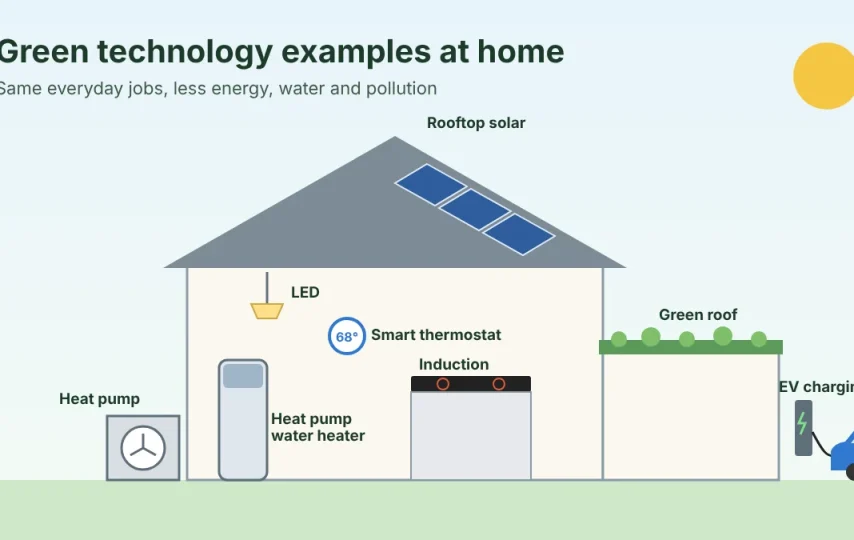

Green technology examples you can use in everyday life include rooftop solar panels, heat pumps, heat pump water heaters, induction cooktops, LED bulbs, smart thermostats, electric cars, water-saving fixtures and green roofs. Each one does a familiar job, such as heating, cooking, lighting or driving, with less energy, water or pollution than the technology it replaces.
This list focuses on technologies a household can choose. For large-scale systems such as carbon capture, desalination and wastewater treatment, see our companion guide to environmental technology examples.
What Is Green Technology?
Green technology is technology designed to do the same job with a smaller impact on the environment: lower emissions, less energy or water, less waste. The terms green technology, clean technology and environmental technology overlap. In this article we use “green technology” for products and systems in homes and transportation, where most people meet it.
| Green technology | What it replaces | Main benefit | Source |
|---|---|---|---|
| Rooftop solar | Grid power from fossil fuels | Clean electricity on site | EIA |
| Air-source heat pump | Furnace, baseboard heater | About 50% less electricity for heating | DOE |
| Geothermal heat pump | Furnace, boiler | 30%–60% less energy | DOE |
| Heat pump water heater | Standard electric water heater | About $550 a year saved | ENERGY STAR |
| Induction cooktop | Gas or electric coil stove | About 85% efficient vs about 32% for gas | ENERGY STAR |
| LED bulbs | Incandescent bulbs | Up to 90% less energy | ENERGY STAR |
| Smart thermostat | Manual thermostat | About 8% lower heating and cooling bills | ENERGY STAR |
| Electric car | Gasoline car | Over 77% of energy reaches the wheels | DOE |
| WaterSense showerhead | 2.5 gpm showerhead | 2,700 gallons of water a year | EPA |
| Green roof | Dark conventional roof | Much cooler roof, less runoff | EPA |
10 Examples of Green Technology
1. Rooftop Solar Panels
Solar panels on a roof turn sunlight into electricity right where it is used. Small-scale solar, mostly rooftop systems on homes and businesses, generated about 93,000 gigawatt-hours in the U.S. in 2025, roughly five times as much as in 2016, according to the U.S. Energy Information Administration. California alone produced 37% of it.
Output depends heavily on roof direction and tilt, so check your orientation first with our solar panel direction tool.
2. Air-Source Heat Pumps
A heat pump works like an air conditioner that can also run in reverse: instead of burning fuel to make heat, it moves heat from outdoor air into the house in winter and out of it in summer. Because moving heat takes less energy than creating it, modern air-source heat pumps can cut electricity use for heating by about 50% compared with furnaces and baseboard heaters, according to the U.S. Department of Energy.
They are no longer a niche product. In 2025, U.S. manufacturers shipped about 3.64 million air-source heat pumps and about 3.25 million gas furnaces, based on AHRI data reported by ACHR News.
3. Geothermal Heat Pumps
A geothermal (ground-source) heat pump uses pipes buried in the yard, where the soil stays at a steady temperature all year. That steady source makes it even more efficient than an air-source unit; DOE says geothermal heat pumps can reduce energy use by 30% to 60% (DOE). The drilling or trenching makes installation much more expensive, so it pays off best in new construction or on larger lots.
4. Heat Pump Water Heaters
Water heating is one of the biggest energy uses in a home. A heat pump water heater pulls heat from the surrounding air into the tank instead of using a heating element alone. ENERGY STAR estimates that a household of four saves about $550 a year on electricity compared with a standard electric water heater, or about $5,610 over the unit’s lifetime (ENERGY STAR). It needs some space around it and works best in a garage, basement or utility room.
5. Induction Cooktops
An induction cooktop uses a magnetic field to heat the pan directly, so little heat is lost to the room. According to ENERGY STAR, induction cooktops are about 85% efficient, compared with roughly 75%–80% for standard electric cooktops and about 32% for gas, making them about three times as efficient as gas. Switching from gas also removes combustion fumes from the kitchen. Most induction cooktops need pans with a magnetic base.
6. LED Light Bulbs
LED bulbs are the simplest green technology most homes already use. ENERGY STAR certified LEDs use up to 90% less energy than standard incandescent bulbs and last about 15 times longer, around 15,000 hours instead of 1,000. One certified bulb can save more than $55 in electricity over its life (ENERGY STAR).
7. Smart Thermostats
A smart thermostat learns your schedule, lowers heating or cooling when nobody is home and can be adjusted from a phone. ENERGY STAR certified models save the average home about 8% on heating and cooling bills, about $50 a year (ENERGY STAR technical bulletin). Savings are larger if you previously kept the house at one temperature around the clock, and smaller if you already adjusted a programmable thermostat.
Start with the cheapest upgrades. LED bulbs and a smart thermostat cost little and pay back quickly. A heat pump, heat pump water heater or induction cooktop makes the most sense when the old appliance needs replacing anyway.
8. Electric Cars
An electric car runs on a battery and an electric motor instead of a gasoline engine. It is far more efficient: EVs convert over 77% of the electrical energy from the grid to power at the wheels, while conventional gasoline vehicles convert only about 12% to 30% of the energy in their fuel (fueleconomy.gov). They also have no tailpipe emissions.
Electric cars made up about a quarter of new cars sold worldwide in 2025, more than 20 million vehicles, and just under 10% of sales in the United States, according to the IEA Global EV Outlook 2026. Hydrogen fuel cell cars are another zero-emission option; here is how hydrogen cars work.
9. Water-Saving Fixtures
Green technology is not only about energy. Standard showerheads use 2.5 gallons per minute (gpm); EPA WaterSense labeled models use no more than 2.0 gpm. EPA estimates the average family could save 2,700 gallons of water a year with them, and more than 330 kilowatt-hours of electricity, because less hot water needs heating (EPA WaterSense). Similar labels exist for toilets and faucets.
10. Green Roofs
A green roof is a layer of plants and growing medium on top of a waterproof membrane. It keeps the roof and the building below cooler and soaks up rain. On a hot August afternoon in Chicago, a green roof measured 91°F to 119°F while the dark conventional roof next to it reached 169°F; extensive green roofs capture between 50% and nearly 100% of incoming rain, depending on their depth and the storm (EPA heat island guide).
Green roofs need a structure that can carry the extra weight and are more common on flat commercial roofs than on houses. Other low-impact roof options are covered in our guide to eco-friendly roofing.
Federal tax credits have ended. The federal credits for home solar and batteries (25D) and for heat pumps and other efficiency upgrades (25C) are not available for expenditures or property placed in service after December 31, 2025, and the new and used EV credits ended for vehicles acquired after September 30, 2025 (IRS). State and utility rebates may still apply; check current rules before you buy.
Which Green Technology Makes the Biggest Difference?
It depends on where your home uses the most energy. For most U.S. homes, heating, cooling, water heating and driving are the big items, so a heat pump, a heat pump water heater and an electric car usually cut the most emissions. LED bulbs, a smart thermostat and a WaterSense showerhead cost the least and are the easiest first steps. Rooftop solar makes sense when your roof gets good sun and you plan to stay in the house for years.
Frequently Asked Questions
What are 5 examples of green technology?
Five common examples are rooftop solar panels, heat pumps, LED light bulbs, electric cars and water-saving fixtures such as WaterSense showerheads.
What is green technology in simple words?
Green technology is any product or system that does a normal job, such as heating a house, cooking or driving, while using less energy or water and creating less pollution than the older technology.
What are examples of green technology at home?
At home, green technology includes solar panels, air-source and geothermal heat pumps, heat pump water heaters, induction cooktops, LED bulbs, smart thermostats, low-flow fixtures and green roofs.
Is an electric car green technology?
Yes. An electric car converts over 77% of the electrical energy from the grid to power at the wheels, compared with about 12% to 30% for a gasoline car, and has no tailpipe emissions. How clean the electricity is depends on the local power mix.
What is the difference between green technology and environmental technology?
They overlap. Green technology usually refers to everyday products like heat pumps or EVs, while environmental technology is used more for large systems that treat pollution, water and waste, such as carbon capture or wastewater treatment.


