A wind turbine technician installs, inspects, maintains and repairs wind turbines. Much of the work happens inside the nacelle, the housing at the top of a tower more than 200 feet tall, where the gearbox, generator and controls sit. Technicians, often called wind techs, climb the tower, find the fault, fix mechanical, electrical and hydraulic systems, and keep the turbine producing power.
The job pays a median of $64,120 a year and usually requires a certificate or associate’s degree rather than a bachelor’s degree, according to the Bureau of Labor Statistics (BLS). Below: what the work looks like day to day, how to become a wind turbine technician step by step, the training and certifications employers look for, and what the latest data says about jobs.
What Does a Wind Turbine Technician Do?
The BLS lists these core duties for wind turbine service technicians:
- assist engineers and ironworkers in installing new turbines;
- inspect towers and their physical integrity;
- climb towers to inspect or repair equipment;
- perform routine maintenance, such as inspecting and lubricating parts;
- test and troubleshoot electrical, mechanical and hydraulic systems;
- replace worn or faulty components;
- collect turbine data for testing and analysis;
- service underground transmission lines, substations and the fiber optic sensing and control systems of a wind farm.
In practice, the work splits into scheduled maintenance (checking bolts, oil, brakes and filters on a fixed plan) and troubleshooting, when a turbine stops and the control system shows a fault. There is a lot of equipment to keep running: the U.S. Wind Turbine Database (version 9.1, September 2026) lists 77,839 utility-scale turbines in 45 states, Guam and Puerto Rico.
Work environment
The job is physical and outdoors. According to the BLS, wind techs:
- work at great heights, climbing ladders inside towers in a fall-protection harness and rappelling down from the nacelle to repair blades;
- work in confined spaces inside the nacelle;
- lift heavy parts and tools, some weighing 50 pounds or more;
- work in heat and cold at rural or offshore wind farms, and travel to those sites;
- mostly work full time and may be on call evenings or weekends; offshore assignments can keep them away from home for days or weeks.
A turbine can start moving or release stored energy while someone is working on it. That is why lockout/tagout is a core safety skill: every energy source is identified, isolated and locked off, stored energy is released, and the technician verifies the turbine is dead before starting work, as required by OSHA rules for wind farms. If you are afraid of heights or tight spaces, this is not the right job.
How to Become a Wind Turbine Technician
You do not need a bachelor’s degree, and certifications are voluntary, but employers expect technical training and safety certificates. A typical path looks like this:
- Finish high school or a GED. Math, physics and shop classes help, because the job is applied mechanics and electricity.
- Complete a wind energy technology program. Most technicians attend a technical school or community college and earn a certificate in wind energy technology or an associate’s degree, according to the BLS. The Department of Energy keeps a map of wind education and training programs at community colleges and universities.
- Get safety certifications. Certifications are not required by law but are available in workplace electrical safety, tower climbing and self-rescue (BLS). Many employers ask for the Global Wind Organisation (GWO) Basic Safety Training, described below.
- Pass the physical and climb test. Expect to show that you can climb a full tower and work at height while carrying tools.
- Learn the specific turbine on the job. Employers provide long-term on-the-job training for the models they maintain, often taught by the turbine manufacturer (BLS).
A background in a related trade, such as electrical work, industrial maintenance or military mechanical service, can shorten the path, because the electrical and mechanical skills carry over.
Wind Turbine Technician Training and Certifications
Wind technician schools teach the systems you will meet in the nacelle. According to the BLS, coursework covers electrical, hydraulic, braking, mechanical and programmable logic control (PLC) systems, plus tower climbing, rescue, safety, first aid and CPR.
| Training | What it covers | Required? |
|---|---|---|
| Certificate in wind energy technology | Electrical, hydraulic, mechanical and PLC systems; climbing and rescue | Usual entry route (BLS) |
| Associate’s degree | The same core plus general education; wider career options | Common, not required |
| GWO Basic Safety Training | First Aid, Manual Handling, Fire Awareness, Working at Height; Sea Survival for offshore | Often requested by employers |
| Electrical safety training | Safe work on energized and de-energized equipment | Often requested |
| Manufacturer training | Specific turbine models | Provided by the employer |
Sources: BLS Occupational Outlook Handbook; Global Wind Organisation, Basic Safety Training standard.
The GWO Basic Safety Training standard has five modules: First Aid, Manual Handling, Fire Awareness, Working at Height and Sea Survival. Sea Survival is the module for offshore work, covering transfers between vessels and turbines. Each module has an initial course and a refresher course, so the certificates have to be kept current.
Before you pay for a program, ask the school three questions: does it have a climbing tower or a working nacelle trainer, is GWO training included in the price, and which employers hired its last graduates. Hands-on equipment and employer connections matter more than the name of the credential.
Wind Turbine Technician Jobs and Outlook
About 11,800 people worked as wind turbine technicians in the U.S. in 2025, according to the BLS. The BLS projects 30% employment growth from 2025 to 2035, to about 15,300 jobs. That is ten times the 3% average for all occupations, although the number of jobs is small. The agency expects about 1,500 openings a year, mostly to replace workers who retire or move to other occupations.
The forecast is lower than the previous one: in its 2024–2034 projections the BLS expected 49.9% growth. The occupation is still among the fastest growing, but the outlook depends on how many new wind farms are built.
Where the jobs are, by industry (share of employment, BLS):
| Employer type | Share of wind techs |
|---|---|
| Wind electric power generation (wind farm owners and operators) | 42% |
| Self-employed | 15% |
| Power and communication line construction | 15% |
| Commercial and industrial machinery repair and maintenance (service companies) | 12% |
Most wind farms are in rural areas of the Great Plains and Texas, so that is where most jobs are. For a wider look at the industry these jobs depend on, see our guide to wind energy pros and cons.
How Much Do Wind Turbine Technicians Make?
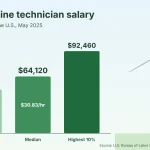
The median annual wage for wind turbine technicians was $64,120 ($30.83 an hour) in May 2025. The lowest-paid 10% earned less than $49,230 and the highest-paid 10% more than $92,460, according to the BLS. That is above the median for all U.S. occupations ($50,980) and for installation, maintenance and repair jobs ($59,620).
Pay depends on the employer: technicians at commercial and industrial machinery repair companies had a median of $70,670, compared with $65,000 at wind power generation companies and $63,080 in line construction. For pay by state, the effect of overtime and travel, and how pay has changed over time, see our detailed guide to wind turbine technician salary.
Is Becoming a Wind Turbine Technician Worth It?
It can be a good fit if you:
- want a skilled trade that starts with a certificate or associate’s degree rather than a four-year degree;
- like mechanical and electrical troubleshooting more than desk work;
- are comfortable with heights, confined spaces and bad weather;
- can live in or travel to rural areas where wind farms are.
It is a poor fit if heights or travel are deal-breakers, or if you need to stay in a large city. The electrical, hydraulic and safety skills also carry over to other power plants and to industrial maintenance. If you are curious about the machines themselves, our article on how much a wind turbine costs explains the equipment from the owner’s side.
Frequently Asked Questions
What does a wind turbine technician do?
A wind turbine technician installs, inspects, maintains and repairs wind turbines. Typical tasks include climbing towers, lubricating and replacing parts, and troubleshooting electrical, mechanical and hydraulic systems, according to the BLS.
How long does it take to become a wind turbine technician?
Most technicians complete a certificate program or an associate’s degree at a technical school or community college. After hiring, employers add long-term on-the-job training on the specific turbines they maintain, so it takes time on the job to become fully independent.
Do you need a degree to be a wind turbine technician?
No. The BLS lists a postsecondary nondegree award, such as a certificate, as the typical entry-level education. An associate’s degree is common but not required.
Is wind turbine technician a dangerous job?
The job involves real hazards: working at heights of more than 200 feet, confined spaces, heavy loads and machinery that can start unexpectedly. Fall protection, rescue training and lockout/tagout procedures are standard parts of the work to control those risks.
How much do wind turbine technicians make an hour?
The median wage was $30.83 an hour in May 2025, according to the BLS. The bottom 10% earned less than about $23.67 an hour and the top 10% more than about $44.45, based on the annual figures divided by 2,080 working hours.