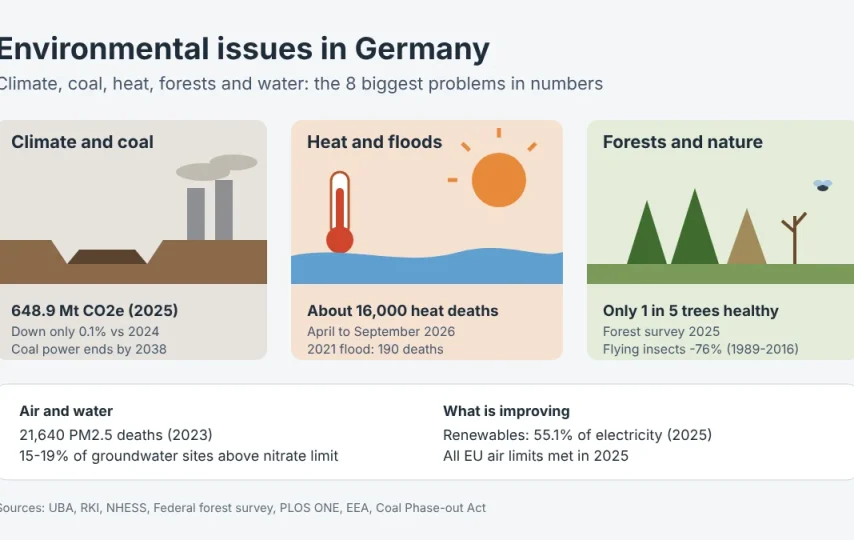

The biggest environmental issues in Germany are climate targets that are slipping out of reach, a power system that still burns lignite, rising emissions from cars and heating, deadly heat waves and floods, dying forests, the loss of insects and open land, nitrate in groundwater, and more packaging waste per person than the EU average. Germany had 83.5 million people at the end of 2025, according to the federal statistics office Destatis, and its Climate Change Act requires a 65% cut in greenhouse gases from 1990 levels by 2030, 88% by 2040 and climate neutrality by 2045.
Below are the eight main environmental problems in Germany, a summary table, what is being done and what you can do.
Top 8 Environmental Issues in Germany
1. Climate Targets Slipping Out of Reach
Germany emitted 648.9 million metric tons of greenhouse gases (CO₂ equivalent) in 2025, about 48% less than in 1990 but only 0.1% less than in 2024, according to the German Environment Agency, the Umweltbundesamt (UBA). To reach the 65% target, emissions would have to fall by an average of 42 million tons a year from 2026 to 2030. Under policies in place in November 2025, the UBA projects only a 62.6% cut by 2030.
The government’s independent Council of Experts on Climate Change went further in May 2026: it expects Germany to miss both the 65% target and its emissions budget for 2021–2030, with a median overshoot of roughly 60 to 100 million tons.
Coal is a large part of the problem. Lignite, the brown coal dug from open-pit mines in the Rhineland and eastern Germany, still generated about 67 TWh of public net electricity in 2025, according to Fraunhofer ISE. The national Coal Phase-out Act ends coal power no later than 2038, with reviews in 2026, 2029 and 2032 that could move the end to 2035. In the Rhineland, the utility RWE agreed to exit coal in 2030, eight years early, but the former village of Lützerath was demolished in January 2023 so the Garzweiler mine could dig beneath it.
2. Rising Emissions From Transport and Heating
Two sectors are moving the wrong way. Transport emissions rose by 2.1 million tons to 146.3 million tons in 2025, and buildings rose by 3.4 million tons to 103.4 million tons, while industry and energy fell, according to the UBA.
The UBA’s projections show that from 2021 to 2030, transport will overshoot its share of the national budget by about 187 million tons and buildings by about 110 million tons. Germany also faces a cumulative gap of 255 million tons under the EU’s Effort Sharing Regulation, which covers transport, buildings, agriculture and waste.
3. Heat Waves, Drought and Floods
Climate change in Germany is already measurable. The country’s average temperature in 2025 was 10.0°C (50.0°F), and Germany has warmed by about 2.5°C (4.5°F) since pre-industrial times, according to the German Weather Service, the DWD. In 2025, a pronounced spring dry spell was followed by a heat wave in late June and early July with temperatures above 35°C (95°F) in many regions.
The Robert Koch Institute (RKI), Germany’s public health agency, estimated about 16,000 heat-related deaths between early April and mid-September 2026, in its final weekly heat mortality report of the season, PTAheute reported. From 2016 to 2025, the annual toll exceeded 4,000 only twice.
Floods are the other extreme. The July 2021 flood killed 190 people in Germany, 134 of them in the Ahr valley, and caused around €33 billion in damage, according to a 2025 study in Natural Hazards and Earth System Sciences. In June 2024, floods in Bavaria and Baden-Württemberg killed at least four people and forced thousands from their homes, AFP reported at the time.
4. Air Pollution in Germany
Air pollution in Germany has fallen a long way, but it still harms health. Fine particle pollution (PM2.5) caused 21,640 premature deaths in Germany in 2023, according to the European Environment Agency (EEA). The death rate per 100,000 people aged 30 and over fell 68.6% from 2005 to 2023.
All EU air quality limits were met everywhere in Germany in 2025, for the eighth year in a row for particulate matter and the second for nitrogen dioxide (NO₂), according to the UBA. The bar is about to rise, though. Stricter EU limits from 2030 cut the annual NO₂ limit from 40 to 20 µg/m³ and the PM2.5 limit from 25 to 10 µg/m³. About 39% of monitoring stations in 2025 were above the future NO₂ limit and about 18% above the future PM2.5 limit.
5. Forest Dieback
Germany’s forests have not recovered from the droughts of 2018–2020. Only about one tree in five was healthy in 2025, about 35% showed substantial crown thinning and another 44% were at the warning level, according to the federal agriculture ministry’s forest condition survey, as summarized by Clean Energy Wire. Pine got worse: only 13% of pines showed no needle loss, down from 20% in 2024.
Forests matter for the climate too. In 2025 they absorbed 19.3 million tons more CO₂ than they released, but land use as a whole remained a net source of 26.9 million tons, according to the UBA.
6. Insect Decline and Land Take
Germany’s best-known biodiversity warning came from a 2017 study in PLOS ONE, based on insect trapping in nature reserves. It found a 76% decline in the seasonal biomass of flying insects over 27 years (1989–2016) in 63 protected areas, and an 82% decline in midsummer (Hallmann et al.). Germany’s national Red List, published by the Federal Agency for Nature Conservation (BfN), rates 29.6% of more than 15,000 assessed invertebrate species as threatened (Forschung & Lehre, 2022).
Habitat keeps disappearing under buildings and roads. From 2021 to 2024, settlement and transport land grew by an average of 50 hectares (about 124 acres) per day, according to the UBA land take indicator. The national target is under 30 hectares (about 74 acres) per day by 2030.
7. Nitrate in Groundwater
Every year since 2008, between 15% and 19% of Germany’s groundwater monitoring sites, roughly one in six, have exceeded the EU nitrate standard of 50 mg per liter, according to the UBA nitrate indicator. The main cause is manure and fertilizer from farming.
The issue reached the EU’s top court. On June 21, 2018, the Court of Justice of the EU found that Germany had breached the Nitrates Directive, and the European Commission closed its follow-up case only in June 2023, after Germany tightened its fertilizer rules, according to the European Commission. In 2025, Germany’s Federal Administrative Court ruled that the government must draw up a national action program against farm nitrate pollution, the UBA notes. Soil-friendly farming methods such as regenerative agriculture aim to keep nutrients in the field instead of in the water.
8. Packaging Waste
Germany generated 215.2 kg (about 474 pounds) of packaging waste per person in 2023, compared with an EU average of 177.8 kg (about 392 pounds), according to Eurostat. In 2022, each resident also produced 606 kg (about 1,336 pounds) of municipal waste, against an estimated 513 kg (about 1,131 pounds) for the EU, according to the EEA country profile.
Recycling is strong, and consumption is starting to fall. Packaging use dropped 5.8% to 17.92 million metric tons in 2023, and 69.4% of packaging waste was recycled, according to the UBA.
Germany Environmental Issues at a Glance
| Issue | Key figure | Source | Trend |
|---|---|---|---|
| Climate targets | 648.9 Mt CO₂e emitted (2025), about 48% below 1990 | UBA | Down only 0.1% from 2024 |
| Transport and heating | Transport 146.3 Mt, buildings 103.4 Mt (2025) | UBA | Both rising |
| Heat and floods | About 16,000 heat deaths (April–September 2026) | RKI | Far above the 2016–2025 level |
| Air pollution | 21,640 PM2.5 deaths (2023) | EEA | Rate down 68.6% since 2005 |
| Forests | About 1 in 5 trees healthy (2025) | Agriculture ministry | Stable, pine worse |
| Insects and land | 76% loss of flying insect biomass (1989–2016) | PLOS ONE | 50 ha/day land take (2021–2024) |
| Nitrate | 15–19% of sites above 50 mg/L | UBA | No clear improvement since 2008 |
| Packaging | 215 kg per person (2023) vs 178 kg EU | Eurostat | Use down 5.8% in 2023 |
What Is Being Done
- Climate law and court pressure. The Climate Change Act sets binding targets to 2045. On January 29, 2026, the Federal Administrative Court confirmed that the government must strengthen its climate action program so the 2030 targets can be met, according to the environment ministry, which presents its 2026 program as the required revision of the 2023 one.
- Renewable power (Energiewende). Renewables supplied 55.1% of gross electricity consumption in 2025, up from 6.3% in 2000; the Renewable Energy Sources Act (EEG) targets at least 80% by 2030, according to the UBA. In 2025, solar overtook lignite for the first time, according to Fraunhofer ISE, and Germany added 4.5 GW of onshore wind, Clean Energy Wire reports. For how wind compares in the U.S., see our guide to wind power pros and cons.
- Heating law rewritten. The Building Modernisation Act, in force since July 29, 2026, repealed the rule that new heating systems run on 65% renewable energy, according to the federal government. New gas and oil heaters in existing buildings must instead use a rising share of climate-neutral fuels: 10% from 2029, 15% from 2030, 30% from 2035 and 60% from 2040, according to the law firm Gleiss Lutz. Check current rules before buying a heating system.
- Cheap public transport. The Deutschlandticket has cost €63 a month since January 2026 and rises to €66.80 on January 1, 2027, according to the federal government. It covers buses, trams, subways and regional trains nationwide, but not long-distance ICE, IC and EC trains.
- Air and farm rules. Tighter fertilizer rules ended the EU nitrate case in 2023, and the UBA expects only isolated exceedances of the stricter 2030 air limits and nationwide compliance by 2035.
Germany is also bound by EU rules, including the 2030 air quality limits and the EU climate targets. For the bigger picture across the continent, see our article on environmental issues in Europe.
What You Can Do
If you live in Germany, travel there or are thinking about a move, these steps connect the problems above to your own choices:
- Take the train and the Deutschlandticket. For a stay of a month or more, the €63 pass (€66.80 from January 2027) covers local and regional transit nationwide, and regional trains can replace many short car trips. Long-distance trains need a separate ticket.
- Prepare for summer heat. Heat caused an estimated 16,000 deaths in 2026. Check DWD heat warnings, drink water, avoid midday exertion and check on older neighbors.
- Sort your trash the German way. Packaging goes in the yellow bin or bag, paper in blue, glass by color, and most plastic and glass drink bottles carry a deposit you get back at the store. Buying loose produce and refillable bottles cuts packaging at the source.
- Choose a heating system carefully. If you own a home in Germany, the new heating law allows gas and oil again, but those systems will need rising shares of climate-neutral fuel from 2029.
- Compare with home. Our article on the top environmental issues in California shows how heat, drought and air pollution play out in one U.S. state, and our overview of global environmental issues puts Germany in world context.
Frequently Asked Questions
What is the biggest environmental issue in Germany?
There is no official ranking, but climate change ties most problems together. Emissions fell only 0.1% in 2025, the UBA projects a 62.6% cut by 2030 against a 65% target, and heat caused an estimated 16,000 deaths in 2026.
Is air pollution in Germany a problem?
Less than before. Germany met all EU air quality limits in 2025, but PM2.5 still caused 21,640 premature deaths in 2023, and many stations are above the stricter EU limits that apply from 2030.
Will Germany meet its 2030 climate target?
Probably not on current policies. The UBA projects a 62.6% cut by 2030, and the Council of Experts on Climate Change expects Germany to miss both the 65% target and its 2021–2030 emissions budget.
When will Germany stop using coal?
By law, coal power ends no later than 2038, possibly 2035 after government reviews. RWE has agreed to leave coal in the Rhineland in 2030.


