As an Amazon Associate, we earn from qualifying purchases. This doesn’t affect our recommendations.
The best solar water heater for you depends first on one thing: whether the collector will see freezing weather. Systems that pump household water straight through the panels work only where it rarely freezes, while systems with a non-freezing fluid loop and a heat exchanger suit cold climates, according to the U.S. Department of Energy. Get that right and a certified system can cut your water heating bill roughly in half, ENERGY STAR says.
Below are five solar water heaters sold on Amazon for three very different jobs: hot water for a house, heat for a swimming pool and a warm shower at camp. A whole-house system is plumbing work; the pool and camping options are things most owners set up themselves.
Quick picks
- Best solar water heater for home: Duda Solar 53-Gallon (200 L) Active Split System — evacuated-tube collector, glycol loop and a separate indoor tank
- Best collector for DIY and retrofits: Duda Solar 30-Tube Evacuated Tube Collector — about 48 sq ft gross area to pair with your own tank
- Best for in-ground pools: SmartPool S601 Solar Pool Heater — two 2 × 20 ft panels that run on your existing pool pump
- Best for above-ground pools: SmartPool SunHeater S120U — one 40 sq ft panel, add up to three in a row
- Best portable solar shower: Advanced Elements 5 Gallon Summer Shower — a black bag that warms in the midday sun
Comparison Table
| Model | Type | Size | Freeze protection | Best for |
|---|---|---|---|---|
| Duda Solar 200 L split system | Active, indirect (glycol), evacuated tubes | 53-gal tank | Yes: glycol loop, tank indoors | Year-round home hot water |
| Duda Solar 30-tube collector | Evacuated-tube collector only | 47.6 sq ft gross area | Depends on your loop design | DIY builds and adding to an existing tank |
| SmartPool S601 | Unglazed pool panels | 80 sq ft per box (2 × 2 × 20 ft) | No: drain for winter | In-ground pools |
| SmartPool SunHeater S120U | Unglazed pool panel | 40 sq ft (2 × 20 ft) | No: drain or store for winter | Above-ground pools |
| Advanced Elements Summer Shower | Portable solar bag | 5 gal (also 2.5, 3 and 10 gal) | No | Camping, cabins, boats |
Specs are manufacturer-rated and taken from manufacturer manuals, the SRCC certificate and independent reviews; checked on November 11, 2026.
Our Picks
1. Duda Solar 53-Gallon Active Split System: Best Solar Water Heater for Home
This is the closest thing on Amazon to the kind of system a solar installer would put on a house in a cold or mixed climate. The evacuated-tube collector sits on the roof, a pump moves a propylene glycol mix through it, and a heat exchanger coil passes the heat to a 53-gallon (200 L) tank that stays indoors. Duda Energy describes it as a “winter resistant” glycol system with a separate tank and says its active collectors are SRCC OG-100 certified.
Because it is a split, pumped system, it needs a controller, a pump station, an expansion tank and proper plumbing. The Duda installation manual describes its SR961s working station with a three-speed pump, controller, flow meter and relief valve; check the listing to see exactly which parts come in the box and which you buy separately.
Key specs
- Tank: 200 L (53 gal), single heat exchanger coil
- Collector: evacuated glass tubes with heat pipes; standard heat pipes rated −10°C to 230°C (14°F to 446°F), optional freeze-protected grades rated to −25°C and −50°C (−13°F and −58°F)
- Heat transfer fluid: food-grade propylene glycol, maximum 60% concentration
- Warranty: tubes 10 years, heat pipes 15 years, manifold and tank 5 years, electronics 1 year (manual)
Pros
- Glycol loop and indoor tank suit climates with hard freezes
- Separate tank can sit in a basement or utility room, away from the roof load
- Long warranty on tubes and heat pipes
Cons
- Plumbing, a pump and a controller mean professional-level installation and permits in most places
- Glycol has to be checked and replaced every few years
- We found SRCC certification only for the collectors (OG-100), not an OG-300 rating for the complete system, which ENERGY STAR requires
2. Duda Solar 30-Tube Evacuated Tube Collector: Best for DIY and Retrofits
If you already have a tank with a solar coil, or you are building a preheat system in front of an existing water heater, the collector alone is the part you need. Duda’s 30-tube model (SRCC model SC5830) uses 30 tubes of 58 × 1,800 mm and has a gross area of 4.426 m², about 47.6 sq ft, according to its SRCC OG-100 certificate. That is in the range DOE suggests for a two- to three-person household in the Sun Belt (see the sizing table below).
The certificate on file lists an expiry date of September 1, 2026, so if a rebate program or your local code requires SRCC certification, check the current SRCC directory before you buy.
Key specs
- Tubes: 30 evacuated tubes, 58 mm × 1,800 mm, with heat pipes
- Gross area: 4.426 m² (47.6 sq ft), SRCC model SC5830
- Mounting: sold with a 45° frame (a 37° version is listed separately)
- Warranty: tubes 10 years, heat pipes 15 years, manifold 5 years (Duda manual)
Pros
- Vacuum-insulated tubes keep heat loss low in cold, windy weather
- In heat-pipe designs like this one, a broken tube can be swapped without draining the fluid loop
- Lets you design the system around a tank and backup heater you already own
Cons
- Collector only: tank, pump station, controller, expansion tank and fluid are extra
- Evacuated-tube collectors can reach very high stagnation temperatures in summer, so the loop needs overheat protection
- SRCC certificate needs checking for current status
3. SmartPool S601: Best Solar Water Heater for In-Ground Pools
Pool heating is where solar thermal pays back fastest. A solar pool heating system usually costs $2,500 to $4,000 to buy and install and pays back in 1 to 7 years, depending on local fuel costs and sunshine, DOE estimates. The S601 is a do-it-yourself version: a box with two 2 × 20 ft black collectors (80 sq ft) that you plumb into the return line so your existing filter pump pushes water through them.
The S601 manual says the system can raise pool temperature by up to 10°F over the season, and its sizing chart is honest about how much panel a real pool needs: two boxes for a 15 × 30 ft pool, three for 16 × 36 ft and four for 20 × 40 ft. For more on the options, see our guide to heating a pool with solar.
Key specs
- Collectors: two 2 × 20 ft panels per box (80 sq ft)
- Rated gain: up to 10°F
- Pump: works with the existing pool pump (about 1 hp for runs up to 30 ft and one story, per the manual)
- Warranty: 5-year limited (first year full, then prorated); freeze damage excluded
Pros
- Uses no electricity beyond the pump you already run
- Clear manufacturer sizing chart by pool size
- Five-year limited warranty
Cons
- One box is not enough for a typical in-ground pool; plan on two to four, each with its own SK21 installation kit
- No freeze protection: the panels must be drained before winter
- Unglazed panels lose heat quickly on cool, windy days
4. SmartPool SunHeater S120U: Best for Above-Ground Pools
The S120U is a single 2 × 20 ft polypropylene panel (40 sq ft) that you plumb into the return line of an above-ground pool. According to the S120U manual, water coming back from the panel runs about 3–5°F warmer than the pool, and you can connect up to three panels in series as your pool grows or your season gets longer.
DOE recommends collector area equal to 50% to 100% of the pool’s surface. For a 12 ft round pool (about 113 sq ft) that means roughly 57 to 113 sq ft, or two to three panels; a single panel gives a small pool a modest boost.
Key specs
- Panel: one 2 × 20 ft polypropylene tube-on-web collector (40 sq ft)
- Return water: about 3–5°F warmer than the pool water
- Expansion: up to three panels in series
- Winter: drain or store indoors; freeze damage is not covered
Pros
- Lowest-cost way to add solar heat to a small pool
- Runs on the pool’s existing filter pump
- Modular: add a second or third panel later
Cons
- One panel is too small for most in-ground pools
- No freeze protection
- Warranty length was not stated in the manual we reviewed; check the listing
5. Advanced Elements Summer Shower: Best Portable Solar Shower
For a campsite, an off-grid cabin without plumbing or a boat deck, the simplest solar water heater is a dark bag left in the sun. The Advanced Elements Summer Shower comes in 2.5, 3, 5 and 10 gallon sizes; the 5-gallon version is a good middle size for two people. In OutdoorGearLab’s review, it heated water in a few hours of midday sun, with the usual drawbacks of gravity showers: low pressure and a heavy bag to hang.
Key specs
- Capacity: 5 gal (other sizes 2.5, 3 and 10 gal)
- Heating: solar, through a dark bag in direct sun
- Empty weight: under 1 lb for the 3-gallon size (OutdoorGearLab)
Pros
- Needs no power, fuel or installation
- Packs small when empty
- Choice of sizes
Cons
- Five gallons of water weighs about 42 lb, so hanging it takes a sturdy branch or hook
- Low water pressure
- Warms only in direct sun; cloudy days give lukewarm water
How to Choose a Solar Water Heater for Home
Match the system type to your climate
DOE sorts home systems into a few types (DOE):
- Active direct: pumps move household water through the collectors. Works well where it rarely freezes.
- Active indirect (closed loop): pumps move a non-freezing fluid such as glycol through the collectors and a heat exchanger. The usual choice in freezing climates; the Duda split system is this type.
- Passive integral collector-storage (batch): a black tank or tubes in an insulated, glazed box. Simple and cheap, but DOE says to install it only in mild-freeze climates.
- Passive thermosyphon: the tank sits above the collector and warm water rises into it without a pump. Most of these systems hold about 40 gallons. Heavy on the roof and vulnerable to freezing unless designed for it.
Passive systems are typically less expensive and can be more reliable, while active systems are usually more efficient, DOE notes.
Size the collector and tank to your household
DOE’s rule of thumb is about 20 sq ft of collector for each of the first two people, plus 8 sq ft for each additional person in the Sun Belt or 12–14 sq ft in the northern U.S. (DOE sizing guide). For storage, a 50- to 60-gallon tank usually covers one to three people and an 80-gallon tank three to four.
| Household | Collector area, Sun Belt | Collector area, northern U.S. | Typical tank |
|---|---|---|---|
| 2 people | 40 sq ft | 40 sq ft | 50–60 gal |
| 3 people | 48 sq ft | 52–54 sq ft | 50–80 gal |
| 4 people | 56 sq ft | 64–68 sq ft | 80 gal |
| 5 people | 64 sq ft | 76–82 sq ft | 80 gal or larger |
Sources: DOE rule of thumb; table values are our own calculation.
Look for SRCC and ENERGY STAR ratings
The Solar Rating & Certification Corporation certifies collectors under OG-100 and complete solar water heaters under OG-300 (SRCC). ENERGY STAR certifies only complete OG-300 systems that have a gas or electric backup and a Solar Uniform Energy Factor above 1.8 (electric backup) or 1.2 (gas backup). The higher the factor, the less backup energy the system uses. Many state and utility rebates require one of these certifications.
Plan for a backup heater
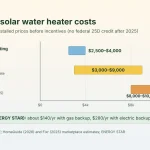
Solar water heaters almost always need a backup for cloudy days and heavy use, DOE says. Most home systems preheat water for an existing gas or electric water heater or use a tank with a built-in electric element. ENERGY STAR estimates savings of about $140 a year with gas backup and about $280 a year with electric backup, over a typical 20-year system life.
Home solar water heaters involve roof penetrations, pressurized hot water and, in active systems, line-voltage controls. Most areas require a permit, and the work belongs with a licensed plumber or solar thermal contractor. Follow the manufacturer’s manual for pressure relief and overheat protection.
Budget for maintenance
In closed-loop systems, antifreeze degrades and should normally be changed every 3–5 years, according to DOE’s maintenance guide. Check the controller and collector shading once a year and flush scale every few years in hard-water areas.
The federal 25D residential clean energy credit, which covered 30% of a solar water heater’s cost, does not apply to systems installed after December 31, 2025 (IRS). State and utility rebates still exist in some places, such as Hawaii. See our breakdown of solar water heater cost and payback; check current rules before you buy.
How We Chose
We compared manufacturer manuals and specifications, SRCC certificates, DOE and ENERGY STAR guidance and independent reviews, and picked one product for each of five distinct jobs. We did not test these products ourselves. Specs and listings were checked on November 11, 2026.
Several products from the earlier version of this article are no longer included because we could not find them on Amazon or confirm they are still sold in the U.S., including the Apricus Wombat, Northern Lights SWH-1 and Sunpad.
Frequently Asked Questions
What is the best type of solar water heater for a cold climate?
An active indirect (closed-loop) system is the usual choice. It circulates a non-freezing fluid such as propylene glycol through the collectors and passes the heat to an indoor tank through a heat exchanger, so no household water sits on the roof. Evacuated-tube collectors also lose less heat than flat plates in cold, windy weather.
How long do solar water heaters last?
ENERGY STAR puts the average life expectancy of certified solar water heating systems at 20 years. Parts wear at different rates: glycol needs replacing every 3–5 years in closed-loop systems, and pumps and controllers usually have shorter warranties than collectors and tanks.
Can a solar water heater provide all of a home's hot water?
Rarely, and not year-round. Systems are sized to cover a large share of demand, and they almost always rely on a gas or electric backup for cloudy days and heavy use. ENERGY STAR says a certified system can cut water heating bills roughly in half.
Is a solar water heater better than a heat pump water heater?
It depends on your sun, climate and budget. A heat pump water heater installs like a normal water heater and, according to ENERGY STAR, can save a household of four about $550 a year compared with a standard electric model. A solar system costs more to install but uses free energy; it makes the most sense in sunny areas with high energy prices or rebates. Read more in our list of green technology examples for the home.
How big a solar pool heater do I need?
DOE recommends a collector area equal to 50% to 100% of your pool’s surface area, more for cooler climates or a longer swimming season. For a 16 × 36 ft pool (576 sq ft), that is roughly 290 to 576 sq ft of panels. The S601 manual recommends three 80 sq ft boxes (240 sq ft) for that size, below DOE’s range, so plan on more panels in cooler climates or for a longer season.

We send one email a week. No spam. Unsubscribe anytime. See our Privacy Policy.