
A clover lawn is a lawn made partly or entirely of white clover (Trifolium repens), a low, creeping legume that pulls nitrogen from the air and feeds it into the soil. That means less fertilizer, fewer mowings and flowers for bees. The trade-offs are real too: more bees underfoot, weaker wear under heavy play, and thin or bare patches in winter. For most yards the practical choice is a grass-and-clover mix rather than pure clover.
Below we explain the types of clover used in lawns, the pros and cons according to university extension services, how clover compares with grass, how to plant it, what it costs and who it suits.
What Is a Clover Lawn?
White clover spreads by stems that run along the soil surface and root at the nodes, forming patches, according to Penn State Extension. It is a perennial, but its foliage usually dies back in winter and regrows from the crown in spring.
Clover used to be a normal part of American lawns. University of Illinois Extension notes that white clover was common in lawns until broadleaf herbicides arrived in the 1950s; those products target broadleaf weeds and often kill clover too. Today clover is coming back as a low-input option, and it fits naturally into other sustainable backyard ideas such as smaller lawns and native plantings.
Types of clover for lawns
| Type | What it is | Height (unmowed) | Best use |
|---|---|---|---|
| White Dutch clover | Common Trifolium repens | 4–8 in (10–20 cm) per Great Basin Seeds; 3–12 in per UMN Extension | Pure clover or a grass mix; most flowers |
| Microclover | Small-leaved selections of white clover (‘Pirouette’, ‘Pipolina’) | 3–6 in per Nature’s Seed; 6–8 in per DLF | Mixed into turf grass at a small share of the seed |
| Clover-grass mix | Grass seed plus a small share of clover | Set by the grass and your mower | Lawns that need a familiar look and better wear |
Sources: Great Basin Seeds; UMN Extension; Nature’s Seed; DLF microclover guide (July 2024).
Microclover has smaller leaves, fewer flowers, a lower growth habit and less clumping than Dutch white clover, according to University of Maryland Extension (updated May 2023). That is why it blends into grass more evenly. Pure white clover lawns are possible, but UMaine Cooperative Extension (February 2023) notes that clover is often mixed with grass, commonly fescue, to reduce patchiness.
Clover Lawn Pros
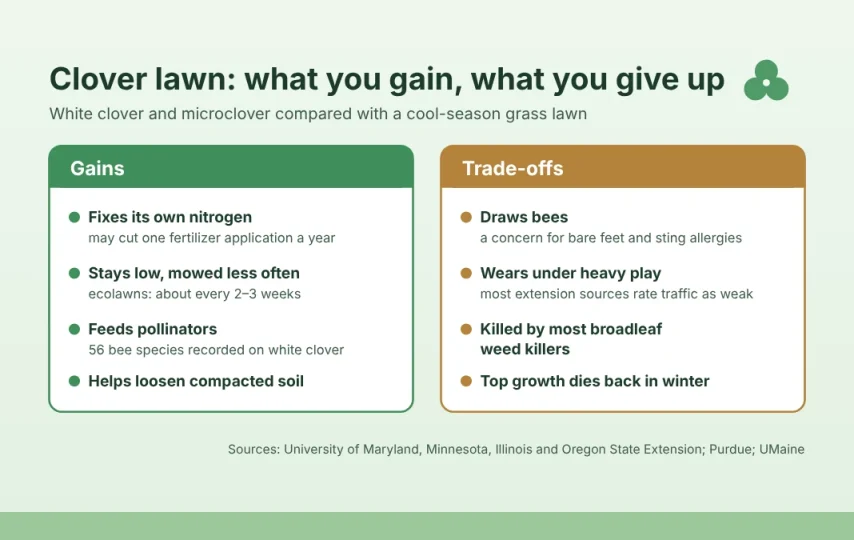
It makes its own fertilizer. Clover is a legume: Rhizobium bacteria in its root nodules convert nitrogen from the air into a form plants can use (Penn State Extension). UMD Extension says microclover in a lawn “may reduce one nitrogen application per year.” Illinois Extension adds that its clippings return organic nitrogen and that using less fertilizer limits runoff into waterways.
Less mowing. Purdue University’s turfgrass program does not expect common white clover to grow much above 5 to 6 inches and suggests, as an open question, that its slow growth might mean fewer mowings. Oregon State’s “ecolawn” mixes of grass, clover and other low plants need mowing about every two to three weeks in spring, summer and fall (OSU Extension).
Less water, green in summer. OSU Extension says ecolawns use up to one-third less water than conventional lawns, and that clover stays green in summer. UMaine Extension calls clover more drought tolerant than many grasses. That matters because outdoor use averages more than 30% of household water use, and up to 60% in arid regions, according to EPA WaterSense. For the bigger picture on supply, see our explainer on whether water is a renewable resource.
Food for pollinators. University of Minnesota research found 56 bee species on white clover alone, according to UMN Extension. It usually blooms from late May to October in Minnesota, with a peak in June.
Fewer weeds and less compaction. Illinois Extension says microclover competes with weeds and helps prevent soil compaction. UMN Extension also credits white clover with breaking up compacted soil.
Clover Lawn Cons
Bees where people walk. Flowers attract bees, which may be a problem for anyone with a sting allergy, UMD Extension notes. UMaine Extension warns that bees on clover are a hazard for bare feet, and Purdue points out that flowering can last for months, not weeks.
Weaker under heavy traffic. UMN Extension lists poor traffic tolerance as a drawback, and UMaine says clover crushes more easily than turf grass and is slippery when wet. Purdue expects, without testing, poor wear and recovery and chronic bare spots where pets or children play. Not every source agrees: NC State Extension lists foot traffic among the challenges white clover resists and names play areas among its uses, and UMN’s bee lawn guide suits sites with light to moderate traffic.
Winter gaps and short life. Top growth dies back in winter, which can leave bare spots and erosion, according to Illinois Extension. UMD Extension says microclover is a perennial but needs reseeding to persist in lawns.
Not for heat, drought or shade everywhere. Here the sources split. Illinois and UMD Extension say microclover does not tolerate high heat or drought and does poorly in shade; UMD also notes occasional southern blight in long, hot, humid spells. UMD’s clover page adds that shallow roots make it vulnerable to drought. On the other side, OSU Extension, writing for the Pacific Northwest, and UMaine Extension call clover drought tolerant.
It spreads where you don’t want it. Clover self-sows and can become a weed in flower beds and along yard edges (UMaine Extension). UMD Extension’s clover page says established patches can widen by “a foot or more each year.” Purdue adds that crisp edges along walks and driveways are hard to keep.
Weed killers can wipe it out. Most broadleaf herbicides labeled for lawns will kill microclover, according to Illinois Extension. Penn State says white clover is best controlled by herbicides containing dicamba, clopyralid, fluroxypyr and quinclorac. If you use a weed-and-feed product, check the label first.
Do not spray a clover lawn with a general broadleaf weed killer. Many common lawn herbicides are designed to remove exactly the plant you just seeded.
Clover vs Grass: How They Compare
| Factor | White clover / microclover | Cool-season turf grass |
|---|---|---|
| Nitrogen fertilizer | Fixes its own; may cut one application per year (UMD) | Mid-Atlantic tall fescue needs 2–3 lb N per 1,000 sq ft a year (Fairfax Master Gardeners) |
| Mowing | Expected to stay under 5–6 in; may need less mowing (Purdue) | Mowed through the growing season |
| Water | Ecolawns use up to 1/3 less water (OSU) | Outdoor use is 30%+ of household water (EPA) |
| Foot traffic | Poor per UMN; weak per Purdue and UMaine; NC State disagrees | Wears better than clover (UMaine) |
| Pollinators | 56 bee species recorded on white clover (UMN) | — |
| Broadleaf herbicides | Most kill it (Illinois) | Grass tolerates labeled products |
Sources as linked in the sections above; the tall fescue figure is from a Fairfax County Master Gardeners article (April 2023).
How to Plant a Clover Lawn
1. Pick the season. Seeding windows depend on your climate:
- Illinois Extension: early spring to late summer.
- DLF (a microclover supplier): early fall and late spring to early summer give the best success; for late-summer seeding, sow at least 6 weeks before the expected killing frost.
- Outsidepride: in spring after the last frost when soil reaches 50°F (10°C), or 6 to 8 weeks before the first hard freeze.
- UMN Extension (Minnesota bee lawns): mid-May to early June, or dormant seeding from early November to mid-December.
UMD Extension notes that white clover seed germinates at soil temperatures of 50°F or higher.
2. Check soil pH. UMN Extension says Dutch white clover tolerates soil pH down to 5.5, and bee lawns prefer pH 6.0 to 7.0. A soil test tells you whether you need lime.
3. Prepare the ground. For overseeding into an existing lawn, Illinois Extension recommends mowing the grass at the lowest setting, then raking and core aerating; tilling isn’t needed. UMN suggests mowing to about 1 inch before overseeding a bee lawn.
4. Seed at the right rate. Rates vary a lot by product and goal, so follow the label. Published figures include:
| Use | Seeding rate | Source |
|---|---|---|
| Microclover into an existing lawn | About 1 lb per 1,000 sq ft | DLF; same rate, unspecified use: Stock Seed Farms, Nature’s Seed |
| Microclover in a new grass lawn | 5% of total grass seed weight | DLF |
| Microclover with tall fescue | 3–5% of seed weight; above 10% it may dominate | Fairfax County Master Gardeners |
| White Dutch clover, new lawn | 1–2 lb per 1,000 sq ft (its FAQ: 1/4–1/2 lb) | Outsidepride |
| White Dutch clover, overseeding | 1/2–1 lb per 1,000 sq ft | Outsidepride |
| White Dutch clover, lawn | 1/4–1/2 lb per 1,000 sq ft | Great Basin Seeds |
| Dutch white clover in a bee lawn mix (with 4 lb fine fescue) | 1.1 oz per 1,000 sq ft | UMN Extension |
Clover seed is tiny, so sow it shallow: Great Basin Seeds says no deeper than 1/4 inch, and Outsidepride up to 1/8 inch. Microclover seed often comes coated with Rhizobium bacteria, which Illinois Extension notes may be missing from residential soils.
5. Keep it moist. Water daily for the first 7 to 10 days until the seed sprouts (Illinois Extension). DLF says to keep the area consistently moist until it establishes, usually within 2 to 3 weeks.
Mixing microclover into grass at a few percent of the seed weight gives you most of the nitrogen benefit while the grass carries the foot traffic. It is the lower-risk way to try a clover lawn.
How to Maintain a Clover Lawn
- Mowing. UMN Extension recommends mowing a bee lawn at 3 inches or higher, about every 2 to 3 weeks. Nature’s Seed says microclover kept at 2 to 3 inches flowers less, which also means fewer bees.
- Fertilizer. Skip nitrogen in most cases. DLF suggests adding phosphorus, potassium or magnesium only if a soil test shows a deficiency.
- Water. Water occasionally in long dry spells; DLF notes microclover may go dormant in hot, dry weather.
- Overseeding. Plan to reseed thin areas. DLF says fall is usually best.
- Edges. Edge beds and walks to keep clover from creeping into them.
Clover Lawn Cost
Prices below are from seller pages as of November 2026; they vary by seller, bag size and sales, so check before you buy:
| Seed | Price | Source |
|---|---|---|
| White Dutch clover | $8.95 per lb | Great Basin Seeds |
| White Dutch clover, inoculated | $7.99 per lb (1 lb bag); $4.00 per lb in a 40 lb bag | Outsidepride |
| Microclover | $33.00 per lb | Stock Seed Farms |
| Microclover ‘Pipolina’ | $35.96 per lb (1 lb, sale; $39.95 regular); $30.53 per lb in a 50 lb bag (sale) | American Meadows |
| Microclover | $44.99 per lb (1 lb, covers 1,000 sq ft) | Nature’s Seed |
By our arithmetic, overseeding 1,000 sq ft (93 m²) of lawn with microclover at 1 lb per 1,000 sq ft costs about $33 to $45 in seed. White Dutch clover at Outsidepride’s new-lawn rate of 1 to 2 lb per 1,000 sq ft costs about $8 to $14 (its 1 lb and 2 lb bags). Labor, aeration and topsoil are extra. On the other side of the ledger, a clover mix can cut fertilizer purchases and mowing time.
Is a Clover Lawn Right for You?
A clover lawn, or a grass-clover mix, makes sense if you:
- want to fertilize less and keep nutrient runoff out of local streams;
- want flowers for bees and can live with them in the lawn;
- have a sunny yard with light to moderate foot traffic;
- are fine with a less uniform look and some winter thinning.
It is a poor fit if:
- someone in the house has a bee sting allergy and the lawn is a play area;
- the lawn takes heavy daily wear from kids’ games or dogs;
- your yard is mostly shade;
- you rely on broadleaf weed killers to keep a pure-grass look.
Clover also works on farms: USDA NRCS and Iowa State Extension rate white clover as a good nitrogen fixer when grown as a cover crop (May 2025); cover crops come up in our explainer on regenerative agriculture. For more home-scale changes, see our eco-friendly house ideas.
Frequently Asked Questions
Does clover need mowing?
Less than grass, but usually some. Purdue’s turfgrass program does not expect common white clover to grow above 5 to 6 inches, and UMN Extension recommends mowing a bee lawn at 3 inches or higher about every 2 to 3 weeks. Mowing low cuts off flowers, which reduces bees.
Is a clover lawn safe for dogs?
We found no extension or veterinary source that addresses white clover and dogs directly. Purdue’s toxic plant page names it as a bloat risk for grazing cattle, sheep and goats, and the ASPCA lists a different species, alsike clover, as toxic to horses. If your dog eats a lot of any plant and seems unwell, call your vet. Wear is a clearer issue: Purdue warns of chronic bare spots where pets play.
Does a clover lawn attract bees?
Yes. University of Minnesota research recorded 56 bee species on white clover. Microclover has fewer flowers than Dutch white clover, according to UMD Extension, and mowing at 2 to 3 inches reduces flowering further.
How long does clover take to grow?
Outsidepride gives 7 to 14 days for white Dutch clover to germinate. DLF says microclover usually establishes within 2 to 3 weeks if kept moist.
Will a clover lawn come back every year?
White clover is a perennial that regrows from the crown each spring, according to Penn State Extension. Even so, UMD Extension says microclover needs periodic reseeding to persist in a lawn.

We send one email a week. No spam. Unsubscribe anytime. See our Privacy Policy.