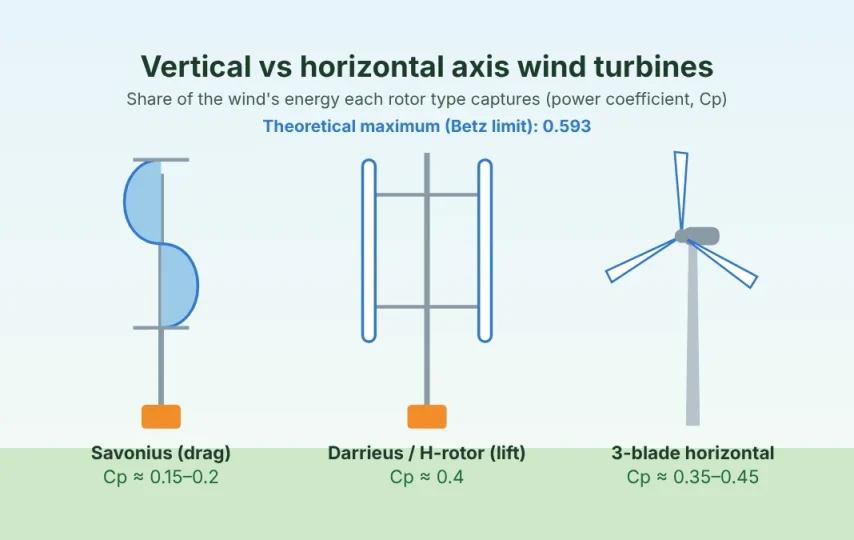

A vertical axis wind turbine for home use spins around an upright shaft, like a carousel, instead of facing into the wind like a propeller. Common examples are the twisted “helix” rotors sold for rooftops, the S-shaped Savonius scoops of small garden and DIY kits, and the straight-bladed H-rotors on small masts. They look neat and catch wind from any direction, but they usually convert less of the wind’s energy than a conventional three-blade turbine.
This guide explains how vertical axis wind turbines (VAWTs) work, how the main designs differ, what independent field trials found when small turbines were put on and around homes, and when a VAWT is a reasonable choice.
How Does a Vertical Axis Wind Turbine Work?
Every wind turbine turns part of the moving air’s energy into rotation, and a generator turns rotation into electricity. A VAWT’s blades are driven either by drag or by lift, and its layout differs from a propeller turbine in two ways:
- Drag. Cup- or scoop-shaped blades are pushed around by the wind, the way an anemometer spins. The returning blade moves against the wind, so a lot of energy is lost. This is how a Savonius rotor works.
- Lift. Airfoil-shaped blades, like a plane’s wing, move faster than the wind and are pulled forward by lift as they sweep around. This is how a Darrieus or H-rotor works, and it is far more efficient.
- Generator at the base. Because the shaft is vertical, the generator and gearbox (if any) can sit at the bottom of the mast instead of at the top.
- No steering. The rotor accepts wind from any direction, so it needs no tail vane or yaw motor.
No turbine can capture more than 59.3% of the wind’s energy, a ceiling known as the Betz limit, and real turbines usually reach 35–45%, according to the University of Calgary’s Energy Education encyclopedia.
Types of Vertical Axis Wind Turbines
| Type | How it works | Typical power coefficient (Cp) | Where you see it |
|---|---|---|---|
| Savonius | Drag: S-shaped or cup-shaped scoops | 0.15–0.2 | Small garden and DIY kits |
| Darrieus (“eggbeater”) | Lift: curved airfoil blades | About 0.4 | 1980s wind farms, research turbines |
| H-rotor (giromill) | Lift: straight vertical airfoil blades | Similar to Darrieus | Most small “vertical” kits for homes |
| Helical (twisted) | Savonius or Darrieus blades twisted around the shaft for smoother torque | Depends on base design | Rooftop and urban models |
| Horizontal axis (for comparison) | Lift: propeller facing the wind | 0.35–0.45 | Nearly all home and utility turbines |
Cp ranges from a 2025 review in the Journal Européen des Systèmes Automatisés. The power coefficient is the share of the wind’s energy a rotor captures.
The helical designs exist to fix two weaknesses. A 2022 review in the Indonesian Journal of Science and Technology notes that twisting Savonius blades keeps torque positive at every angle, that helical Darrieus rotors are quieter, and that hybrid Savonius-Darrieus rotors help a Darrieus start on its own, something a plain Darrieus often cannot do.
Advantages and Disadvantages of VAWTs
1. Advantage: wind from any direction
A VAWT does not need to turn to face the wind. This is a real design advantage where the wind shifts often, such as around buildings. It does not mean the turbine catches more energy: small-wind author Hugh Piggott calls the idea that VAWTs work in lower winds than horizontal turbines “nonsense” (Scoraig Wind).
2. Advantage: quiet, slow rotors
Slow drag-type rotors turn at low speed. Piggott sums it up: “Low speed VAWTs are quiet and durable. Their efficiency is dismal.” We found no controlled study comparing VAWT and horizontal turbine noise at home scale.
3. Disadvantage: lower efficiency per dollar
Because a Savonius captures roughly half as much of the wind’s energy as a good propeller turbine, it needs a bigger rotor, and more material, for the same output. Wind energy writer Paul Gipe compared one small commercial VAWT with a horizontal turbine of similar rating and found about half the efficiency at the rated wind speed (Wind-Works).
4. Disadvantage: fatigue and reliability
Each blade of a lift-type VAWT is pushed one way and then the other on every turn, which loads the blades and bearings in cycles. Sandia National Laboratories ran a long VAWT research program from the 1970s into the 1990s (Sandia retrospective), and the Darrieus turbines installed in California wind farms in the 1980s are no longer running, according to Scientific American. Utility-scale wind today is almost entirely three-blade horizontal axis turbines.
5. Unproven: safer for birds
VAWTs are often marketed as bird-friendly. We found no peer-reviewed evidence that they kill fewer birds than small horizontal turbines. A UK study of small turbines at home sites estimated about 0.08–0.28 bird deaths per turbine per year overall, without separating rotor types (Minderman et al., 2014, via PNNL Tethys).
What Field Trials Show About Rooftop and Home Turbines
The bigger problem is usually not the rotor type but where home turbines go. Roofs and backyards have weak, gusty wind.
- Warwick Wind Trials (UK, 2007–2008): 26 building-mounted turbines under 2 kW averaged a capacity factor of 0.85% including downtime, about 214 Wh a day, while each turbine’s own electronics used around 80 Wh a day (Warwick Wind Trials report).
- Energy Saving Trust (UK, 2009): no urban or suburban building-mounted turbine in the 57-site trial produced more than 200 kWh a year, while pole-mounted 2.5–6 kW turbines at rural sites produced over 18,000 kWh (University of Southampton).
- NREL review of U.S. projects (2016): none of the built-environment case studies met its energy estimate, measured capacity factors ranged from under 1% to 7%, and turbines were often shut down or removed early because of vibration, noise or reliability problems (NREL).
- Boston Museum of Science rooftop wind lab (2009): in its first weeks, the 1.2 kW Windspire VAWT recorded a capacity factor of about 2.4%, below a 2.4 kW horizontal Skystream on the same roof at about 9.2%, according to museum figures reported by Scoraig Wind. The Windspire’s maker filed for bankruptcy in 2012 (Northern Nevada Business Weekly).
Only one vertical axis model is on the Small Wind Certification Council’s list of certified small turbines: the Hi-VAWT DS3000, rated at 1.4 kW at 11 m/s and about 2,460 kWh a year at a 5 m/s (11 mph) average wind (ICC). Most VAWTs sold online have no independent certification.
Are Vertical Axis Wind Turbines Worth It for a Home?
For most homes, no, at least not as a way to cut the power bill. Many small VAWT kits sold online are rated at wind speeds of 12 m/s (about 27 mph) or more; one generic 400 W model, for example, lists a rated wind speed of 12 m/s (inverter.com). Wind power rises with the cube of wind speed, so at a 10 mph average such a turbine makes only a small fraction of its label rating (our calculation: (10 ÷ 27)³ ≈ 5%).
A VAWT can make sense when:
- you want a small, quiet charger for a battery at a windy site and accept low output;
- the site has constantly shifting wind and a horizontal turbine cannot be mounted high enough;
- it is a teaching or demonstration project rather than a power source.
Before buying any turbine, check the basics from the U.S. Department of Energy: an average annual wind speed of at least 9 mph for an off-grid system and 10 mph for a grid-connected one, plus local zoning and HOA rules. A turbine should sit at least 30 feet above anything within 300 to 500 feet (NDSU Extension), which is rarely possible on a roof. The federal 25D tax credit no longer covers small wind: the IRS says it is not allowed for expenditures after December 31, 2025.
If you have a windy, open site, a small three-blade turbine with a published energy figure will usually produce more per dollar. See our picks of the best home wind turbines, and our guide to how much a wind turbine costs for larger systems.
For the bigger picture on wind power, see wind energy pros and cons.
Frequently Asked Questions
Do vertical wind turbines work for homes?
They turn and make some electricity, but measured output on and around homes is low. Rooftop and urban turbines in UK and U.S. field trials ran at capacity factors from under 1% to about 7%, far below the estimates their owners were given.
Are vertical axis wind turbines better than horizontal ones?
Not for energy per dollar. A Savonius rotor captures about 15–20% of the wind’s energy and a Darrieus about 40%, compared with 35–45% for a three-blade horizontal turbine. VAWTs do accept wind from any direction and can be quieter.
Can I put a vertical axis wind turbine on my roof?
You can, but roofs have weak, turbulent wind, and mounting a turbine on a building can transmit vibration and noise into the house. NREL found that no built-environment project in its review met its energy estimate. Check structural loads and local permits first.
How much electricity does a small vertical wind turbine produce?
It depends on the wind far more than on the label. A 400 W model rated at 12 m/s produces only a few percent of that rating in a 10 mph wind. The certified Hi-VAWT DS3000, a 1.4 kW machine, is rated at about 2,460 kWh a year at an 11 mph average.
Are vertical axis wind turbines safe for birds?
They are often marketed that way, but we found no peer-reviewed study showing that they kill fewer birds than small horizontal turbines. A UK study of small turbines at home sites estimated fewer than one bird death per turbine per year, without comparing rotor types.

We send one email a week. No spam. Unsubscribe anytime. See our Privacy Policy.


