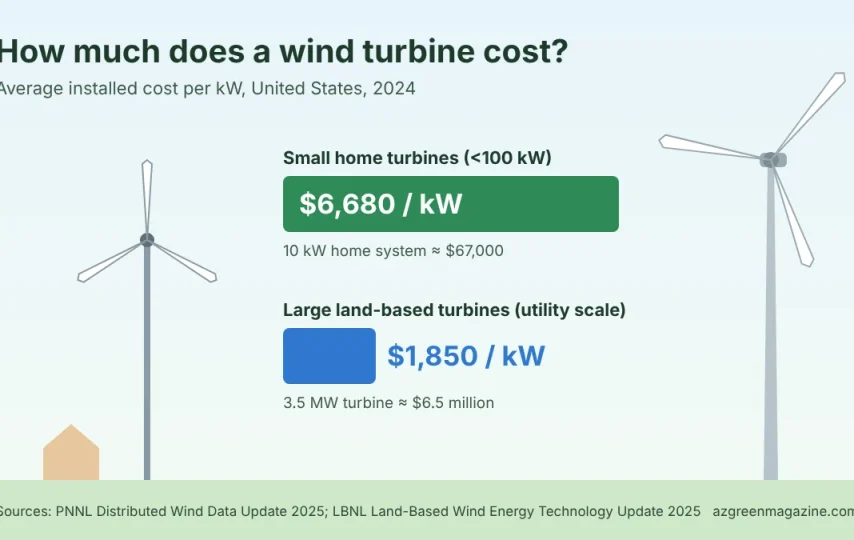

How much does a wind turbine cost? For a home, expect roughly $5,000 to $10,000 per kilowatt (kW) of capacity, installed, according to the U.S. Department of Energy. New small wind projects in the U.S. averaged $6,680/kW in 2024, so a 10 kW system that can cover much of a typical home’s electricity use comes to about $67,000 before incentives. A large utility-scale turbine costs far less per kW, about $1,850/kW in 2024, but at 3.5 MW each that is still around $6.5 million per turbine.
Below are the numbers for each size, what drives the price, how much electricity you can expect for your money, and when a home turbine actually pays off.
How Much Does a Wind Turbine Cost by Size?
| Turbine type | Typical size | Installed cost per kW | Example total cost |
|---|---|---|---|
| Small home turbine | 400 W – 20 kW | $5,000–$10,000 (DOE range); $6,680 average in 2024 | 10 kW: about $50,000–$100,000; about $67,000 at the 2024 average |
| Large land-based (utility) turbine | 3.5 MW average in 2024 | About $1,850 (2024 average, whole project) | About $6.5 million per turbine |
Sources: small turbine sizes and cost range from the DOE and its small wind consumer guide; the 2024 small wind average from PNNL’s distributed wind data update, 2025 edition; utility-scale figures from LBNL’s Land-Based Wind Energy Technology Update: 2025 Edition. The example totals are our own multiplication of size by cost per kW.
The PNNL average of $6,680/kW is based on 30 small wind projects installed in 2024 (45 turbines, 875 kW in total). With such a small sample, individual quotes can be well above or below it.
How Much Does a Home Wind Turbine Cost?
The DOE says residential turbines usually range from 400 watts to 20 kW, and that a home using about 10,649 kWh a year (877 kWh a month) would need a turbine rated at roughly 5 to 15 kW to make a significant contribution, depending on local wind speed. At the DOE’s $5,000–$10,000/kW range, that means:
- 5 kW: about $25,000–$50,000
- 10 kW: about $50,000–$100,000
- 15 kW: about $75,000–$150,000
The price usually includes the turbine, the tower, wiring, an inverter, installation and permitting. The tower is a big part of the bill: the DOE notes that small turbine towers can range from 90 to 140 feet, because the rotor needs to be at least 30 feet above anything within 300 feet to catch clean, steady wind.
What changes the price
- Tower height and type. Taller towers cost more but reach stronger wind, which often raises output enough to justify it.
- Grid-connected or off-grid. Off-grid systems need batteries and often a backup source such as a small solar array.
- Site work. Foundations, trenching for cables and access for a crane or tower-raising equipment depend on your land.
- Permits and interconnection. Zoning, height limits, setbacks and your utility’s interconnection rules all add time and cost.
How Much Electricity Does a Home Wind Turbine Produce?
Output depends on turbine size and, above all, on wind speed. Small wind projects in PNNL’s sample averaged a 16% capacity factor in 2024, which means they produced 16% of what they would if they ran at full power all year.
Here is a rough estimate for a 10 kW turbine at that average: 10 kW × 8,760 hours × 0.16 ≈ 14,000 kWh a year. That is more than the 10,649 kWh the DOE uses for a typical home, but a turbine on a less windy site could produce half as much or less. Only a site assessment by an installer can tell you what your turbine will really generate.
Do not size a turbine from the manufacturer’s rated power alone. Rated power is measured at a high wind speed that most sites rarely see. The DOE recommends an average annual wind speed of at least 9 mph (4 m/s) at hub height, and at least 10 mph for grid-connected systems.
Are Home Wind Turbines Worth It?
A simple payback estimate shows why the answer depends so much on the site. Using the numbers above:
| Item | Value |
|---|---|
| 10 kW system at the 2024 average cost | About $66,800 |
| Annual output at a 16% capacity factor | About 14,000 kWh |
| Average U.S. residential electricity price, 2025 | 17.3 cents/kWh (EIA) |
| Value of the electricity per year | About $2,400 |
| Simple payback | About 28 years |
The DOE says small wind systems have an average useful life of about 20 years, so on an average site a home turbine may not pay for itself through bill savings alone. The math improves with a windier site, higher local electricity prices, grants, or a remote location: the DOE notes that running a power line to a remote site can cost $15,000 to more than $50,000 per mile, which can make an off-grid wind-and-solar system the cheaper option.
The DOE’s own checklist for small wind is a good filter. A turbine is worth considering if you have:
- At least one acre of land.
- An average annual wind speed of at least 9–10 mph at hub height.
- Local zoning that allows tall structures.
- Relatively high electricity costs, or no affordable grid connection.
If your property passes those tests, compare models in our list of the best home wind turbines. For the bigger picture, including grid-scale benefits and drawbacks, see our guide to wind energy pros and cons.
Are There Tax Credits for Wind Turbines in 2026?
The federal 30% Residential Clean Energy Credit used to cover small wind turbines. Under P.L. 119-21, signed in 2025, the credit does not apply to expenditures made after December 31, 2025, and an expenditure counts as made when installation is completed, according to the Congressional Research Service. A home turbine installed in 2026 therefore does not qualify.
Other support still exists. In 2024, USDA Rural Energy for America Program (REAP) grants, state incentives and state production tax credits for distributed wind totaled $10 million across 15 states, according to PNNL. REAP grants are for agricultural producers and rural small businesses, not regular homeowners. Rules change often, so check current state and utility programs before you buy.
How Much Does a Commercial Wind Turbine Cost?
For wind farms, LBNL reports an average installed project cost of $1,850/kW in 2024, while the turbines themselves averaged a transaction price of about $1,070/kW. The rest covers foundations, roads, electrical work, grid connection and development. The average new land-based turbine in 2024 was rated at 3.5 MW, with a hub height of 106 meters (348 ft) and a rotor diameter of 137 meters (449 ft).
Because these turbines are large, run at an average capacity factor of 34% to 37.5%, and sit on windy sites, their electricity is cheap: about $40 to $67 per MWh for plants built in 2023 and 2024, depending on the region, according to LBNL.
Frequently Asked Questions
How much does a 10 kW wind turbine cost?
About $50,000 to $100,000 installed, based on the DOE’s range of $5,000 to $10,000 per kW. At the 2024 U.S. average for small wind projects ($6,680/kW), a 10 kW system comes to about $67,000.
How much does one large wind turbine cost?
A typical new land-based turbine rated at 3.5 MW costs about $6.5 million as part of a wind farm, based on LBNL’s 2024 average project cost of $1,850/kW. The turbine alone accounts for a little over half of that.
Can a wind turbine power a whole house?
It can on a windy site with enough land. The DOE estimates that a typical home needs a 5 to 15 kW turbine to make a significant contribution. Most grid-connected homes still draw from the grid on calm days.
How long does a home wind turbine last?
The DOE puts the average useful life of a small wind system at about 20 years, with routine maintenance and occasional replacement of parts such as blades or bearings. Some systems have run for 50 to 60 years.


