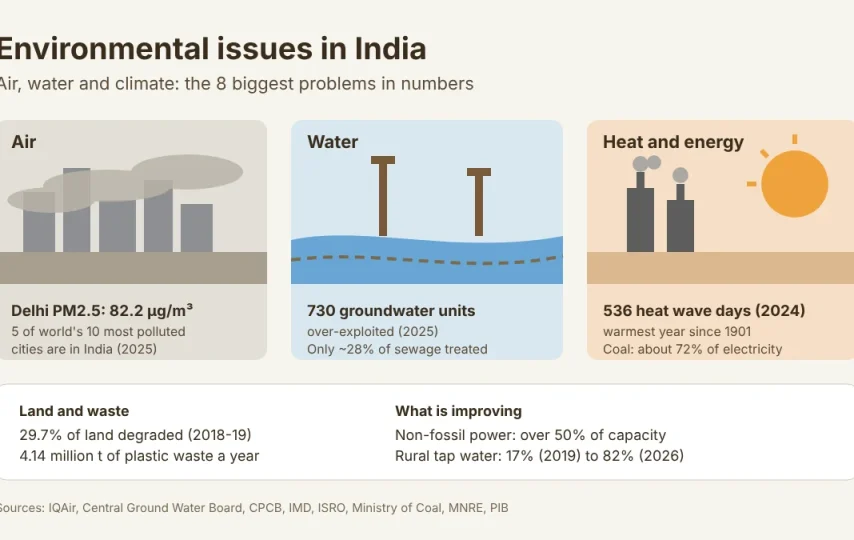

The biggest environmental issues in India are toxic air, falling groundwater, polluted rivers, growing piles of waste and plastic, extreme heat, floods and landslides, degraded land and a power system that still runs mostly on coal. The scale is unique: India has about 17% of the world’s population but only about 4% of its freshwater, according to India’s Ministry of Jal Shakti.
India became the world’s most populous country in 2023, with about 1.45 billion people in 2024, and its population is projected to peak at about 1.7 billion in the early 2060s, according to the UN World Population Prospects 2024 as reported by PTI. Below are the eight main problems with the latest figures, a summary table, what is being done and what you can do.
Top 8 Environmental Issues in India
1. Air Pollution
India’s air is among the most polluted in the world. In IQAir’s 2025 World Air Quality Report, India ranked as the 6th most polluted country, and five of the world’s 10 most polluted cities were Indian, led by Loni near Delhi with an average PM2.5 level of 112.5 µg/m³, as reported by Siasat. New Delhi was the most polluted capital at 82.2 µg/m³ (The Wire).
The health cost is enormous. The State of Global Air 2024 report attributed 2.1 million deaths in India in 2021 to air pollution, including 169,400 children under five (The South First). Sources include vehicles, industry, construction dust, coal plants, burning of household fuels and, in autumn, the burning of crop stubble in Punjab and Haryana.
2. Water Scarcity and Falling Groundwater
Groundwater is India’s lifeline: it meets about 62% of irrigation needs, 85% of rural drinking water and 50% of urban demand, according to the Press Information Bureau (PIB). The Central Ground Water Board’s 2025 assessment found that India extracts 247.22 billion cubic meters a year, 60.63% of what can be extracted sustainably, and that 730 of 6,762 assessment units (10.8%) are over-exploited, meaning more water is pumped than is recharged (PIB). Another 201 units are classed as critical.
3. River Pollution and Untreated Sewage
The Central Pollution Control Board’s 2025 report identified 296 polluted river stretches on 271 rivers, down from 351 in 2018; 25 of them are in the worst category, as summarized by Policy Edge. The main cause is sewage. Indian cities generated 72,368 million liters of sewage a day in 2021, but installed treatment capacity covered only 43.9% of it, and only about 28% was actually treated, according to CPCB data reported by Down To Earth.
4. Waste and Plastic
Indian cities produce nearly 162,000 tonnes of solid waste a day, and old dumpsites hold about 250 million tonnes of legacy waste, of which 87.7 million tonnes had been cleaned up by January 2026 (PIB). Plastic waste reached 4.14 million tonnes in 2022-23, up from 3.36 million tonnes in 2018-19, according to CPCB figures released by PIB. Plastic that is not collected ends up in drains, rivers and the sea.
5. Extreme Heat
2024 was India’s warmest year since records began in 1901, with a mean temperature 0.65°C above normal, according to the India Meteorological Department (IMD) as reported by Deccan Herald. The country logged 536 heat wave days that summer, the most in 14 years (Scroll), and official surveillance recorded 67,637 suspected heatstroke cases and 374 deaths between March 1 and July 27, 2024 (PTI via DT Next).
The long-term trend is clear. India’s average temperature rose by about 0.7°C between 1901 and 2018, and under a high-emissions scenario it could rise by about 4.4°C by 2100, according to the Ministry of Earth Sciences’ 2020 climate assessment.
6. Floods and Landslides
Monsoon downpours regularly cause deadly floods and landslides, especially in hilly areas. In the early hours of July 30, 2024, landslides after torrential rain destroyed villages in Wayanad district, Kerala. By August 26, 231 bodies had been recovered and about 119 people were still missing, according to an official situation report.
7. Land Degradation
Nearly a third of India’s land is degraded. The Desertification and Land Degradation Atlas by the Indian Space Research Organisation (ISRO) found 97.85 million hectares of degraded land in 2018-19, 29.7% of the country, up from 28.76% in 2003-05, as reported by Down To Earth. India’s target is to restore 26 million hectares by 2030.
8. Coal and Rising Emissions
India is the world’s third-largest greenhouse gas emitter after China and the U.S., and in 2024 it recorded the largest absolute increase in the G20, according to UNEP’s Emissions Gap Report 2025 as reported by Mongabay India. Its emissions per person are still below the global average. Energy-related CO2 rose 5.3% in 2024, the fastest rate among major economies (IEA).
Coal is the reason. Coal plants generate about 72% of India’s electricity, and coal production reached 1,047.5 million tonnes in 2024-25, according to the Ministry of Coal. Coal also adds to the air pollution described above.
India’s Environmental Issues at a Glance
| Issue | Key figure | Source | Trend |
|---|---|---|---|
| Air pollution | Delhi PM2.5: 82.2 µg/m³ (2025) | IQAir | Slowly improving |
| Groundwater | 730 of 6,762 units over-exploited (2025) | Central Ground Water Board | Slightly improving |
| River pollution | 296 polluted river stretches (2025 report) | CPCB | Improving |
| Sewage | About 28% of sewage treated (2021) | CPCB | Improving |
| Plastic waste | 4.14 million tonnes (2022-23) | CPCB | Growing |
| Extreme heat | 536 heat wave days (2024) | IMD | Worsening |
| Land degradation | 29.7% of land degraded (2018-19) | ISRO | Worsening |
| Coal power | About 72% of electricity | Ministry of Coal | Share slowly falling |
What Is Being Done
- Clean air plan. The National Clean Air Programme covers 130 cities and aims to cut particulate pollution by up to 40% by 2025-26. In 2024-25, 103 of those cities had lower PM10 levels than in 2017-18, but only 22 met the national standard (PIB). Stubble fires in Punjab and Haryana fell by about 90% in the 2025 season compared with 2022 (PIB).
- Tap water and river cleanup. Under the Jal Jeevan Mission, 82.09% of rural households had tap water by July 2026, up from 16.71% in 2019 (PIB). The Namami Gange program for the Ganges has completed 355 of 524 projects, with 4,050 million liters a day of sewage treatment capacity operating (PIB).
- Renewable energy. Non-fossil sources passed 50% of India’s installed power capacity in June 2025, five years ahead of its 2030 target, and reached 262.74 GW by November 2025, including 132.85 GW of solar, according to the Ministry of New and Renewable Energy. The goal is 500 GW of non-fossil capacity by 2030 and net zero by 2070.
- Plastics and forests. A ban on identified single-use plastic items took effect on July 1, 2022. Forest and tree cover reached 25.17% of India’s area in 2023 (Forest Survey of India via PIB), and India’s 3,682 tigers are about 70% of the world’s wild tigers (PIB).
Installed capacity is not the same as generation. Non-fossil sources make up more than half of India’s power plant capacity, but because solar and wind run only part of the day, coal still produces most of the electricity.
What You Can Do
From the U.S., India’s environment can feel distant, but the same choices matter everywhere:
- Follow the data, not the headlines. IQAir rankings, CPCB reports and IMD bulletins are public and updated regularly, and they show both the problems and the progress.
- Support cleaner supply chains. Many clothes and consumer goods sold in the U.S. are made in India; brands that publish factory-level data on water and energy use give you a way to choose.
- Compare countries. Our overview of global environmental issues puts India in world context, while our articles on environmental issues in Canada and environmental issues in Brazil show how other large countries differ. For a school project, our guide to human-environment interaction explains the framework.
Frequently Asked Questions
What is the biggest environmental issue in India?
Air pollution. It was linked to 2.1 million deaths in India in 2021, according to the State of Global Air 2024 report, and five of the world’s 10 most polluted cities in 2025 were Indian.
Why is India's air so polluted?
A mix of sources: vehicles, industry, coal power plants, construction dust, household cooking fuels and seasonal crop burning. In winter, cold, still air traps the pollution over northern India, especially around Delhi.
Is India running out of water?
Not nationally, but many areas are. India uses about 60% of its sustainably extractable groundwater on average, yet 730 assessment units, about 11%, pump more than nature replaces.
Is India doing anything about climate change?
Yes. More than half of its power capacity is now non-fossil, ahead of its 2030 target, and it aims for net zero by 2070. But coal still generates about 72% of its electricity, and emissions are still rising.


