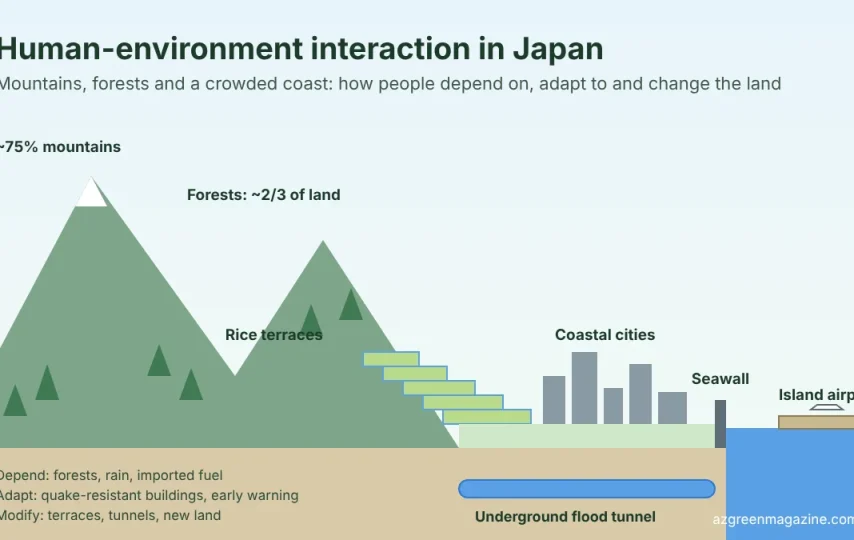

Human-environment interaction in Japan is shaped by one hard fact: about three-quarters of the country is mountains, according to Japan’s Ministry of Land, Infrastructure, Transport and Tourism (MLIT). People crowd onto narrow coastal plains, depend on forests, rain and imported fuel, adapt to earthquakes, tsunamis and floods, and modify the land by terracing hillsides and building islands in the sea.
This guide uses the three types of human-environment interaction (dependence, adaptation and modification) to explain Japan with 10 real examples and current data.
Japan’s Environment at a Glance
| Feature | Key figure | Source |
|---|---|---|
| Mountainous land | About 75% of the country | MLIT |
| Forest cover | About two-thirds of the land (25 million hectares) | Forestry Agency |
| Large earthquakes | 18.5% of the world’s M6+ quakes on 0.28% of its land | 2014 disaster management white paper |
| Active volcanoes | 7% of the world’s total | 2014 disaster management white paper |
| Energy self-sufficiency | 15.3% (fiscal 2023) | METI |
| Renewable share of electricity | 22.9% (fiscal 2023, incl. hydro) | METI |
How People in Japan Depend on the Environment
1. Forests that cover two-thirds of the country
Forests cover about two-thirds of Japan’s land, or roughly 25.05 million hectares as of 2017, according to the Forestry Agency’s survey summarized by Nippon.com. About 40% of that is planted forest. The forests also protect the steep slopes that most of the country is made of: they slow rainwater and hold soil in place.
2. Rain and short, steep rivers
Japan gets almost twice the world’s average annual precipitation, but because so many people live on so little land, the water available per person is only about one-sixth of the world average, MLIT notes. Its rivers are short and steep, so they rise and fall quickly: peak flows relative to basin size are 10 to 100 times those of large continental rivers. People depend on this water for rice paddies, cities and hydropower, but must also defend against it.
3. Imported energy
Japan has few fossil fuel resources of its own. In fiscal 2023, its energy self-sufficiency rate was 15.3%, according to the Ministry of Economy, Trade and Industry (METI). Thermal power plants still produced 68.6% of electricity, renewables including hydropower 22.9% and nuclear 8.5%. This dependence on imported fuel is a big reason Japan invests in alternatives such as hydrogen cars.
How People in Japan Adapt to the Environment
4. Earthquake-resistant buildings
Japan records 18.5% of the world’s earthquakes of magnitude 6 or greater, although it covers only 0.28% of the world’s land, according to a 2014 government white paper on disaster management cited by Nippon.com. The country adapts through its building law. The current “New Earthquake Resistance Standard” dates from a 1981 revision of the Building Standard Act, and later amendments followed major earthquakes, the Japan Concrete Institute explains.
5. Earthquake early warning
Since about 2007, a national network of roughly 1,000 seismic stations has detected the first, weaker waves of an earthquake and sent alerts before the stronger shaking arrives, IEEE Spectrum reports. On March 11, 2011, people in the Tohoku region got about 10 to 30 seconds of warning, and Tokyo residents about a minute. Alerts go out through TV, radio and phones, and can automatically stop elevators, computers and factory lines.
6. Living with tsunamis
The magnitude 9.0 earthquake and tsunami of March 11, 2011, killed 15,901 people, and 2,519 were still listed as missing 15 years later, according to National Police Agency figures reported by Nippon.com. The tsunami destroyed or damaged about 190 km of the roughly 300 km of coastal levees in Iwate, Miyagi and Fukushima, and at its peak about 470,000 people were evacuated, the Reconstruction Agency reports. Coastal levees are a modification of the shoreline; warning systems and evacuation plans are the adaptation side of the same problem.
The same disaster caused the Fukushima Daiichi nuclear accident, which still shapes Japan’s energy debate. In fiscal 2023, nuclear power supplied only 8.5% of the country’s electricity, according to METI. One natural event can reshape a country’s energy choices for decades.
How People in Japan Modify the Environment
7. Rice terraces on the hillsides
With little flat land, farmers carved paddies into slopes. At Shiroyone Senmaida on the Noto Peninsula, more than 1,000 small rice fields step down to the sea, according to Japan’s tourism database at MLIT. The fields are too small and steep for machines, so they are still worked by hand, and they also act as small dams for water and sediment. The Noto Peninsula was designated a Globally Important Agricultural Heritage System in 2011.
8. Flood tunnels under Tokyo
Because about half of Japan’s population and three-quarters of its assets were located in river flood zones (MLIT, 1985 data), the country builds big flood defenses. The best known is the Metropolitan Area Outer Underground Discharge Channel north of Tokyo, built between 1993 and 2006, according to MLIT’s Edogawa River office. Its 6.4 km of tunnels run about 50 m underground and pumps can send up to 200 tons of water per second into the Edo River.
9. Islands built in the sea
When there is no room on land, Japan builds new land. Kansai International Airport opened in September 1994 on an artificial island about 5 km off the coast in Osaka Bay, the Institution of Civil Engineers notes. The soft seabed compressed under its weight: the island sank about 50 cm a year at first and about 7 cm a year by 2008, and costs rose from $14 billion to $20 billion. It is a clear example of the environment pushing back.
10. Industrial pollution and Minamata disease
The most painful example of negative human-environment interaction in Japan is Minamata disease. A chemical plant of Chisso Co. in Minamata City discharged methylmercury, a by-product of acetaldehyde production, with its wastewater; it built up in fish and shellfish, and people who ate them were poisoned. The first patient was reported in 1956, and the government officially recognized the cause in 1968, according to Japan’s Ministry of the Environment. By March 2001, 2,955 patients had been officially certified across two outbreaks. Japan’s experience led to a global treaty: the Minamata Convention on Mercury, adopted in Kumamoto in October 2013 and in force since August 2017, according to UNEP.
What Japan Shows About Human-Environment Interaction
Japan is a useful case study because the three types of interaction are so easy to see. People depend on forests, rain and imported fuel; adapt with building codes, warning systems and evacuation plans; and modify the land with terraces, tunnels and artificial islands. The results run both ways: some changes, such as flood tunnels, protect people, while others, such as the mercury pollution in Minamata or the sinking airport island, came back to harm them or cost far more than planned.
For a school project on the five themes of geography, use the table above for “place,” then pick one example from each section here for “human-environment interaction”: forests (dependence), earthquake building rules (adaptation) and rice terraces or flood tunnels (modification).
For a wider view of environmental problems around the world, see our guide to global environmental issues.
Frequently Asked Questions
How do people in Japan adapt to their environment?
They build to strict earthquake standards (the current one dates from 1981), use a nationwide earthquake early warning system and protect coasts with levees and evacuation plans. Farmers adapt to steep terrain by growing rice on terraces.
How have humans modified the environment in Japan?
By terracing hillsides for rice, planting forests, building dams and underground flood channels, and creating new land in the sea, such as the artificial island of Kansai International Airport.
What natural resources does Japan depend on?
Mainly forests, which cover about two-thirds of the land, and abundant rain and rivers for farming, drinking water and hydropower. Japan imports most of its energy: its self-sufficiency rate was 15.3% in fiscal 2023.
What is a negative example of human-environment interaction in Japan?
Minamata disease. Methylmercury discharged by a chemical plant poisoned fish and the people who ate them; the first case was reported in 1956, and the government recognized the cause in 1968.
Why do so many people in Japan live on the coast?
About three-quarters of the country is mountainous, so cities, farms and industry are concentrated on the narrow coastal plains and river valleys, which also exposes them to tsunamis and floods.


