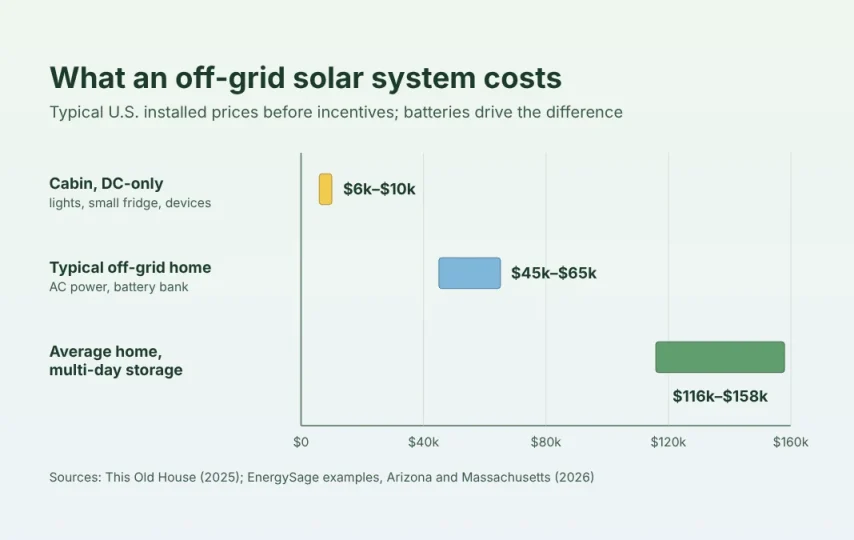

How much does an off-grid solar system cost? In the U.S., a small DC-only system for a cabin or tiny house costs about $6,000–$10,000 installed, a typical off-grid home system runs about $45,000–$65,000, according to This Old House, and a system that covers an average-size home with several days of battery backup often costs $115,000 or more, according to EnergySage. The battery bank is the main reason off-grid solar costs two to three times as much as a grid-tied system of the same size.
Below we explain where those numbers come from, what each component costs, how to size a system for your own home and when going off-grid makes financial sense.
Off-Grid Solar System Cost by System Size
Estimates vary widely because sources assume different amounts of battery storage. The biggest difference is how many days your home must run on batteries alone.
| System | What it powers | Typical installed cost | Source |
|---|---|---|---|
| DC-only system | Cabin, tiny house, RV: lights, small fridge, electronics | $6,000–$10,000 | This Old House (2025) |
| 3 kW system | Small, efficient home | $30,000–$35,000 | HomeGuide |
| 5–10 kW system | Typical off-grid home | $40,000–$80,000 | HomeGuide |
| Average off-grid home | Whole home, AC power, battery bank | $45,000–$65,000 | This Old House (2025) |
| 13.6 kW + about 119 kWh of storage | Average-size Arizona home, about 30 kWh a day, multi-day backup | $115,945 | EnergySage (2026) |
| 10.8 kW + about 162 kWh of storage | Average-size Massachusetts home, multi-day backup | $157,949 | EnergySage (2026) |
Sources: This Old House, HomeGuide, EnergySage. Prices before incentives.
EnergySage’s examples use installed Tesla Powerwall batteries and enough storage for several cloudy days, which is why they are far higher. In the same examples, a grid-tied system for the same homes cost $44,139 in Arizona and $45,208 in Massachusetts, so the off-grid version cost roughly 2.6 to 3.5 times as much (EnergySage).
DIY kits cost much less than installed systems. EnergySage lists examples such as an ECO-WORTHY 2.34 kW kit at $3,599 and an EG4 shed and garage kit at $8,504, but kits do not include installation, permits, mounting labor or, often, enough battery for a whole home. See our picks of the best off-grid solar systems for complete kits from cabins to whole houses.
What Makes Up the Cost
Batteries are the largest single expense in most off-grid systems. The median installed cost of home battery storage was $1,130 per kWh in the first half of 2026, according to EnergySage’s H1 2026 market report. At that rate, 30 kWh of storage costs about $34,000 and 100 kWh about $113,000 (our own calculation). DIY LiFePO4 server-rack batteries cost far less per kWh but do not include installation. Lead-acid batteries are cheaper up front, about $100–$300 per kWh according to ConsumerAffairs, but last only about 3–7 years and need regular maintenance.
Solar panels are a small part of the bill. Panels make up about 12% of the cost of a typical grid-tied installation, according to EnergySage, and HomeGuide puts panels alone at about $0.80–$1.80 per watt.
Inverter and charge controller. An off-grid inverter-charger costs about $1,500–$3,000 or more and a charge controller $100–$1,000, according to HomeGuide. Split-phase inverters that supply 240 V for well pumps and dryers sit at the top of that range.
Installation, permits and design. Labor is about 7–10% of the installed cost, typically $3,000–$8,000 for a 5–10 kW system (HomeGuide). NREL’s cost model for a residential battery adds about $1,600 for permitting, inspection and interconnection (NREL ATB).
Backup generator. Most full-time off-grid homes keep a generator for long cloudy spells. HomeGuide estimates $6,000–$11,000 for an installed whole-house generator.
For comparison, a grid-tied system cost a median $2.57 per watt in the first half of 2026, according to EnergySage, with an average system of about 12 kW costing about $31,000 before incentives.
The federal 30% Residential Clean Energy Credit (25D) has ended. The IRS says the credit is not allowed for expenditures made after December 31, 2025, and an expenditure counts as made when installation is complete (IRS). Many cost guides still subtract 30%; ignore that and check current state and local programs.
How to Estimate the Cost of Your Own System
The price depends on three numbers: your daily energy use, your winter sunshine and how many days of battery backup you want.
- Daily use. The average U.S. home used about 865 kWh a month in 2024, according to the EIA, or about 28.5 kWh a day. Your utility bills give your own figure.
- Array size. Divide daily use by your peak sun hours (the daily solar energy at your site expressed as hours of full 1 kW/m² sunlight, as PVEducation explains) and allow about 15% for losses. NREL’s PVWatts gives monthly figures for your address.
- Battery size. Multiply daily use by the days of autonomy you want and divide by the usable depth of discharge. Penn State’s solar design course shows that about three days of storage gives roughly 95% availability in a sunny location (Penn State AE 868).
Worked example (our own calculation): 28.5 kWh a day ÷ 4 peak sun hours ÷ 0.85 ≈ 8.4 kW of panels. Battery: 28.5 kWh × 3 days ÷ 0.8 usable ≈ 107 kWh. At EnergySage’s median of $1,130 per kWh, that battery alone would cost about $121,000 installed, which is why off-grid homes that start from average consumption reach six figures.
Cutting your daily load is the cheapest way to lower the cost. Every kWh a day you save removes about 3.75 kWh of battery capacity in the example above (3 days ÷ 0.8). Switching to propane or wood heat, a heat-pump water heater and efficient appliances often costs less than the batteries they replace.
Battery Replacement and Running Costs
An off-grid system is not a one-time purchase. Most solar batteries last 10–15 years and carry a 10-year warranty that typically guarantees 60–70% of the original capacity at the end, according to EnergySage. Off-grid batteries cycle every day, so they reach their warranty’s cycle limit sooner than backup batteries in grid-tied homes. NREL’s cost model assumes a 15-year life and annual operating costs of a few percent of the capital cost (NREL ATB).
Lead-acid banks need distilled water, equalizing charges and terminal cleaning, and ConsumerAffairs estimates their 10-year cost at $2,000–$9,000 including one or two replacements, compared with $7,000–$13,000 for lithium-ion that needs none (ConsumerAffairs).
Is Off-Grid Solar Worth It?
For most homes that already have a power line, no: a grid-tied system costs a fraction as much and uses the grid as free storage. Off-grid solar makes financial sense mainly when connecting to the grid is expensive. Angi estimates that running a new overhead power line costs about $40,000–$80,000 per mile and an underground line $50,000–$150,000 per mile (Angi); your utility’s line-extension rules decide the real figure. For a remote cabin used part-time, a small DC system or a power station with panels is often the cheapest way to get electricity at all.
If you want backup power rather than independence, a grid-tied system with a home battery gives you outage protection at a much lower cost. Before you commit, compare the off-grid quote with the utility’s written estimate for a line extension, and size the system for your winter months. Our guide to how many solar panels you need walks through array sizing, and the flexible vs rigid solar panels comparison helps for cabins and RVs.
Frequently Asked Questions
How much does an off-grid solar system cost for a 2,000 sq ft house?
Square footage matters less than energy use. A 2,000 sq ft home using the U.S. average of about 28 kWh a day typically needs 8–10 kW of panels and a large battery bank; installed estimates range from about $45,000–$80,000 for systems with modest storage to $115,000 or more with several days of backup.
Is there a tax credit for off-grid solar in 2026?
Not at the federal level. The 30% Residential Clean Energy Credit does not apply to systems installed after December 31, 2025, according to the IRS. Some states and utilities still offer incentives, so check current rules where you live.
Can I build an off-grid solar system myself to save money?
DIY kits cost a fraction of an installed system, and a cabin system can be a DIY project. For a home, most jurisdictions require permits and inspections, battery systems must meet fire-code limits, and connecting to a home’s wiring should be done by a licensed electrician.
What is the most expensive part of an off-grid solar system?
The battery bank. At a median of $1,130 per kWh installed in early 2026, storage for one to three days of an average home’s use usually costs more than the panels, inverter and labor combined (our own comparison of the estimates above).


