As an Amazon Associate, we earn from qualifying purchases. This doesn’t affect our recommendations.
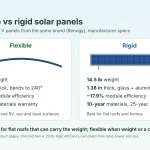
The best flexible solar panels are the ones whose voltage matches your charge controller and whose bend limit fits your roof: a 12-volt 100-watt panel like the Renogy 100W Flexible works with almost any RV or boat system, while higher-voltage panels such as CIGS thin-film need an MPPT controller to charge a 12-volt battery efficiently. Flexible panels are much lighter than framed ones (Renogy’s 100 W flexible panel weighs about 37% as much as its framed 100 W panel), but they come with shorter warranties.
Below are six flexible solar panels and kits that are currently listed by U.S. retailers, plus how to size and mount them.
Quick picks
- Best overall: Renogy 100W Flexible Solar Panel — 12-volt panel that bends up to 240 degrees
- Best complete kit: Go Power! Solar Flex Kit GP-FLEX-220 — two 110 W panels with a 30-amp Bluetooth controller
- Best peel-and-stick: BougeRV Yuma 100W CIGS Thin-Film Panel with Tape — thin-film panel with adhesive backing and a 10-year product warranty
- Best for partial shade: Renogy Flex ShadowFlux 200W — N-type cells with 30 bypass diodes
- Best for EcoFlow power stations: EcoFlow 100W Flexible Solar Panel — comes with a solar-to-XT60 cable
- Best ETFE surface: ALLPOWERS SF100 100W Flexible Solar Panel — ETFE top layer and IP68 rating
Comparison Table
| Model | Rated power | Weight | Max bend | Voltage at max power (Vmp) | Warranty | Best for |
|---|---|---|---|---|---|---|
| Renogy 100W Flexible | 100 W | 5.3 lb | 240° | 20.7 V | 5 years | Most 12 V RV and boat systems |
| Go Power! GP-FLEX-220 | 2 × 110 W | 2.9 lb per panel | 30° | not listed (Voc 21.0 V) | 5-year output | A complete RV kit |
| BougeRV Yuma 100W CIGS (tape) | 100 W | 4.54 lb | 9.4 in bend diameter | 24 V | 10-year product, 25-year performance | No-drill installs on curved roofs |
| Renogy Flex ShadowFlux 200W | 200 W | 7.72 lb | 270° | 37.8 V | 3 years | Roofs with vents, racks or shade |
| EcoFlow 100W Flexible | 100 W | 5.1 lb | 258° | 17.1 V | 3 years | EcoFlow power stations |
| ALLPOWERS SF100 | 100 W | 5.29 lb | “U-shape” | 25.5 V | 2 years | Wet and marine conditions |
Specs are manufacturer-rated or as listed by authorized retailers; checked on November 4, 2026.
Our Picks
1. Renogy 100W Flexible Solar Panel: Best Overall
Renogy’s 100-watt flexible panel is the safe default for an RV, van or small boat with a 12-volt battery. Its voltage at maximum power is 20.7 V, so it works with both PWM and MPPT controllers, and at 0.08 inch thin it bends up to 240 degrees to follow a curved roof, according to Renogy’s specifications (Renogy 100W Flexible on Amazon). For comparison, Renogy lists its framed 100-watt panel at 14.5 lb, almost three times as much.
Key specs
- Rated power: 100 W (±3%); Vmp 20.7 V, Voc 24.4 V
- Weight: 5.3 lb; size 43.0 × 22.9 × 0.1 in
- Bend: up to 240 degrees
- IP67 junction box and connectors
- Warranty: 5 years output and materials; at least 90% of output within 5 years
Pros
- Works with almost any 12-volt controller
- Very thin and light for a 100 W panel
- Widely sold, so replacement panels are easy to match
Cons
- Module efficiency is 15.7% in Renogy’s spec table, below the ShadowFlux, ALLPOWERS and Go Power panels
- Shown as backordered on Renogy’s own store on November 4, 2026
- Warranty is half of Renogy’s 10-year materials warranty on its framed panels
2. Go Power! Solar Flex Kit GP-FLEX-220: Best Complete Kit
If you want everything in one box, Go Power’s Solar Flex kit pairs two 110-watt flexible panels with a 30-amp PWM controller that has Bluetooth, plus connectors and mounting hardware (Go Power spec sheet). Go Power also sells the same panel as a 110 W expansion kit, so you can add panels later without changing the controller as long as the total current stays within its 30-amp limit, according to retailer listings.
Key specs
- Rated power: 220 W (two 110 W panels); Voc 21.0 V, Isc 6.31 A per panel
- Weight: 2.9 lb per panel; size 44.6 × 21.4 × 0.1 in
- Bend: 30 degrees maximum recommended
- Controller: GP-PWM-30, 30 A, Bluetooth
- Warranty: 5-year output warranty
Pros
- Panels, controller and hardware in one kit
- Lightest panels on this list per watt
- Expansion panels available from the same brand
Cons
- Only 30 degrees of bend, much less than the other picks
- PWM controller, not MPPT
- Panels are 110 W each, so a large array needs many panels
3. BougeRV Yuma 100W CIGS Thin-Film Panel with Tape: Best Peel-and-Stick
BougeRV’s Yuma uses CIGS (copper indium gallium selenide) thin-film cells instead of silicon wafers, which lets the panel bend to a 9.4-inch diameter. The compact version has pre-applied adhesive, so you can mount it without drilling, and BougeRV says the glue holds at highway speeds (BougeRV Yuma on Amazon). Its 10-year product warranty is the longest on this list.
Key specs
- Rated power: 100 W (±5%); Vmp 24 V, Voc 30.5 V
- Cell efficiency: 17%
- Weight: 4.54 lb; thickness 0.06 in
- Bend: down to a 9.4-inch diameter
- Warranty: 10-year product, 25-year performance
Pros
- No drilling or brackets
- Longest warranty of the group
Cons
- At 24 V Vmp, it needs an MPPT controller to charge a 12 V battery efficiently
- BougeRV’s claim of up to 38% more energy on cloudy days than monocrystalline panels gives no test details beyond an 8-hour cloudy day
- The long version with pre-punched holes was sold out on BougeRV’s store on November 4, 2026
4. Renogy Flex ShadowFlux 200W: Best for Partial Shade
RV roofs are crowded with vents, air conditioners and racks that cast shadows. Renogy’s ShadowFlux flexible panel uses N-type cells and 30 bypass diodes, and Renogy says lab tests of the 200 W panel under simulated partial shade kept up to 85% of output (Renogy Flex ShadowFlux 200W on Amazon). Renogy lists up to 25% cell efficiency; the 200 W panel measures 62.2 × 27.4 inches. A 100 W version is also available.
Key specs
- Rated power: 200 W; Vmp 37.8 V, Voc 44.1 V
- Cell efficiency: up to 25%
- Weight: 7.72 lb; thickness 0.1 in
- Bend: up to 270 degrees
- IP68; warranty: 3 years
Pros
- Most watts per square foot on this list
- Designed for partial shade
- 200 W in one panel means fewer roof penetrations and cables
Cons
- 37.8 V Vmp requires an MPPT controller for a 12 V battery
- 3-year warranty
- The 200 W panel was backordered on Renogy’s store on November 4, 2026
5. EcoFlow 100W Flexible Solar Panel: Best for EcoFlow Power Stations
If your battery is an EcoFlow portable power station rather than a fixed RV battery bank, EcoFlow’s flexible panel is the simplest match: it comes with a solar-to-XT60 charging cable (EcoFlow 100W Flexible on Amazon). Retailers list a 23% efficiency rating; it flexes up to 258 degrees and carries an IP68 waterproof rating.
Key specs
- Rated power: 100 W (±5 W); Vmp 17.1 V, Voc 20.3 V
- Efficiency: 23% (as listed by retailers)
- Weight: 5.1 lb; listed size 41.5 × 24.1 in
- Bend: up to 258 degrees
- IP68; warranty: 3 years
Pros
- Plugs straight into EcoFlow power stations
- Low voltage also suits 12 V systems with a PWM controller
Cons
- Short 3.3-foot cable
- Backordered at some retailers (Adorama expected stock on December 14, 2026)
- Not much reason to choose it if you do not own an EcoFlow
6. ALLPOWERS SF100 100W Flexible Solar Panel: Best ETFE Surface
The ALLPOWERS SF100 has a honeycomb-textured ETFE surface and is rated IP68, which suits boats and other wet locations, according to ALLPOWERS (ALLPOWERS SF100 on Amazon). ALLPOWERS rates its cells at 22% to 25% efficiency and says the panel can bend into a U shape.
Key specs
- Rated power: 100 W (±5%); Vmp 25.5 V, Voc 30.6 V
- Weight: 5.29 lb; size 39.68 × 22.83 × 0.11 in
- ETFE surface; IP68
- MC4 connectors
- Warranty: 2 years
Pros
- ETFE top layer
- Works with power stations and MC4 systems
- Compact for 100 W
Cons
- 25.5 V Vmp needs an MPPT controller for a 12 V battery
- 2-year warranty
- Listed as pre-order on the ALLPOWERS store on November 4, 2026
How to Choose a Flexible Solar Panel
Flexible or rigid?
Choose flexible only when weight, a curved surface or a no-drill install matters. Renogy, which sells both, says rigid panels are the better choice for flat roofs, maximum output and long-term durability (Renogy). We compare the two in detail in flexible vs rigid solar panels.
Match the voltage to your controller
Check the panel’s voltage at maximum power (Vmp). A PWM controller pulls the panel’s voltage down to near the battery’s voltage, and Victron Energy calls PWM “a good low cost solution for small systems only” (Victron Energy). Low-voltage panels (Renogy 100W at 20.7 V Vmp, EcoFlow at 17.1 V, Go Power at 21.0 V open-circuit) work with either type. Panels at 24 V or more (BougeRV CIGS, ALLPOWERS, ShadowFlux) need an MPPT controller to use their full output on a 12 V battery.
Respect the bend limit
The bend figures in the table are maximums. Go Power recommends no more than 30 degrees; Renogy’s and EcoFlow’s panels are rated for far more. Measure the curve of your roof first and pick a panel rated for it.
Plan for heat
Flexible panels sit flat on the roof with no air gap, so they run hotter. Renogy says this causes “more heat buildup when installed flush” and notes that some flexible installs use a mounting method that creates an air gap beneath the panel (Renogy). In an older field report it suggested a thin layer such as 1/4-inch corrugated plastic under the panel to let air flow (Renogy).
Compare warranties
Warranties on the panels above range from 2 to 10 years. Renogy’s framed 100 W panel, by comparison, has a 10-year materials warranty and a 25-year power warranty, according to Renogy. Compare the materials warranty and the power warranty separately: they cover different failures.
Size the system to your daily use
A rough daily estimate is panel watts × peak sun hours × 0.86, where 0.86 reflects the 14% default system losses in NREL’s PVWatts model (NREL PVWatts manual). Peak sun hours depend on your location and season; NREL’s PVWatts calculator gives them for any U.S. address. Flat mounting and heat can reduce output further, while a fixed home array also depends on its tilt and direction (see our solar panel direction by ZIP code tool).
| Panel power | 3 peak sun hours | 4 peak sun hours | 5 peak sun hours |
|---|---|---|---|
| 100 W | about 258 Wh/day | about 344 Wh/day | about 430 Wh/day |
| 200 W | about 516 Wh/day | about 688 Wh/day | about 860 Wh/day |
| 400 W | about 1,032 Wh/day | about 1,376 Wh/day | about 1,720 Wh/day |
Add up the watt-hours your devices use per day and pick a panel size that covers them with some margin. For a whole off-grid home rather than an RV, see our guide to the best off-grid solar systems.
Fuse the wiring between panel, controller and battery as the manufacturer’s manual specifies, and use a licensed electrician for any connection to a home’s electrical system.
How We Chose
We compared manufacturer spec sheets, authorized retailer listings and warranty terms, and kept only panels that are currently listed by U.S. retailers. We did not test these products ourselves. The models in the earlier version of this article were replaced: the SunPower 110W flexible panel is listed as discontinued by retailers, and the other 2021 picks (Uni-Solar 136W, Renogy 175W, ALLPOWERS 50W, XINPUGUANG 200W, Rich Solar 300W and Solar Cynergy 120W) were dropped in favor of current models. All listings were checked on November 4, 2026.
Frequently Asked Questions
Are flexible solar panels any good?
Yes, for the right job. They are much lighter than framed panels and can follow curved RV, van and boat surfaces, but they usually run hotter when mounted flat and carry shorter warranties (2 to 10 years for the panels above). For a flat roof that can carry the weight, a rigid panel is usually the better long-term buy.
How long do flexible solar panels last?
Manufacturers do not publish lifespans, but warranties give a guide: 2 to 5 years for most silicon flexible panels on this list and 10 years for BougeRV’s CIGS panel. Renogy’s framed panel, by comparison, has a 10-year materials and a 25-year power warranty. Mounting with an air gap and staying within the bend limit help a flexible panel last longer.
What is in a flexible solar panel kit?
A kit usually includes one or more panels, a charge controller, cables and connectors, and mounting hardware. The Go Power! GP-FLEX-220, for example, includes two 110 W panels, a 30 A PWM controller with Bluetooth, connectors and hardware. A battery and an inverter are usually sold separately.
Do flexible solar panels work on boats?
Yes, if the panel is built for wet conditions. Their light weight and bend let them fit curved decks and hard tops where a framed panel would not. Look for an IP67 or IP68 rating and corrosion-resistant connectors, and keep the panel within its bend limit.

We send one email a week. No spam. Unsubscribe anytime. See our Privacy Policy.