Hydropower pros and cons come down to a clear trade-off. On the plus side, hydroelectric plants run on a renewable resource, have some of the lowest life-cycle emissions of any power source, last for decades and can ramp up within minutes when the grid needs power. On the minus side, dams change entire rivers: they block migrating fish, flood land and sometimes towns, cost a lot to build, and produce less electricity in dry years.
Below we explain how hydropower works, go through six advantages and six disadvantages with current data, and look at what the trade-off means today.
How Does Hydropower Work?
A hydroelectric plant turns the energy of falling or flowing water into electricity. According to the U.S. Energy Information Administration (EIA), water flows through a pipe called a penstock, pushes against the blades of a turbine and spins a generator. How much power a plant makes depends on two things: the volume of water flowing and the “head,” the height the water drops.
There are three main types of plants:
- Storage (reservoir) plants. A dam holds back a river and creates a lake; operators release water through the turbines when they need power. Most U.S. hydropower plants are this type.
- Run-of-river plants. The river’s natural current turns the turbines, often with a small weir that diverts part of the flow. There is little or no reservoir.
- Pumped storage plants. Water is pumped uphill to a reservoir when electricity is cheap and released through turbines when demand is high. These plants work like a giant battery and use more electricity than they produce.
In 2025, conventional hydropower supplied about 5.6% of all U.S. utility-scale electricity and 23.1% of renewable electricity, the EIA reports. Worldwide it is still the largest renewable source: hydro produced 14.3% of global electricity in 2024, more than wind (8.1%) or solar (6.9%), according to Ember’s Global Electricity Review 2025.
Advantages of Hydropower
1. Renewable fuel that is free
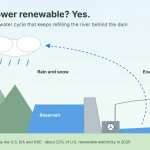
Hydropower uses water that the sun keeps recycling through evaporation, rain and snow. The U.S. Department of Energy (DOE) calls it a renewable, domestic source of energy: a plant does not burn fuel, so its operating costs do not depend on coal, oil or gas prices. We explain the details, and the caveats, in is hydropower renewable?
2. Very low life-cycle emissions
A running hydro plant emits no smoke. Building the dam takes a lot of concrete and steel, and some reservoirs release methane as flooded plants decompose, but over the whole life cycle the total stays low. The Intergovernmental Panel on Climate Change (IPCC) puts the median for hydropower at about 24 grams of CO2-equivalent per kilowatt-hour, compared with about 490 g for natural gas, as summarized by the International Hydropower Association. Only wind and nuclear have lower medians in the IPCC’s assessment.
3. Flexible power on demand
This is hydropower’s biggest advantage over wind and solar. A storage plant can go from zero to full output quickly, the DOE notes, which makes it a backup when other plants trip offline. The DOE estimates U.S. hydropower’s firm capacity at more than 24 gigawatts (GW), enough for about 16 to 24 million homes, and says replacing that capability would take 24 GW of 10-hour storage (DOE Hydropower Basics).
4. Large-scale energy storage
Pumped storage plants soak up surplus power and give it back hours later. The U.S. had about 23,156 megawatts (MW) of pumped storage capacity in 18 states in 2025, led by California, Virginia and South Carolina (EIA). Battery storage is growing faster, reaching nearly 52 GW of capacity by mid-2026 according to the EIA, but most batteries discharge for a few hours, while large reservoirs can store much more energy.
5. Plants last for generations
Hydropower facilities typically operate for 65 to 85 years, according to the DOE, and the EIA puts a plant’s life at 50 to 100 years. Many U.S. dams were built before the mid-1970s and are still producing power. Over that time, the emissions from the original construction are spread across decades of output. The global weighted average cost of electricity from new hydro plants was $0.057 per kilowatt-hour in 2024, according to IRENA.
6. Water benefits beyond electricity
Reservoirs often do several jobs at once. The DOE lists flood control, irrigation support and drinking water supply among hydropower’s benefits, and nearly 700 U.S. hydropower plants have reservoirs that offer some form of recreation, such as boating, fishing and swimming (DOE).
Disadvantages of Hydropower
1. Dams block and kill fish
Dams cut rivers into pieces. Salmon, shad and other fish that swim upstream from the sea to spawn can no longer reach their habitat, and the EIA notes that turbines kill or injure some of the fish that pass through them: about 5% to 10% even for the best existing designs. Fish ladders and elevators help but do not fully solve the problem. The most dramatic fix is removal: four large dams on the Klamath River in California and Oregon were taken down by 2024, reopening more than 400 miles of habitat to salmon, steelhead and lamprey (NOAA Fisheries).
2. Rivers and ecosystems change
“A dam and reservoir can change natural water temperatures, water chemistry, river flow characteristics, and silt loads,” the EIA explains. Downstream, the river may carry less sediment and colder or warmer water than the species living there are adapted to, and the effects can reach far beyond the reservoir itself.
3. Flooded land and displaced communities
A reservoir covers whatever was in the valley: forests, farmland, archaeological sites and sometimes towns. The EIA notes that building a dam may require relocating people. On very large projects abroad, this has meant moving whole communities, which is one of the main reasons new large dams are controversial.
4. Output depends on rain and snow
Hydropower is only as reliable as the water supply. Western U.S. hydropower fell to a 22-year low in the 2022–23 water year, down 11% from the year before, and Washington’s output dropped 23% (EIA, 2024). In late 2024 the EIA forecast that U.S. hydropower generation for the year would be 13% below the 10-year average and the lowest since 2001, as drought spread across most of the country (EIA). In dry years, utilities replace the missing hydro with other plants, often gas.
5. High upfront cost and long build times
A dam is a huge civil engineering project. IRENA’s data put the global average installed cost of new hydropower at about $2,267 per kilowatt in 2024, up 52% since 2010, while the costs of solar and wind fell sharply over the same period (IRENA). Permitting, environmental review and construction can take many years, so new large dams are rare in the U.S.
6. Limited room for new large dams
Most of the best U.S. sites were developed decades ago. There is still potential at existing dams: fewer than 3% of the country’s more than 90,000 dams produce power, according to the DOE, and the agency estimated in 2012 that about 12,000 MW could be added at non-powered dams (EIA). But building a brand-new large reservoir on a free-flowing river is now the exception rather than the rule.
Hydropower Pros and Cons at a Glance
| Pros | Cons |
|---|---|
| Renewable, no fuel cost | Blocks fish migration; turbines kill 5–10% of fish passing through |
| About 24 g CO2e/kWh over the life cycle (IPCC median) | Changes river temperature, flow and sediment |
| Ramps up quickly; over 24 GW of firm U.S. capacity | Floods land; may displace communities |
| Pumped storage: about 23 GW in the U.S. | Output drops in droughts (2023–2024 lows) |
| Plants last 65–85 years or more | High upfront cost: about $2,267/kW globally in 2024 |
| Flood control, irrigation, drinking water, recreation | Few good sites left for new large dams |
Is Hydropower Good or Bad Overall?
For the power grid, existing hydropower is hard to replace. It is low-carbon, it can follow demand minute by minute, and pumped storage helps absorb the growing output of wind and solar. That is why most of the U.S. debate is about keeping and modernizing existing plants rather than building new large dams.
For rivers, the cost is real and long-lasting. Every dam is a trade-off between electricity, water supply and the health of a river, and in some cases, as on the Klamath, communities have decided the river is worth more without the dam.
“Renewable” and “harmless” are not the same thing. Hydropower is renewable because its fuel, water moved by the sun, keeps coming back. Its environmental impact depends on the size of the dam, where it is built and how it is operated.
If you are comparing energy sources, see our look at wind energy pros and cons, which has the opposite profile: almost no impact on rivers, but output that varies with the weather.
The Future of Hydropower
The DOE’s analysis suggests U.S. hydropower capacity could grow by about 50%, to about 150 GW, by 2050, mainly through new pumped storage, upgrades to existing plants and power added to dams that do not generate electricity yet (DOE). DOE-sponsored research also aims to bring fish mortality in turbines below 2%, and one fish-friendly turbine tested in a study passed more than 99% of fish safely.
Frequently Asked Questions
What is the biggest disadvantage of hydropower?
The biggest disadvantage is the impact of dams on rivers. They block fish migration, change water temperature and flow, and flood land upstream. These effects last as long as the dam stands.
What are 3 advantages of hydropower?
It is renewable and uses no fuel, it has very low life-cycle emissions (about 24 g CO2e/kWh, the IPCC median), and it can ramp up quickly to balance the grid. Many reservoirs also provide flood control, irrigation water and recreation.
Is hydropower renewable?
Yes. The water that turns the turbines is replenished by the water cycle, which the sun drives. Some U.S. states, however, do not count large hydropower plants toward their renewable energy targets.
Why is hydropower not used more?
Most of the best U.S. sites already have dams, new large dams are expensive and slow to permit, and their environmental impact makes them controversial. Growth today comes mostly from pumped storage and upgrades at existing dams.
How long does a hydroelectric dam last?
Hydropower facilities typically last 65 to 85 years, according to the DOE, and many run for a century with upgrades to turbines and generators.