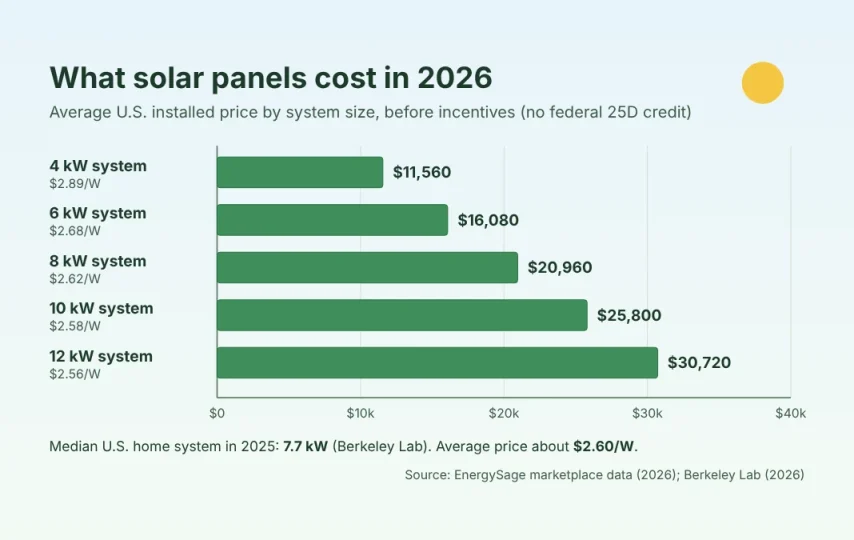

How much do solar panels cost? A home solar system in the U.S. costs about $2.60 per watt before incentives, according to EnergySage marketplace data (November 2026). That puts the solar panel cost at roughly $16,000 for a 6 kW system and $26,000 for a 10 kW system, installed. Industry-wide averages run higher: the SEIA/Wood Mackenzie Solar Market Insight Q3 2026 put the average residential system price at $3.36 per watt in the second quarter of 2026.
Homeowners whose systems are installed after December 31, 2025, can no longer claim the federal residential clean energy credit (25D), so buyers now pay these prices unless a state or utility program applies. Below we break the cost down by system size, state and component, then look at batteries, maintenance, payback and the incentives that remain.
Solar Panel Cost Per Watt: What the Main Sources Say
Solar prices are usually compared in dollars per watt of panel capacity (W), which lets you compare systems of different sizes. The sources below measure different things, so their numbers differ.
| Source | What it measures | Residential price |
|---|---|---|
| EnergySage (2026) | Quotes on its marketplace, before incentives | $2.60/W average; median $2.57/W in H1 2026 |
| SEIA/Wood Mackenzie (Q3 2026 report) | Industry-wide average system price, Q2 2026 | $3.36/W |
| Berkeley Lab (2026 data update) | Median price of host-owned systems installed in 2025 | $3.60/W |
| Tesla (2025) | “All-in” range from sources cited by Tesla, including DOE | $2.74–$3.30/W |
Sources: EnergySage cost data and EnergySage H1 2026 market report; SEIA; Berkeley Lab chart values as reported by Mercom; Tesla (updated October 2025).
How you pay matters, too. In Berkeley Lab’s 2026 data update, loan-financed systems were priced considerably higher than cash purchases, and Mercom reports the chart values as $3.00/W for cash and $4.50/W for loans in 2025. The same report found median prices among the 100 largest residential installers ranging from $2.4 to $6.3 per watt, which is why getting several quotes pays off.
Cost of Solar Panels for a House by System Size
The median U.S. home solar system installed in 2025 was 7.7 kW, and most fell between about 5 and 12 kW, according to Berkeley Lab. The average system quoted on EnergySage is larger, about 12 kW. In EnergySage’s data, bigger systems cost more in total but generally less per watt.
| System size | EnergySage $/W | EnergySage price before incentives | At SEIA’s $3.36/W (our calculation) |
|---|---|---|---|
| 4 kW | $2.89 | $11,560 | $13,440 |
| 6 kW | $2.68 | $16,080 | $20,160 |
| 8 kW | $2.62 | $20,960 | $26,880 |
| 10 kW | $2.58 | $25,800 | $33,600 |
| 12 kW | $2.56 | $30,720 | $40,320 |
Sources: EnergySage (marketplace data, 2026); SEIA/Wood Mackenzie Q2 2026 average price multiplied by system size (our own calculation).
The right size depends on your electricity use, roof and local sunshine. We will cover that in a separate guide to how many solar panels you need; for orientation and tilt, try our solar panel direction calculator.
How Much Does One Solar Panel Cost?
The panel itself is the cheap part. Module prices for the distributed (residential and commercial rooftop) segment averaged $0.37 per watt in Q2 2026, down 16% from a year earlier (SEIA). At that price, one 400 W panel costs about $148 (our calculation). Installed as part of a full system at EnergySage’s $2.60/W, each 400 W panel’s share of the bill is about $1,040 (our calculation), because wiring, inverters, labor and paperwork come with it.
Solar Panel Installation Cost Breakdown: Hardware vs Soft Costs
Most of what you pay is not the panels. Berkeley Lab estimates that soft costs and balance-of-system costs (everything except the module) make up roughly 80% of the median installed price (Berkeley Lab, 2026). EnergySage applies shares from a 2021 study by NREL (now the National Laboratory of the Rockies) to its average 12 kW system:
| Component | Share of total | On a $31,135 system |
|---|---|---|
| Solar panels | 12% | $3,736 |
| Inverters | 10% | $3,114 |
| Racking and electrical wiring | 12% | $3,736 |
| Supply chain costs and sales tax | 11% | $3,425 |
| Installation labor | 7% | $2,179 |
| Permitting and interconnection | 8% | $2,491 |
| Sales and marketing | 18% | $5,604 |
| Overhead and installer profit | 22% | $6,850 |
Source: EnergySage, based on a 2021 NREL study; rows combined by us.
Tariffs push hardware prices in both directions. SEIA says module prices fell after the IEEPA tariffs were invalidated at the start of 2026, while Section 232 tariffs on copper, steel and aluminum keep raising electrical and structural costs. A presidential proclamation of August 6, 2026 adds a 15% tariff (10% for the UK) on polysilicon and its derivatives, including solar cells and modules, for goods entered on or after December 4, 2026, with a minimum import price of $0.38 per watt for modules (Wiley).
Solar Panel Cost by State
Prices vary by labor rates, permitting rules and local competition. EnergySage’s state data shows a wide spread:
| State | Average $/W | Average system cost before incentives |
|---|---|---|
| Florida | $2.12 | $33,907 |
| Arizona | $2.25 | $30,029 |
| Texas | $2.26 | $30,046 |
| North Carolina | $2.44 | $35,513 |
| California | $2.52 | $21,230 |
| New York | $2.77 | $33,424 |
| Massachusetts | $2.90 | $32,061 |
| Illinois | $2.92 | $33,903 |
| Alabama | $3.72 | $54,060 |
Source: EnergySage, state marketplace data updated November 6, 2026. Total costs differ mostly because typical system sizes differ by state.
Tesla Solar Panels Cost
Tesla’s design tool gives a solar quote after you enter your address and average electric bill. Its own cost breakdown page (updated October 2025) lists internal data for 8 kW and larger systems ranging from $2.54/W in Arizona to $3.45/W in Massachusetts. Compare a Tesla quote against at least two local installers, as you would any other.
How Much Do Solar Batteries Add?
More buyers now add storage: 37% of new home solar systems in 2025 included a battery, up from 25% in 2024 (Berkeley Lab). Among cash-purchase systems, median prices were $2.1 per watt higher with a battery than without.
A Tesla Powerwall 3, with 13.5 kWh of capacity, costs about $13,473 installed before incentives, according to EnergySage (May 2026). Across its marketplace, EnergySage reported battery prices of $1,130 per kWh in the first half of 2026. If you want to run a home without the grid at all, the math changes completely; see our breakdown of off-grid solar system cost.
Solar Panel Maintenance Cost and Running Costs
Grid-tied panels have no fuel cost. These are the typical running costs:
- Maintenance: about $300 to $850 a year on average, depending on system size and warranty terms, according to HomeGuide.
- Cleaning: $150 to $500 per professional cleaning, or $10 to $20 per panel (HomeGuide), which notes that rain and the panels’ tilt often keep them clean enough; our guide on how to clean solar panels shows when it pays off.
- Inspection: $150 to $350 if your contract does not include it (HomeGuide).
- Inverter replacement: $1,500 to $3,000; microinverters cost 15% to 25% more to replace than string inverters (HomeGuide). HomeGuide notes that string inverters have a shorter lifespan than the panels, so budget for a replacement.
The panels themselves last a long time. The Department of Energy says most systems keep at least 80% of their original output for at least 25 years.
Payback: How Much Does Solar Cost vs What It Saves?
Savings depend on how much your panels produce and what your utility pays or charges for each kWh. EIA forecasts an average U.S. residential electricity price of 18.17 cents per kWh in 2026 (EIA Short-Term Energy Outlook, November 2026). Production per watt ranges from about 1.0 to 1.3 kWh a year in the Northeast to 1.5 to 1.8 in the Southwest, according to EnergySage.
Worked example (our own calculation): a 7.7 kW system at $2.60/W costs about $20,020 with no tax credit.
| Location type | kWh per watt per year | Annual output | Value at 18.17¢/kWh | Simple payback |
|---|---|---|---|---|
| Midwest or Mid-Atlantic | 1.2 | 9,240 kWh | about $1,679 | about 12 years |
| Sunny state (e.g., California) | 1.5 | 11,550 kWh | about $2,099 | about 9.5 years |
This assumes every kWh offsets power you would otherwise buy at the retail rate. If your utility credits exports at less than retail, payback is longer; maintenance and an inverter swap also add to it, while rising electricity prices shorten it. For your own roof, NREL’s free PVWatts calculator estimates output from local weather data. EnergySage puts typical payback at about 10 years, and Tesla’s cost page says 6 to 12 years.
Solar Incentives in 2026
- Federal 25D credit: ended. The IRS says the residential clean energy credit is not allowed for expenditures made after December 31, 2025, and an expenditure counts as made when installation is completed.
- Leases and PPAs. A company that owns the system can still claim the commercial 48E credit and may pass part of it on, as EnergySage explains. Under the 2025 law, such a system qualifies only if its construction began by July 4, 2026, or it is placed in service by December 31, 2027; IRS Notice 2025-42 (August 2025) tightened what counts as starting construction, as KPMG summarizes. By the end of H1 2026, about 41% of installers on EnergySage were quoting third-party ownership (leases or PPAs), up from about 14% at the start of the year (EnergySage).
- State programs. Some states still offer their own credits. New York, for example, gives a 25% income tax credit of up to $5,000 for purchased systems, or leases and PPAs of at least 10 years, at a principal residence (NY Department of Taxation; Form IT-255 instructions for 2025). Search your state’s rebates and net metering rules in the DSIRE database.
Tax rules for solar changed several times in 2025 and 2026. Check current rules with the IRS, your state energy office and a tax professional before you count on any credit.
How to Lower Your Solar Panel Cost
- Get at least three quotes. Installer prices in Berkeley Lab’s data range from $2.4 to $6.3 per watt.
- Compare cash, loan and lease. In Berkeley Lab’s data, cash purchases were priced well below loan-financed systems. EnergySage found pre-paid leases priced 39% below cash per kWh in H1 2026, while a cash purchase beat a PPA with no prepayment by 33% per kWh.
- Ask what is in the price: panel and inverter brand, warranties, monitoring, roof work and any main panel upgrade.
If you are weighing building-integrated panels instead of a standard rack, compare prices in our solar roof shingles buying guide. For hot water only, a solar water heater is a smaller project.
Frequently Asked Questions
How much do solar panels cost for a 2,000 sq ft house?
House size matters less than electricity use. Most U.S. home systems installed in 2025 were between about 5 and 12 kW (Berkeley Lab); EnergySage prices 6 kW at $16,080 and 10 kW at $25,800 before incentives. Heavy air conditioning or EV charging pushes the size up.
Is there still a federal tax credit for solar panels in 2026?
Not for systems you buy. The 25D credit does not apply to installations completed after December 31, 2025. Companies that lease systems or sell power through PPAs may still claim the 48E credit if they meet the 2025 law’s deadlines (construction begun by July 4, 2026, or in service by December 31, 2027); check current rules.
How long do solar panels take to pay for themselves?
EnergySage estimates about 10 years on average. In our example, a 7.7 kW system pays back in about 9.5 to 12 years, depending on sunshine, if every kWh is valued at the retail rate; lower export credits stretch that.
Are solar panels cheaper to lease or buy?
It depends on the contract. In H1 2026, EnergySage found that a cash purchase beat a PPA with no prepayment by 33% per kWh, while pre-paid leases came in 39% below cash. In the same comparison, loans were the most expensive option per kWh.
How much does solar panel maintenance cost per year?
HomeGuide puts average maintenance at $300 to $850 a year. Plan separately for an inverter replacement, which costs $1,500 to $3,000.

We send one email a week. No spam. Unsubscribe anytime. See our Privacy Policy.


