Solar roof shingles are roofing products with built-in solar cells: they keep out the rain and make electricity at the same time. They look better than panels, but they cost more per watt, produce less power per square foot and are sold by very few companies. Contractor marketplace Fixr put the average installed price at about $46,000 in January 2026, and Tesla stopped taking new Solar Roof orders in August 2026, according to trade press reports.
For most homes, standard rooftop panels remain the cheaper way to go solar. Solar shingles make the most sense when you are replacing your roof anyway and appearance or HOA rules rule out panels.
In this guide:
- What solar shingles are and which brands you can still buy
- How much solar shingles cost
- Solar shingles vs. solar panels, side by side
- Roof requirements, installation and warranties
- Incentives after the federal tax credit ended
- When solar shingles are worth it, plus a buying checklist
What Are Solar Roof Shingles?
Solar shingles (also called solar roof tiles) are a type of building-integrated photovoltaics, or BIPV: solar cells built into a part of the building itself rather than mounted on top of it. Instead of racking bolted through an existing roof, each shingle is installed as part of the roof covering, usually next to ordinary asphalt shingles.
How they work:
- Each shingle holds a small strip of silicon solar cells under glass or a polymer cover.
- Shingles are wired together in series into strings under the roof surface.
- The strings feed an inverter, which turns direct current into household alternating current.
- Your home uses the power first; surplus goes to the grid or a battery.
A single shingle is small. GAF’s current shingle is rated at 57 watts and CertainTeed’s Solstice at up to 70 watts, so a 7 kW system needs more than 100 of them (our calculation). The U.S. Department of Energy notes that BIPV still faces high costs, installation complexity and codes that are “very poorly aligned” with these products, based on industry responses to its BIPV request for information.
Which Solar Shingles Can You Buy in 2026?
The market has shrunk sharply. Here is where the best-known brands stand as of November 2026.
| Brand / product | Power per shingle | Status (November 2026) |
|---|---|---|
| GAF Energy Timberline Solar ES 2 | 57 W | Listed on GAF’s website; ask local roofers about availability |
| CertainTeed Solstice Shingle | up to 70 W | Listed on CertainTeed’s website |
| CertainTeed Landmark PWR | 85 W | New; available from November 1, 2026 |
| Tesla Solar Roof | n/a | New orders stopped, as reported August 20, 2026 |
| SunTegra | 114 W | Closure announced October 2025 |
Sources: GAF, CertainTeed, Solar Power World on CertainTeed, Electrek, Solar Power World on SunTegra.
GAF Energy Timberline Solar ES 2
GAF Energy launched the second-generation Timberline Solar ES 2 in February 2025, rated at 57 watts per shingle, 23% more than its predecessor, according to the company’s press release. GAF says it installs alongside its Timberline asphalt shingles, with the same crew and tools.
GAF’s product page lists a size of 68¾ × 16⅞ inches, a weight of 10.1 lb, about 1.7 kW per roofing square (100 sq ft), a minimum roof pitch of 2:12, a Class A fire rating (UL 790) and a Class F wind rating (ASTM D3161).
The company has been restructuring. It laid off 138 employees in California, closed its San Jose R&D facility and is moving its headquarters and manufacturing to Georgetown, Texas, a plant with 250 MW of annual capacity, Solar Power World reported in December 2025. The product is still listed for homeowners, but ask your roofer about local availability and lead times. GAF also ran a voluntary recall in 2023 covering about 2,100 installations from November 2021 to April 2023, after one fire and five thermal incidents, according to Solar Power World.
CertainTeed Solstice Shingle and Landmark PWR
CertainTeed’s Solstice Shingle is installed directly on the roof sheathing with standard deck screws and carries a 25-year electricity generation warranty, according to the manufacturer, which also says it is rated for 110 mph winds and any wind zone, including Florida’s high-velocity hurricane zone. CertainTeed’s newer Landmark PWR uses half-cut cells in 4-foot shingles rated at 85 W each and became available on November 1, 2026, Solar Power World reported.
Tesla Solar Roof: Discontinued
On August 20, 2026, Electrek reported, citing two people close to the program, that Tesla had told installers Solar Roof tiles were no longer available to order and that it would supply only conventional panels. Contractors later told Roofing Contractor that Tesla had notified installers it would no longer accept new Solar Roof orders. Tesla has not made a public announcement, but its Solar Roof web page now redirects to its solar panels page. Adoption was always small: Wood Mackenzie counted about 3,000 Solar Roofs installed from 2017 to 2022, according to EnergySage. If you already own one, keep your warranty documents. Installer NRG Clean Power says existing Solar Roof warranties remain valid, and contractors told Roofing Contractor that Tesla said it will keep honoring warranties.
Any quote that still offers a “Tesla Solar Roof” should be checked carefully. Ask the installer in writing where the tiles come from and who will honor the warranty.
How Much Do Solar Shingles Cost?
No government agency tracks solar shingle prices, so the figures below come from contractor marketplaces and are estimates, not quotes.
| Measure | Solar shingles | Source |
|---|---|---|
| Typical installed project | about $46,000 (range $27,600–$60,000) | Fixr, January 2026 |
| Per square foot | $21–$25, average $23 | Fixr, January 2026 |
| Per watt | $3.50–$8.00 | Fixr, January 2026 |
| CertainTeed system | about $4.50/W; about $45,000 for 10 kW | CertainTeed via EnergySage, December 2024 |
| Premium over panels | roughly 60%–190% for the same output | EnergySage, December 2024 |
Sources: Fixr (updated January 30, 2026); EnergySage (updated December 4, 2024). All prices are before incentives.
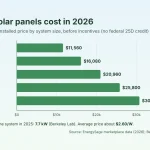
For comparison, the median price of solar quoted on EnergySage’s marketplace was $2.57 per watt before incentives in the first half of 2026, according to EnergySage’s market report. At that price, a 7 kW panel system works out to about $18,000 (our calculation). Our solar panel cost breakdown covers panel prices by system size and state.
Solar shingles are part of the roof itself, so the fair comparison is shingles versus a new conventional roof plus panels, not shingles versus panels alone.
Solar Shingles vs Solar Panels
| Factor | Solar shingles | Solar panels |
|---|---|---|
| Installed cost per watt | $3.50–$8.00 (Fixr) | median $2.57 (EnergySage, H1 2026) |
| Efficiency | 15%–20% (Fixr) | 19%–22% (Fixr) |
| Power density | about 14–17 W per sq ft (EnergySage, GAF) | over 20 W per sq ft (EnergySage) |
| Warranty | 25 years typical (GAF, CertainTeed) | 25-year performance warranty is common (EnergySage) |
| Roof needs | new roof or full re-roof; pitch limits (GAF: 2:12+) | any sound roof; replace an old roof first (ENERGY STAR) |
| Installers | few, brand-certified roofers | widely available |
| Looks | low profile, blends with roof | visible racked panels |
Sources: Fixr, EnergySage on shingles and warranties, GAF, ENERGY STAR.
Lower power density matters on small roofs. Because shingles produce less per square foot, the same system needs more roof area, and shingles follow the roof plane, so they cannot be tilted toward the sun. Panels can be angled on racks; our solar panel direction tool shows the best orientation and tilt for your ZIP code.
Roof Requirements and Installation
Solar roof shingles replace part of the roof covering, so the time to consider them is when you need a new roof; GAF says “the best time to explore solar roofing is when you’re planning a new roof.” GAF’s shingles install alongside its asphalt shingles and require a pitch of at least 2:12, so they are not an option for flat roofs.
The main factors are the same as for any solar project. ENERGY STAR notes that roof direction and pitch matter and that “if your roof needs renovations, it makes sense to replace it before installing solar panels” (ENERGY STAR). It also notes that shade from trees or nearby buildings can reduce output.
A typical project runs:
- Site assessment: roof measurements, shading, electrical panel check and a production estimate.
- Design and contract: shingle layout, inverter choice, warranty terms.
- Permits and utility application: building and electrical permits from your city or county, plus an interconnection request to your utility.
- Re-roofing and solar installation: tear-off, underlayment, solar shingles and regular shingles installed together, then wiring and inverter.
- Inspection and permission to operate: the local inspector signs off and the utility approves the system before you switch it on.
Roof and electrical work is dangerous and warranty-sensitive. GAF’s warranty, for example, excludes damage from installation that does not follow its instructions. Use a brand-certified roofer and a licensed electrician, and never install or repair solar shingles yourself.
Warranties and Lifespan
Read the warranty before you sign; it differs from a panel warranty in important ways. GAF’s Timberline Solar ES limited warranty covers leaks from manufacturing defects for 25 years (10 years non-prorated) and power output for 25 years, guaranteeing 84.8% of rated output in year 25. Wind damage is covered up to 130 mph for 15 years, prorated after the first year, and hail is excluded.
For conventional panels, a 25-year performance warranty is standard, often guaranteeing about 80% output at year 25, according to EnergySage. The Department of Energy puts the average operational life of a solar panel at 25 to 35 years (DOE).
Solar shingles need little upkeep beyond keeping them free of heavy debris; our guide on how to clean solar panels explains safe methods that apply to both.
Tax Credits and Incentives in 2026
The federal Residential Clean Energy Credit (Section 25D), which covered 30% of the cost of home solar, has ended. The IRS says the credit “will not be allowed for any expenditures made after December 31, 2025,” under Public Law 119-21 (the One Big Beautiful Bill Act). An expenditure counts as made when installation is completed, so paying early did not preserve the credit for systems finished in 2026.
What remains:
- State and local incentives: rebates, property tax or sales tax exemptions and performance payments vary by state. Search your state in DSIRE, the incentives database run by the N.C. Clean Energy Technology Center at N.C. State University.
- Net metering: in some areas your utility credits surplus power on your bill, but some states and utilities now pay less than the retail rate for exported power (ENERGY STAR).
- Utility programs: some utilities offer their own solar or battery incentives.
The federal credit ended at the end of 2025, and state and utility programs change often. Check current rules with your state energy office and utility before you count on any incentive.
Are Solar Shingles Worth It?
You are replacing your roof anyway: possibly. You pay for roofing once, and the solar premium is the difference between the solar roof and a standard new roof. Get a quote for a conventional re-roof plus panels to compare.
Your HOA or historic district restricts panels, or appearance matters most: this is the strongest case. Solar shingles sit almost flush and blend with the roof. Our overview of eco-friendly roofing options covers other roofing choices if you are weighing alternatives.
Your roof is in good shape: no. Tearing off a sound roof to install solar shingles adds cost without adding power; rack-mounted panels are cheaper and produce more.
You want the fastest payback or the most power from a small roof: no. Panels cost less per watt and fit more watts per square foot. With the federal credit gone, the higher upfront price of shingles takes even longer to recover.
Solar Shingles Buying Checklist
- Confirm the product is currently sold in your state and get the manufacturer’s spec sheet.
- Use a roofer certified by that manufacturer, and ask how many solar roofs the crew has installed.
- Get at least three quotes, including one for a conventional roof plus panels. ENERGY STAR notes that “it pays to get multiple quotes.”
- Compare price per watt, not just the total, and ask for the estimated annual production in kWh.
- Read the warranty: leak coverage, output guarantee, wind limit, hail exclusion, and who pays for labor on repairs.
- Ask who handles permits, inspections and utility interconnection.
- Check your utility’s net metering or export rate and state incentives in DSIRE.
- Ask what happens if the manufacturer stops making the product: who supplies replacement shingles?
Frequently Asked Questions
How much do solar shingles cost?
Fixr put the typical installed cost at about $46,000 in January 2026, with most projects between $27,600 and $60,000, or $3.50 to $8 per watt. Conventional solar had a median price of $2.57 per watt in the first half of 2026, according to EnergySage.
Are solar shingles better than solar panels?
Not on cost or output. Panels are cheaper per watt, generally more efficient and easier to find installers for. Solar shingles win on appearance and can make sense when you need a new roof anyway or HOA rules limit panels.
Does Tesla still sell the Solar Roof?
No. Electrek reported in August 2026 that Tesla had stopped accepting new Solar Roof orders and would supply only conventional solar panels; Tesla has not announced it publicly, but the Solar Roof page now redirects to its solar panels page. Existing owners should keep their warranty paperwork and contact Tesla for service.
How long do solar shingles last?
Major brands warrant solar shingles for 25 years. GAF guarantees 84.8% of rated output in year 25. Fixr estimates a lifespan of 25 to 30 years, similar to conventional panels.
Is there a federal tax credit for solar shingles in 2026?
No. The 30% residential clean energy credit does not apply to systems whose installation was completed after December 31, 2025. State, local and utility incentives may still apply; check DSIRE and your utility.

We send one email a week. No spam. Unsubscribe anytime. See our Privacy Policy.