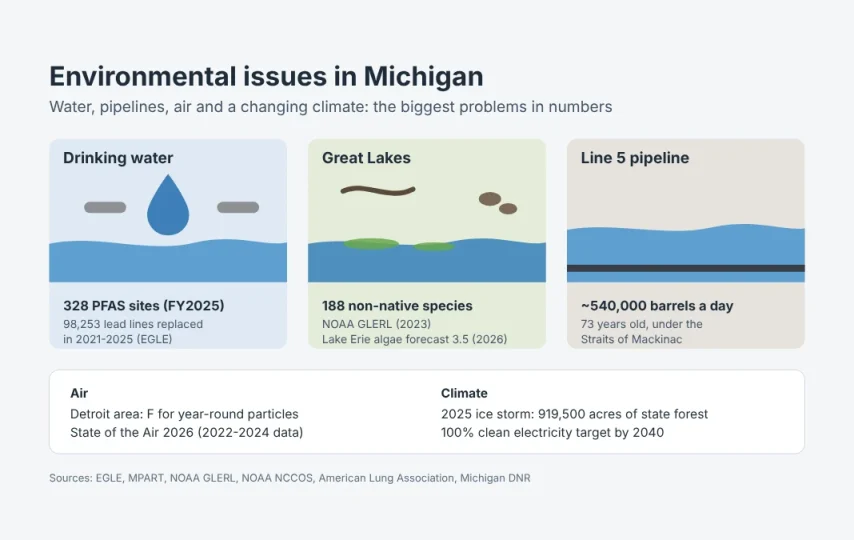

The biggest environmental issues in Michigan are PFAS “forever chemicals” in groundwater, lead pipes in drinking water systems, toxic algae in western Lake Erie, the Line 5 oil pipeline under the Straits of Mackinac, polluted air in metro Detroit, invasive species in the Great Lakes, extreme weather and swinging lake levels, and toxic hot spots left by industry. Michigan had 10,127,884 residents on July 1, 2025, according to Census Bureau estimates published by the state’s Center for Data and Analytics, and its MI Healthy Climate Plan aims to cut greenhouse gas emissions 52% by 2030 and reach carbon neutrality by 2050.
Many of these problems are shared with neighboring states and Ontario, so this article pairs well with our overview of the top environmental issues in the USA. Below are the eight main environmental problems in Michigan, a summary table, what is being done and what you can do.
Top 8 Environmental Issues in Michigan
1. PFAS Contamination
PFAS (per- and polyfluoroalkyl substances) are industrial chemicals used in firefighting foam, coatings and waterproofing that barely break down in nature. At the end of fiscal year 2025, the Michigan PFAS Action Response Team (MPART) listed 328 sites where groundwater PFAS exceeds state criteria and the source is known, plus 38 “areas of interest” where the source is still unknown, according to the Department of Environment, Great Lakes, and Energy (EGLE).
The 300th site, added in January 2025, was the Nankin Township Landfill in Wayne County, which took waste from 3M and other companies from the 1940s to the early 1960s; groundwater testing there found up to 80 parts per trillion (ppt) of PFOA, EGLE reported.
Michigan set its own enforceable drinking water limits for seven PFAS in August 2020, including 8 ppt for PFOA and 16 ppt for PFOS, according to MPART.
2. Lead Pipes and the Legacy of Flint
On April 25, 2014, Flint switched its water source to the Flint River without corrosion control, and lead from old pipes leached into the water of a system serving nearly 100,000 residents, according to the EPA Office of Inspector General. The city returned to Detroit water on October 16, 2015. Flint has met the federal lead standard since July 2016, about 98% of residential lead service lines have been replaced, and roughly 500 remained in early 2026, according to EGLE.
Benton Harbor showed a faster response was possible. Starting in October 2021, the city replaced or verified nearly 4,500 service lines and finished about five months ahead of its 18-month goal, according to MDHHS.
Statewide, Michigan’s Lead and Copper Rule requires water systems to replace lead and galvanized lines within 20 years starting in 2021. Utilities replaced 98,253 such lines from 2021 to 2025 (28,332 in 2025 alone), according to EGLE. The remaining job is large: Planet Detroit estimated about 580,030 lead and galvanized lines statewide in December 2025.
3. Toxic Algae in Western Lake Erie
Southeast Michigan borders western Lake Erie, where phosphorus from farm fertilizer feeds summer blooms of cyanobacteria (blue-green algae). In August 2014, the toxin microcystin forced a do-not-drink advisory for several hundred thousand people served by Toledo’s water system, including communities in southeast Michigan, Michigan Sea Grant reported.
Bloom size swings with spring rain. NOAA rated the 2025 bloom 2 to 3 on its 10-point severity scale, among the mildest this century, compared with 9 to 10 in the record year 2011, WCMU reported. For 2026, NOAA forecast in June a moderate bloom of 3.5, with a range of 3 to 4.5. Michigan’s Lake Erie action plan targets a 40% cut in phosphorus loads from a 2008 baseline, according to EGLE.
4. Line 5 and Oil Pipeline Risks
Enbridge’s Line 5 is 73 years old and carries about 540,000 barrels a day of oil and natural gas liquids from Superior, Wisconsin, to Ontario, including a roughly 4-mile crossing of the Straits of Mackinac where Lakes Michigan and Huron meet, States Newsroom reported in July 2026. Enbridge wants to move the crossing into a tunnel under the lakebed.
In July 2026, EGLE and the Department of Natural Resources (DNR) issued state permits for the tunnel. On July 31, 2026, the Michigan Supreme Court sent the Michigan Public Service Commission’s approval back for a new review, and in August 2026, the U.S. Army Corps of Engineers approved its federal permit, according to Michigan Public. Attorney General Dana Nessel’s lawsuit to shut down the current pipeline is still pending, and Enbridge is countersuing the state. In September 2026, four Michigan tribes asked EGLE for a hearing to overturn the state permits, Michigan Public reported.
The risk is not theoretical. On July 25, 2010, Enbridge’s Line 6B ruptured near Marshall and spilled at least 20,082 barrels (about 843,000 gallons) of crude oil, which flowed more than 35 miles down the Kalamazoo River, according to the U.S. Department of Justice. The 2016 settlement totaled $177 million.
5. Air Pollution in Metro Detroit
In the American Lung Association‘s “State of the Air” 2026 report, based on 2022–2024 data, the Detroit-Warren-Ann Arbor metro area got an F for year-round particle pollution, and Wayne County, its worst county, got F grades for ozone and short-term particle pollution. The metro area ranked 9th worst in the nation for year-round particle pollution, 11th worst for short-term particle pollution and 39th worst for ozone.
The short-term particle ranking got worse, from 22nd worst in the previous report, and Wayne County averaged 9.3 days a year with unhealthy particle levels and 6.8 days with unhealthy ozone.
6. Invasive Species in the Great Lakes
As of 2023, 188 non-native species had been identified in the Great Lakes, according to a 2024 study by NOAA’s Great Lakes Environmental Research Laboratory and partners in the Journal of Great Lakes Research. The study ranked zebra mussels, quagga mussels, alewife and sea lamprey as the four most damaging. One sea lamprey can kill up to 40 pounds (18 kg) of fish in its life, and lake trout catches fell by 98% after lampreys spread through the lakes, according to EGLE. With lamprey control, Lake Superior’s lake trout were declared fully restored in 2024, the same article says. The next threat is invasive carp moving up from the Mississippi basin. The $1.15 billion Brandon Road project near Joliet, Illinois, meant to stop them, has been delayed by funding and management disputes, Michigan Advance reported in April 2026.
7. Climate Change, Extreme Weather and Lake Levels
Climate change in Michigan shows up as stronger storms and wider swings in water. A historic ice storm that began March 29, 2025, knocked out power to 145,000 utility customers at its peak and damaged or destroyed about 3 million acres of land, including 919,500 acres of state forest, according to DNR figures reported by Michigan Public. The federal government approved $50 million in public assistance but in October 2025 denied aid for individual residents, Michigan Public reported.
Lake levels moved from one extreme to the other in seven years. Lake Michigan-Huron hit an all-time monthly low of 576.02 feet in January 2013, according to the University of Michigan’s GLISA, then set new monthly record highs in 2020 that caused significant shoreline erosion and flooding, according to the U.S. Army Corps of Engineers.
On emissions, Michigan’s latest inventory shows 2021 greenhouse gas emissions about 20% below 2005 levels, according to EGLE, well short of the 52% goal for 2030.
8. Toxic Hot Spots From Past Industry
Under the U.S.-Canada Great Lakes Water Quality Agreement, places where local human activity has badly impaired the use of the water are listed as “Areas of Concern” (AOCs), according to the EPA. Michigan had 14; four have been cleaned up and removed from the list (Deer Lake and White Lake in 2014, the Lower Menominee River in 2020 and Muskegon Lake in 2025), and 10 remain, including the Detroit, Rouge, Kalamazoo and Saginaw rivers, according to EGLE.
Michigan Environmental Issues at a Glance
| Issue | Key figure | Source | Trend |
|---|---|---|---|
| PFAS | 328 contamination sites + 38 areas of interest (FY2025) | EGLE / MPART | 8 areas of interest added in FY2025 |
| Lead pipes | 98,253 lead and galvanized lines replaced (2021–2025) | EGLE | Replacement pace up each year |
| Lake Erie algae | 2026 forecast 3.5 of 10 (moderate) | NOAA | Varies by year; 2025 rated 2 to 3 |
| Line 5 | About 540,000 barrels a day, 73-year-old line | States Newsroom | Tunnel permits issued, court cases open |
| Air quality | F grades for ozone and particles, Detroit area (2022–2024) | American Lung Association | Short-term particles worse |
| Invasive species | 188 non-native species in the Great Lakes (2023) | NOAA / J. Great Lakes Res. | Carp barrier delayed |
| Extreme weather | 919,500 acres of state forest hit by 2025 ice storm | DNR | Lake levels: record low 2013, record highs 2020 |
| Toxic hot spots | 10 of 14 Areas of Concern remain (2025) | EGLE | 4 delisted since 2014 |
What Is Being Done About Environmental Problems in Michigan
- Clean energy laws. Laws signed on November 28, 2023, require utilities to get 50% of electricity from renewables by 2030 and 60% by 2035, and 100% from clean sources by 2040, according to the governor’s office. Michigan added 1,698 MW of renewable capacity in 2024, according to EGLE. Large buyers are signing up too: GM’s Michigan solar projects add 300 MW across two farms.
- Stricter drinking water rules. Michigan’s PFAS limits were adopted in 2020, and its lead action level dropped from 15 to 12 parts per billion on January 1, 2025, according to EGLE.
- Great Lakes cleanup. State and federal agencies keep working through the 10 remaining Areas of Concern; Muskegon Lake came off the list in 2025 after decades of cleanup, according to EGLE.
- Nutrient reduction. Michigan’s Lake Erie action plan, updated in 2025, targets runoff in the River Raisin and Maumee watersheds, wastewater plant upgrades and wetland restoration.
- Invasive species control. The Great Lakes Fishery Commission, founded in 1955, runs sea lamprey control across the basin, and Michigan law requires boaters to remove drain plugs and plants before moving a boat.
Michigan shares the Great Lakes with Ontario, so many fixes are binational. For the Canadian side of the same problems, see our article on the top environmental issues in Canada.
What You Can Do
- Find out what your service line is made of. Every Michigan water system had to submit a service line materials inventory to EGLE by October 2024. Ask your utility whether your address has a lead or galvanized line and when it is scheduled for replacement. Until then, run cold water before drinking and use a filter certified for lead.
- Check the MPART site map. If you use a private well, look up nearby PFAS sites on the MPART website. MPART samples some wells as part of its site investigations, and the site lists certified labs if you want to test your own.
- Clean, drain, dry. Before you move a boat between lakes, remove plants, pull drain plugs and empty live wells and bilges. It is the law in Michigan, with fines up to $100, according to the state invasive species program.
- Follow fish advisories. Check MDHHS Eat Safe Fish guidelines before eating fish from Areas of Concern and PFAS-affected waters.
- Watch air quality alerts. On ozone action days in metro Detroit, limit outdoor exercise and drive less.
- Use less fertilizer. Test your lawn soil before adding phosphorus; runoff from lawns and fields feeds algae. Our guide to whether water is a renewable resource explains why clean freshwater is limited even in the Great Lakes State.
For a comparison with another big state, see the top environmental issues in California, where drought and wildfire dominate instead of water quality.
Frequently Asked Questions
What is the biggest environmental issue in Michigan?
There is no official ranking. Water quality ties most problems together: PFAS at 328 known contamination sites, hundreds of thousands of lead and galvanized service lines still in the ground, and toxic algae in western Lake Erie.
Is Michigan's drinking water safe?
There is no single statewide answer. Flint has tested below the federal lead action level since July 2016. Risks remain for homes with lead service lines and for private wells near PFAS sites, so check with your utility and the MPART site map.
What is happening with Line 5?
As of November 2026, Enbridge has state permits from EGLE and the DNR and a federal permit from the Army Corps for a tunnel under the Straits of Mackinac. The Michigan Supreme Court sent the Public Service Commission’s approval back for review, and the attorney general’s lawsuit to shut down the current line is still pending.
How is climate change affecting Michigan?
It brings heavier storms and wider swings in lake levels. The March 2025 ice storm damaged 919,500 acres of state forest, and Lake Michigan-Huron went from a record low in 2013 to record highs in 2020.

We send one email a week. No spam. Unsubscribe anytime. See our Privacy Policy.

