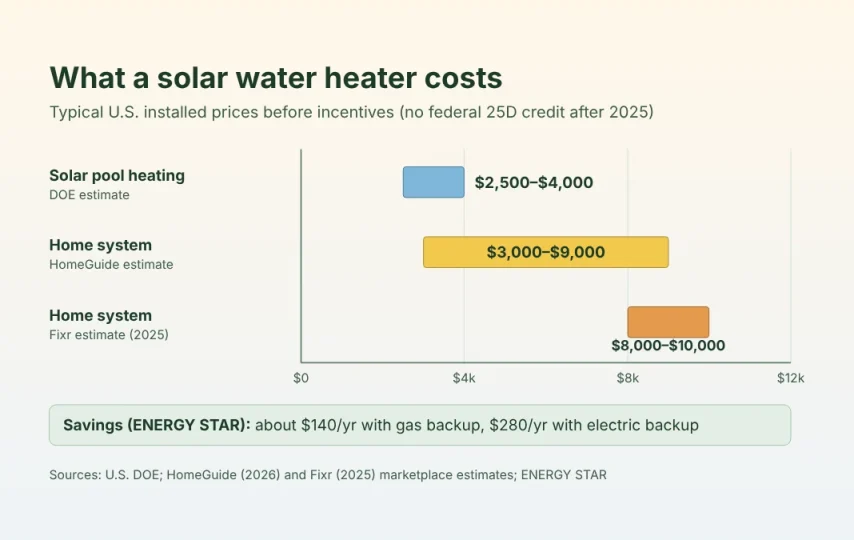

How much does a solar water heater cost? For a home system, installer marketplace estimates put the installed price at about $3,000 to $9,000, with a $6,000 average (HomeGuide), or $8,000 to $10,000, with most homeowners paying about $9,000 (Fixr, January 2025). A solar pool heating system is cheaper, usually $2,500 to $4,000 installed, according to the U.S. Department of Energy.
The solar water heater cost you will actually pay depends on the system type, your climate and how much collector area your household needs. Below are prices by type, what a system saves, how long it takes to pay back now that the federal tax credit has ended, and how it compares with a heat pump water heater.
Solar Water Heater Cost by System Type
There is no official national price survey for solar water heating, so the figures below come from installer marketplaces. They are equipment-only prices; installation adds labor, plumbing, roof work and permits.
| System or part | Equipment price (Fixr) | Equipment price (HomeGuide) |
|---|---|---|
| Active system (pumps and controls) | $2,000–$4,000 | $2,300–$6,000 |
| Indirect (closed-loop glycol) system | $3,000–$4,000 | — |
| Passive system | $1,000–$3,000 | $1,000–$3,700 |
| Thermosyphon system | $1,500–$3,000 | — |
| Evacuated-tube collector | $1,200–$4,500 | — |
| Flat-plate collector | $600–$1,200 | — |
Sources: Fixr (updated January 2025), HomeGuide (2026). Marketplace estimates, not official data.
Passive systems are typically less expensive than active systems but usually not as efficient, while passive designs can be more reliable and last longer, according to DOE. Active indirect systems cost the most because they add a pump, controller, heat exchanger and antifreeze loop, but they are the usual choice where winters freeze.
DOE’s own rough guide is that household-sized solar water heaters cost “on the order of $100” per square foot of collector (DOE). Treat it as a ballpark: the worked example on the same page is based on much older prices.
What Drives the Price?
Collector area. DOE suggests about 20 sq ft of collector for each of the first two people in a household, plus 8 sq ft for each additional person in the Sun Belt or 12–14 sq ft in the northern U.S. (DOE). A family of four needs roughly 56 sq ft in a sunny state and 64–68 sq ft up north (our own calculation), so the same household pays more for solar hot water in Minnesota than in Arizona.
Tank size. DOE puts a 50- to 60-gallon tank at one to three people and an 80-gallon tank at three to four. Many systems use a solar storage tank in front of your existing water heater, which then works as the backup.
Climate. Direct systems that pump household water through the panels are cheaper but suit only places where it rarely freezes. Closed-loop glycol and drainback systems cost more and work in cold climates.
Installation. Roof mounting, pipe runs between the roof and the tank, electrical work for the pump and controller, and permits make up much of the gap between equipment prices and installed prices. Long pipe runs and steep or fragile roofs push the cost up.
Maintenance. In closed-loop systems the antifreeze normally needs changing every 3–5 years, and DOE suggests flushing scale on a similar schedule where water is hard (DOE). Budget for a service visit every few years.
How Much Does a Solar Water Heater Save?
Water heating typically accounts for about 18% of a home’s energy use, according to the DOE Energy Saver Guide. A certified solar water heater can cut the water heating bill roughly in half, and ENERGY STAR estimates the savings at:
- about $140 a year, or $2,900 over the system’s life, with a gas backup;
- about $280 a year, or $5,200 over the system’s life, with an electric backup.
ENERGY STAR puts the average life of certified systems at 20 years. Savings grow with energy prices: the U.S. average residential electricity price is forecast at 18.21 cents per kWh in 2026, up from 17.30 cents in 2025, according to the EIA Short-Term Energy Outlook (October 2026).
Payback: Are Solar Water Heaters Worth It?
Simple payback is the installed cost divided by yearly savings. Using the marketplace prices and ENERGY STAR savings above:
| Installed cost | Backup fuel | Savings per year | Simple payback |
|---|---|---|---|
| $6,000 | Electric | $280 | about 21 years |
| $9,000 | Electric | $280 | about 32 years |
| $6,000 | Gas | $140 | about 43 years |
| $6,000 minus a $2,750 rebate | Electric | $280 | about 12 years |
Our own calculation; ignores maintenance, financing and future price changes.
On national-average numbers, a home solar water heater rarely pays for itself within its 20-year life, especially against gas. It works out better where three things line up: strong sun, expensive electricity and a rebate. A family with high hot water use, an electric water heater and a south-facing roof gets the most from it. Solar pool heating is a different story: DOE estimates a payback of 1 to 7 years, depending on local fuel costs and sunshine, because pool panels are simple and the alternative (gas or electric pool heating) is costly.
The federal 25D residential clean energy credit, which paid back 30% of the cost, does not apply to systems whose installation is completed after December 31, 2025, under Public Law 119-21 (IRS). A system paid for in 2025 but finished in 2026 does not qualify. Many older cost guides still subtract the credit; check current rules.
Rebates and Incentives in 2026
With 25D gone, incentives come from states and utilities:
- Hawaii has the strongest program. Hawaii Energy offers an instant rebate of up to $2,750 for a solar water heater in the 2026–2027 program year, through a participating contractor; the program does not cover Kauaʻi. Hawaii law has also required solar water heaters on most new single-family homes since 2010 (HRS §196-6.5).
- Other states and utilities: search the DSIRE database for your ZIP code; some offer rebates or other incentives for solar thermal equipment. Check each program’s equipment and installer requirements before you sign a contract.
- Federal home energy rebates under the Inflation Reduction Act are run by the states, and DOE’s Home Upgrades page lists heat pump water heaters among eligible products but not solar water heaters.
Solar vs Heat Pump Water Heater Cost
For most U.S. homes the main alternative is a heat pump water heater. ENERGY STAR estimates that one saves a household of four about $550 a year compared with a standard electric water heater, or more than $5,610 over its lifetime, with about $1,503 in extra upfront cost. That is a far shorter payback than a home solar water heater on national averages, and installation looks like replacing an ordinary tank.
Solar still has a place: it uses no electricity for heat, and in Hawaii-style conditions (strong sun, high power prices, generous rebates) it competes well. For more home upgrades compared side by side, see our green technology examples.
What It Means for You
- Get at least two quotes from contractors who install SRCC-certified systems, and ask for the system’s Solar Uniform Energy Factor and estimated yearly savings.
- If you have an electric water heater that is near the end of its life, compare a solar quote with a heat pump water heater quote before deciding.
- For a pool, solar is usually the cheapest way to add heat; see our picks of the best solar water heaters, which include in-ground and above-ground pool kits.
Frequently Asked Questions
How much does a solar water heater cost to install?
Installer marketplaces estimate about $3,000 to $9,000 installed, with a $6,000 average (HomeGuide), or $8,000 to $10,000, with about $9,000 typical (Fixr, 2025). Closed-loop systems for cold climates and larger families sit at the top of the range.
Is there a tax credit for solar water heaters in 2026?
No federal credit. The 25D residential clean energy credit does not apply to systems installed after December 31, 2025. Some states and utilities still offer rebates, such as Hawaii Energy’s instant rebate of up to $2,750; check current rules in your state.
How much does a solar pool heater cost?
DOE says a solar pool heating system usually costs $2,500 to $4,000 to buy and install and pays back in 1 to 7 years. Do-it-yourself panel kits cost less, but most in-ground pools need several of them.
How long does a solar water heater last?
ENERGY STAR puts the average life of certified solar water heating systems at 20 years. Pumps, controllers and antifreeze need attention sooner: DOE recommends changing antifreeze every 3–5 years.
Are solar water heaters worth it?
They are worth it where sun is strong, electricity is expensive and a rebate cuts the price, as in Hawaii. On U.S. average prices and without the federal credit, simple payback on a home system often runs past 20 years, and a heat pump water heater usually pays back sooner.


