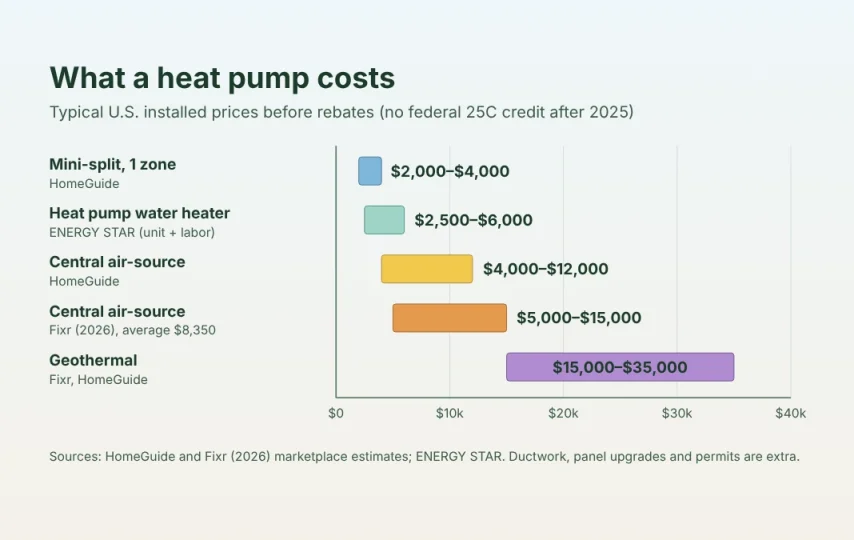

How much does a heat pump cost? A central air-source heat pump for a typical U.S. home costs about $4,000 to $12,000 installed according to HomeGuide, while Fixr (January 2026) puts the national average at $8,350 within a $5,000 to $15,000 range. A one-room ductless mini-split is cheaper, at roughly $2,000 to $4,000, and a geothermal system is the most expensive, at $15,000 to $35,000.
There is no official national price survey for heat pumps, so all installed prices here come from contractor marketplaces and are labeled that way. Below we break the heat pump cost down by type and size, list the extras that push a quote up, and look at running costs and the incentives that are still available after the federal tax credit ended.
Heat Pump Cost by Type
The type of system matters more than the brand. Ducted systems replace a furnace and central air conditioner; ductless mini-splits heat and cool one room or zone per indoor unit; geothermal systems pull heat from the ground through buried loops.
| Heat pump type | Typical installed price | Source |
|---|---|---|
| Ductless mini-split, 1 zone | $2,000–$4,000 | HomeGuide |
| Ductless mini-split, 3 zones | $7,000–$11,000 | HomeGuide |
| Ductless mini-split, 5 zones | $11,000–$17,000 | HomeGuide |
| Central air-source (ducted) | $4,000–$12,000 | HomeGuide |
| Central air-source (ducted) | $5,000–$15,000 | Fixr (2026) |
| Geothermal (ground-source) | $15,000–$35,000 | Fixr, HomeGuide |
| Heat pump water heater | about $2,500–$6,000 | ENERGY STAR (our sum of unit + labor) |
Sources: HomeGuide air-source and ductless cost guides (2026); Fixr, updated January 22, 2026; ENERGY STAR. All are marketplace or program estimates, not quotes.
For the unit alone, HomeGuide lists $1,500 to more than $7,000 for an air-source heat pump, with installation labor adding about $2,000 to $3,500. A heat pump water heater, which only heats your hot water, costs $1,500 to $3,000 for the unit plus $1,000 to $3,000 for labor and materials, according to ENERGY STAR.
Heat Pump Price by Size
Heat pumps are sized in tons of cooling capacity (1 ton = 12,000 Btu per hour). A bigger house usually needs a bigger unit, and the heat pump price climbs with it. The two marketplaces below disagree on the upper end, which is a good reminder to collect several quotes.
| Size | Home size (HomeGuide) | HomeGuide installed | Fixr installed |
|---|---|---|---|
| 2 tons | 900–1,400 sq ft | $5,000–$7,000 | $5,000–$8,000 (2 tons, 1,000 sq ft) |
| 3 tons | 1,500–2,100 sq ft | $5,700–$8,500 | $6,700–$14,000 (2.5–3 tons, 1,500 sq ft) |
| 4 tons | 2,100–2,700 sq ft | $6,500–$11,000 | $8,000–$20,000 (3–4 tons, 1,800–2,000 sq ft) |
| 5 tons | 2,500–3,500 sq ft | $7,000–$12,000 | $9,500–$22,000 (3.5–5 tons, 2,500 sq ft) |
Sources: HomeGuide; Fixr (January 2026).
Square footage is only a rough guide. A contractor should size the unit with a load calculation (often called Manual J) that accounts for insulation, windows and climate. An oversized heat pump costs more up front and cycles on and off; an undersized one leans on backup heat in cold snaps.
What Adds to Heat Pump Installation Cost
The base price assumes your home already has working ducts and enough electrical capacity. These extras are where quotes most often grow:
- New or repaired ductwork: about $2,000 to $7,500 for a typical home, or $10 to $25 per linear foot, according to Angi. Homes without ducts often choose ductless mini-splits instead.
- Electrical work: a dedicated circuit for a mini-split runs about $250 to $900 (HomeGuide). If the main panel is too small, an upgrade has cost $520 to $2,103 (HomeAdvisor data, 2022).
- Permits: about $100 to $300 (HomeGuide).
- Cold-climate models: units built to keep their capacity near 0°F cost more than standard models, but they reduce the need for backup heat.
Equipment prices also rose with the switch to new refrigerants. Since January 1, 2025, new residential air conditioning and heat pump systems installed in the U.S. must use a refrigerant with a global warming potential of 700 or less, unless all their components were made or imported before 2025, under EPA’s Technology Transitions rule. In May 2025, Carrier told investors that its units with the new R-454B refrigerant cost about 10% more than R-410A models, and in spring 2025 most major equipment makers announced price increases, many in the 2% to 10% range, citing tariffs and higher costs, as ACHR News reported.
How Much Does a Heat Pump Cost to Run?
A heat pump moves heat instead of making it, so it delivers more heat than the electricity it uses. The U.S. Department of Energy says a heat pump can cut the electricity used for heating by up to 75% compared with electric resistance heat such as baseboard heaters. Field tests in DOE’s cold-climate heat pump challenge recorded efficiencies (COP) of roughly 1.5 to 4.5 between −15°F and 65°F, with units still heating efficiently below 0°F (DOE, 2024).
Whether that lowers your bill depends on what you heat with now:
- Electric resistance, propane or heating oil: savings are largest. An NREL study published in 2024 found that 92% to 100% of such homes that also have air conditioning would save, with median savings of about $300 to $650 a year (NREL via ScienceDaily). In Michigan, DOE estimated that homes leaving propane or electric heat for a cold-climate heat pump would save about $1,500 a year on average (DOE, 2024).
- Natural gas: savings depend on local gas and electricity prices. DOE estimated in 2024 that about 13 million homes heated with natural gas would already save by switching to a heat pump (DOE).
For context, the U.S. Energy Information Administration expects households heating with natural gas to spend about $640 this winter (November 2026 to March 2027), compared with $1,246 for propane and $2,115 for heating oil (EIA Winter Fuels Outlook, October 2026 forecast). EIA’s electricity figure, $1,196, mixes heat pumps with less efficient resistance heating, so it is not a heat pump cost estimate.
Seal air leaks and add insulation before you buy. DOE says weatherizing first can cut the cost of a heat pump by up to $3,700 for older homes (built before 1970) in cold climates, because a tighter house needs a smaller unit (DOE). It is also the first step in our list of eco-friendly house ideas.
Tax Credits and Rebates for Heat Pumps in 2026
- Federal tax credit (25C): ended. The IRS says the credit is not allowed for any property placed in service after December 31, 2025, under Public Law 119-21.
- Federal Home Energy Rebates: run by states. DOE lists up to $8,000 per household under the HOMES program and up to $14,000 under the High-Efficiency Electric Home Rebates (HEEHR), “available in select states” (DOE). DOE paused the programs for review in 2025, and as of mid-October 2026 only West Virginia and Florida had federal approval for reworked programs (S&P Global). Under DOE Program Notice 26-2 (May 2026), these electric home rebates no longer pay for replacing gas or oil appliances.
- Utility and state programs: many utilities still offer their own heat pump rebates. Ask your utility before you sign a contract, since some programs require pre-approval.
Incentive rules changed several times in 2025 and 2026. Check current rules with your state energy office and utility before you count on a rebate.
Is a Heat Pump Worth the Cost?
A heat pump makes the most financial sense when you need to replace an old air conditioner, furnace or water heater anyway, because you pay only the difference over a like-for-like replacement. It also pays off faster in homes that now burn propane or heating oil or use baseboard heat.
The heat pump water heater is the easiest win. ENERGY STAR estimates a certified model saves a family of four about $550 a year compared with a standard electric water heater, or more than $5,610 over its lifetime (ENERGY STAR). If you are weighing a solar option instead, see our breakdown of solar water heater cost.
Plan for the long run, too. DOE’s federal buyer guidance analyzes air-source heat pumps over a 15-year life (DOE FEMP), and the federal minimum efficiency for new split-system heat pumps has been SEER2 14.3 and HSPF2 7.5 since January 1, 2023 (DOE). Heat pumps are one of the green technologies you can use at home that change both your bill and your emissions.
Frequently Asked Questions
How much does a heat pump cost for a 2,000 sq ft house?
A 2,000 sq ft home usually needs a 3- to 4-ton heat pump. HomeGuide puts a 3-ton system (for 1,500–2,100 sq ft) at $5,700 to $8,500 installed, while Fixr lists $8,000 to $20,000 for 3 to 4 tons. New ductwork or an electrical panel upgrade would come on top.
How much is a heat pump without installation?
HomeGuide lists about $1,500 to more than $7,000 for an air-source heat pump unit alone, with installation labor adding about $2,000 to $3,500. Most manufacturers require professional installation for the warranty to apply.
Is there still a federal tax credit for heat pumps in 2026?
No. The 25C energy efficient home improvement credit does not apply to property placed in service after December 31, 2025. State-run Home Energy Rebates and utility rebates may still be available, so check with your state energy office and utility.
Is a heat pump cheaper to run than a gas furnace?
It depends on local prices. Heat pumps almost always cost less to run than electric resistance, propane or oil heat, but compared with natural gas the result varies by state. DOE estimated in 2024 that about 13 million gas-heated homes would already save.
Do heat pumps work in cold climates?
Yes. Cold-climate models in DOE’s field tests kept heating efficiently below 0°F, and ENERGY STAR certified cold-climate heat pumps must deliver at least 70% of their 47°F heating capacity at 5°F.

We send one email a week. No spam. Unsubscribe anytime. See our Privacy Policy.

