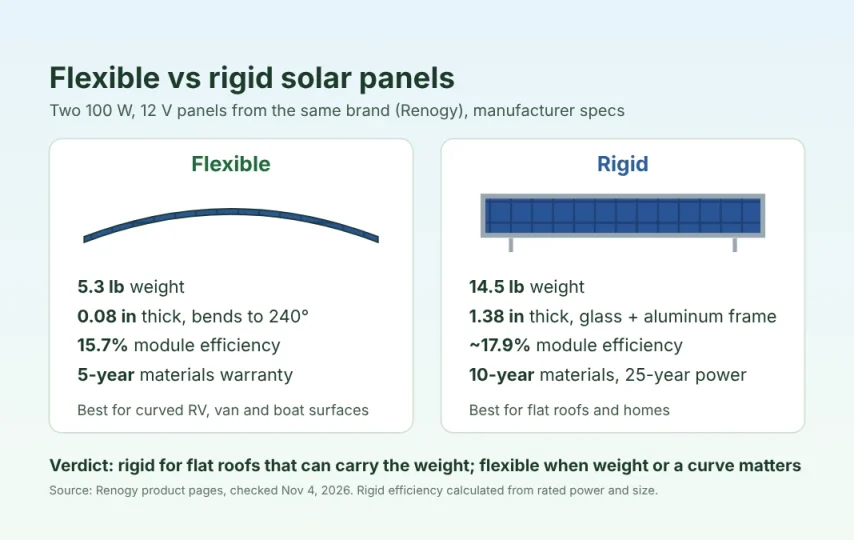

In the flexible vs rigid solar panels choice, rigid panels win for most flat roofs: they run cooler, last longer and carry much longer warranties. Flexible panels win when weight or a curved surface matters. Renogy’s 100-watt flexible panel weighs 5.3 lb against 14.5 lb for its framed 100-watt panel (Renogy flexible, Renogy rigid), but its materials warranty is 5 years instead of 10.
Below is how the two types differ on weight, efficiency, heat and lifespan, and which one suits an RV, a boat, a van or a house.
Flexible vs Rigid Solar Panels at a Glance
The table compares two 100-watt, 12-volt panels from the same brand, so the differences come from the construction rather than the maker.
| Criterion | Flexible (Renogy 100W Flexible) | Rigid (Renogy 100W Monocrystalline) | Winner |
|---|---|---|---|
| Weight | 5.3 lb (2.4 kg) | 14.5 lb (6.6 kg) | Flexible |
| Thickness | 0.08 in | 1.38 in (with frame) | Flexible |
| Size | 43.0 × 22.9 in | 43.3 × 20.0 in | Rigid (smaller for the same power) |
| Module efficiency | 15.7% (spec table) | about 17.9% (from rated power and size) | Rigid |
| Materials warranty | 5 years | 10 years | Rigid |
| Power warranty | 90% of output within 5 years | 95% at 5 years, 90% at 10 years, 80% at 25 years | Rigid |
| Mounting | Adhesive, sealant or grommets, flush to the surface | Brackets or rails with an air gap | Depends on the roof |
| Bend | Up to 240 degrees | None | Flexible |
Sources: Renogy product pages for the flexible and rigid panels, checked November 4, 2026. The rigid panel’s efficiency is our calculation (100 W ÷ 0.56 m²); Renogy does not list it.
What Is the Difference Between Flexible and Rigid Solar Panels?
A rigid panel sandwiches silicon cells between tempered glass and a backsheet and holds them in an aluminum frame. Renogy’s rigid panel, for example, uses low-iron tempered glass and a corrosion-resistant aluminum frame. The frame lets it sit on brackets a few inches above the roof.
A flexible panel replaces the glass and frame with thin polymer layers, so the whole panel is a few millimeters thick and bends to follow a curve. There are two main kinds:
- Thin silicon panels, such as the Renogy flexible panel above.
- Thin-film panels, most often CIGS (copper indium gallium selenide). The U.S. Department of Energy says commercial CIGS modules typically reach 12% to 14% efficiency; newer flexible products claim more, such as 17% cell efficiency for BougeRV’s Yuma panel (BougeRV).
Weight and Mounting: Flexible Wins
Weight is the main reason to choose flexible. In the pair above, the flexible panel weighs a little over a third as much as the rigid one, and with no frame or brackets the total roof load drops further. That matters on fiberglass RV roofs, camper shells, boat biminis and other surfaces that were never designed to carry a rack of glass panels.
Mounting is also simpler. Renogy notes that flexible panels “do not need traditional mounting hardware” and attach directly to the surface, while rigid panels go on rails or brackets (Renogy). Some flexible panels come with pre-applied adhesive, so no holes are drilled at all.
The trade-off is that a panel glued to a roof is hard to remove, inspect or replace. A rigid panel on brackets can be unbolted in minutes.
Heat and Output: Rigid Wins
Solar panels lose output as they get hotter, and a panel’s back side is where much of its heat escapes. A rigid panel on brackets has air flowing underneath; a flexible panel glued flat to a roof does not. Renogy says flush-mounted flexible panels see “more heat buildup” and that rigid panels “dissipate heat and perform better, especially in hot conditions” (Renogy).
How much hotter? Sandia National Laboratories’ module temperature model (King et al., 2004) gives separate coefficients for panels on an open rack and panels with an insulated back (Sandia PV Performance Modeling Collaborative). Plugging in full sun (1,000 W/m²) and a light 1 m/s breeze, the model puts an open-rack glass-and-polymer panel about 26°C (47°F) above the air temperature and an insulated-back panel about 58°C (104°F) above it, a gap of roughly 31°C (56°F). With a temperature coefficient of −0.38% per °C, the figure BougeRV lists for its CIGS panel, that gap would cost about 12% of output.
That is a model estimate for a fully insulated back. A flexible panel on a metal or fiberglass roof sheds some heat into the roof, so real losses are usually smaller, but the direction is the same.
You can narrow the gap. Renogy notes that some flexible installs use a mounting method that creates an air gap, and in a field report it recommended a thin layer such as 1/4-inch corrugated plastic under the panel to let air flow (Renogy).
Efficiency: Rigid Wins (Slightly)
Like-for-like, rigid panels usually pack more watts into the same area. Renogy’s own comparison lists flexible panels as “generally lower” in efficiency (Renogy), and in the pair above the flexible panel needs about 14% more surface for the same 100 W.
The gap is closing. Some newer flexible panels use high-efficiency N-type cells: Renogy lists up to 25% cell efficiency for its Flex ShadowFlux panel (about 18% module efficiency from its rated power and size) (Renogy). If roof area is your limit, compare the watts per square foot of the exact models you are considering rather than the panel type.
How Long Do Flexible Solar Panels Last?
No public long-term dataset tracks flexible panels separately, so warranties are the best guide. Flexible panels typically carry 2 to 10 years: Renogy’s 100W flexible has 5 years, Renogy’s Flex ShadowFlux 3 years and BougeRV’s CIGS Yuma 10 years for the product with a 25-year performance warranty (BougeRV). Renogy’s framed panel, for comparison, has a 10-year materials warranty and a 25-year power warranty.
For rigid panels there is long-term field data. A review by NREL researchers of 2,128 reported degradation rates found a median loss of 0.5% of output per year (NREL), so at that median rate a panel would still deliver about 88% of its rated power after 25 years. Renogy itself says “if long-term durability is your priority, rigid panels are the best choice” (Renogy).
What shortens a flexible panel’s life: heat from flush mounting, bending beyond the rated limit, and point loads such as being stepped on. Keep the panel within its bend rating, give it airflow where you can, and keep foot traffic off it.
Which One Should You Choose?
- Curved RV or camper roof, or a roof with a low load limit: flexible. The weight saving is large and the panel follows the curve. A 12-volt 100 W panel such as the Renogy 100W Flexible works with most controllers.
- Flat RV, trailer or van roof that can carry the weight: rigid. You get a cooler panel, a longer warranty and easy removal, at the cost of brackets and about three times the weight.
- Boat bimini, dodger or curved deck: flexible, with an IP67 or IP68 rating. A rigid panel on a stainless frame is better where you have a flat, strong mounting point.
- House roof: rigid. A 25-year power warranty covers far longer than any flexible panel’s, and racked panels stay cooler. See our guide to off-grid solar systems for homes for the larger picture.
- Portable charging for camping: neither; a folding portable panel is built for that job.
If you have decided on flexible, our list of the best flexible solar panels and kits compares six current models on weight, bend, voltage and warranty.
Before buying any panel, check its voltage at maximum power (Vmp). Panels above about 24 V need an MPPT charge controller to charge a 12 V battery efficiently; Victron Energy explains that a PWM controller pulls the panel down to near battery voltage.
Frequently Asked Questions
Are flexible solar panels any good?
Yes, when weight or a curved surface matters. In one brand’s 100 W pair, the flexible panel weighs a little over a third as much as the framed one and can be mounted without brackets. Their drawbacks are higher operating temperatures when mounted flat, somewhat lower efficiency and shorter warranties, usually 2 to 10 years.
Are flexible solar panels worth it?
They are worth it on RV, camper and boat surfaces that cannot carry framed panels or are curved. On a flat roof that can carry the weight, a rigid panel usually gives more energy over its life for the money, because it runs cooler and is warranted for much longer.
How long do flexible solar panels last?
Manufacturers do not publish lifespans, but warranties of 2 to 10 years are typical, compared with a 10-year materials and 25-year power warranty on Renogy’s framed panel. An air gap underneath, staying within the bend limit and avoiding foot traffic all help a flexible panel last longer.
Do flexible solar panels need an air gap?
They do not require one, but it helps. Renogy notes that air gaps reduce heat buildup and has suggested a thin layer such as 1/4-inch corrugated plastic under the panel to reduce heat buildup.
Are flexible solar panels less efficient than rigid ones?
Usually a little. In the same brand’s 100 W pair, the flexible panel’s module efficiency is 15.7% against about 17.9% for the rigid panel. Some newer flexible panels use N-type cells rated up to 25%, so compare specific models.


