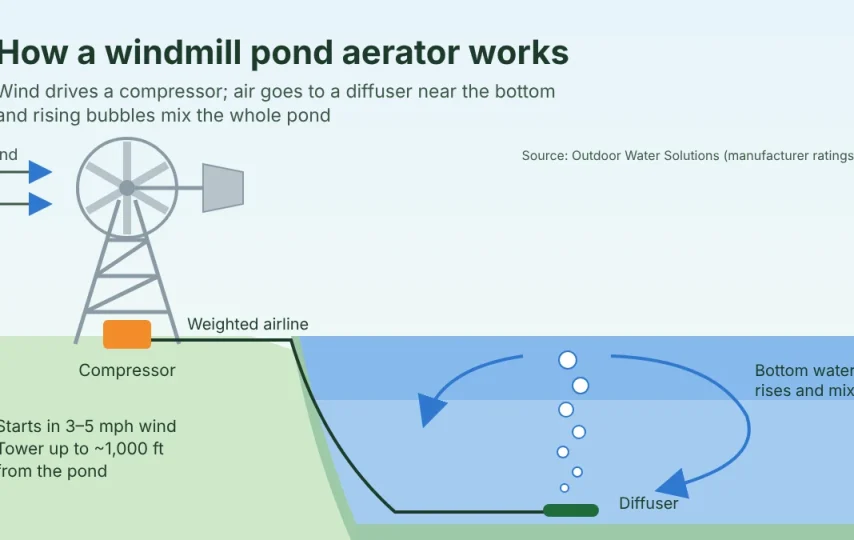

A windmill pond aerator uses the wind to run a small air compressor, which pushes air through a hose to a diffuser near the bottom of the pond. The rising bubbles lift oxygen-poor bottom water to the surface, where it picks up oxygen from the air, so the whole pond stays mixed. It needs no electricity, but it only works when the wind blows, and the University of Kentucky notes that wind systems do not run on hot, calm days and nights, when fish are most at risk.
Below is how a pond aeration windmill works, how much wind and depth it needs, what size pond one unit covers, and when a solar or electric aerator is the better choice.
How a Windmill Pond Aerator Works
A windmill aerator looks like a farm windmill, but instead of pumping water it pumps air. The system has four parts:
- Head and tail. The wheel turns in the wind, and the tail keeps it facing the wind. Some heads are self-governing and turn partly out of the wind in storms: on the Becker BWM16W, for example, the tail turns the head 12 to 15 degrees out of the wind at 30 mph (Septic Solutions listing).
- Compressor. The turning shaft drives a small piston or diaphragm air compressor; Koenders, for example, uses a single-diaphragm compressor on its galvanized system (Environmental Expert).
- Airline. Air travels through tubing to the pond. The part that lies on the pond bottom is weighted so it sinks.
- Diffuser. An airstone or membrane diffuser releases fine bubbles a little above the bottom.
The bubbles matter less for the oxygen they carry than for the water they move. As Clemson Cooperative Extension explains, bubbles grow as they rise and drag bottom water to the surface, mixing the water column. The University of Kentucky calls this de-stratification: the main effect is circulating deep water to the surface, and oxygen transfer from the bubbles is secondary.
The diffuser should sit near the bottom, not on it. Placing it directly on the bottom can stir up sediment, release nutrients and make the water cloudy, according to University of Maryland Extension.
Why Ponds Need Aeration
In summer, many ponds stratify: a warm top layer floats on a cold bottom layer, and the two do not mix. Algae and plants at the surface make oxygen in daylight, while decaying material at the bottom uses it up. The bottom layer can run out of oxygen completely.
The risk shows up in two ways:
- Low oxygen at night. Dissolved oxygen (DO) is lowest just before daybreak, according to Texas A&M AgriLife. Warm water also holds less oxygen: 7.4 mg/L at saturation at 90°F (32°C) compared with 11.9 mg/L at 45°F (7°C).
- Turnover. A cold rain, strong wind or the first cold spell of fall can suddenly mix the oxygen-poor bottom water into the whole pond (University of Kentucky). In Pennsylvania, summer fish kills occur most often in late July and accelerate in early August, linked to hot, dry weather and algae die-offs (Penn State Extension).
| Dissolved oxygen | What it means for fish |
|---|---|
| 5 mg/L | Optimum |
| 2–4 mg/L | Most species are stressed |
| Below 2 mg/L | Fish deaths usually occur |
Source: Texas A&M AgriLife. Trout and other coldwater fish need more, about 7 mg/L (University of Kentucky).
Continuous circulation keeps the pond from stratifying in the first place. It works as prevention: the University of Kentucky notes that de-stratification “will do little to correct such an event once it is in progress.”
How Much Wind Does a Windmill Aerator Need?
Manufacturers list low start-up speeds, but real output rises with wind speed:
- Outdoor Water Solutions’ 12-foot system is listed as operating in 3–5 mph winds (Natural Waterscapes).
- Becker lists a minimum wind of 5 mph for the BWM16W (Septic Solutions).
- The pond management company Aquatic Biologists says windmills need an average wind of about 11 mph to aerate properly.
The gap between these numbers is the key point. A windmill can turn in a light breeze and still move too little air to circulate a pond. A taller tower helps because it reaches steadier wind above trees and buildings: Outdoor Water Solutions says its 20-foot tower produces about 20% more aeration than its 12-foot tower (Natural Waterscapes). For more on why height matters for any wind machine, see our guide to wind power pros and cons.
What Size Pond Can One Windmill Aerator Handle?
Manufacturers rate their units by surface area and depth:
| System (manufacturer rating) | Pond size | Depth | Airflow |
|---|---|---|---|
| Outdoor Water Solutions 12 ft and 20 ft Deluxe | 0.25–3 acres | Up to 30 ft | Up to 4.5 cfm (20 ft Deluxe) |
| Outdoor Water Solutions Super Premier 24 ft | Up to 2 acres | Up to 30 ft | Up to 4.5 cfm |
| Koenders single diaphragm | Up to 2 acres | Not listed | Up to 1.5 cfm |
| Becker BWM16W | Up to 2 acres | Up to 40 ft | 2.4–5 cfm |
Sources: Natural Waterscapes (Outdoor Water Solutions), Environmental Expert (Koenders), Septic Solutions (Becker). Ratings are manufacturer claims at good wind; real coverage depends on wind and pond shape.
Extension guidance gives a simpler rule. Clemson says one diffuser can circulate about 1 to 2 acres, and odd shapes, narrow arms and canals need more diffusers. Diffuser aeration works best in deeper ponds: the University of Kentucky says diffusers are most efficient in ponds 8 feet deep or more, and large, shallow ponds need more diffusers. Ponds deeper than about 5 to 6 feet typically need a compressed-air diffuser system rather than a surface aerator, according to the University of Maryland.
Windmill vs. Solar vs. Electric Pond Aerators
| Windmill | Solar | Electric | |
|---|---|---|---|
| Power source | Wind only | Sun; battery for night | Grid |
| Running cost | None | None | Electricity |
| Works on calm, hot nights | No | Only with a battery | Yes |
| Distance from pond | Up to about 1,000 ft (manufacturers) | Panels need direct sun | Needs a power line |
| Best for | Remote, windy, open sites | Remote, sunny sites | Ponds where reliability matters most |
The biggest weakness of wind is timing. The University of Kentucky notes that “wind powered systems would not function during the hot, calm days or nights of summer, another period when the need for de-stratification would be critical,” and solar systems without backup stop at night and in cloudy weather. Even an Outdoor Water Solutions reseller describes windmill aeration as supplemental and notes that wind is not a constant energy source.
The biggest strength is location. Because the airline can run a long way, the windmill can sit on the windiest spot on your land: both Outdoor Water Solutions and Koenders list placement up to about 1,000 feet from the pond.
Installing and Maintaining a Windmill Aerator
- Siting. Choose an open, consistently breezy spot, clear of trees and buildings. A longer airline is usually better than a sheltered tower.
- Starting up. If you start aerating a stratified pond in summer, start slowly. Clemson says a system installed in summer should be started in short increments (10 minutes per day) over the first two weeks to mix the water gradually; check the manufacturer’s start-up instructions too.
- Wear parts. Natural Waterscapes, which sells Outdoor Water Solutions systems, says the compressor’s wear parts (diaphragms, valves and seals) should be renewed every 4 to 6 years (Natural Waterscapes).
- Storms. Some towers, such as the Becker BWM16W, have a hinged base so the tower can be lowered for maintenance or storms.
Aeration keeps ice thin or open, and that ice is dangerous. In Minnesota, a DNR permit is required to install and operate an aeration system on public waters, thin-ice warning signs are required around the open water, and the DNR’s aeration program coordinator warns that “ice is never 100% safe, and extreme care should be taken on aerated lakes” (Minnesota DNR). If you aerate a pond in winter, mark the area and keep people and pets off the ice.
Winter aeration can also help. Under snow-covered ice, plants make less oxygen while decay continues, and Penn State Extension suggests keeping a small area ice-free or aerating when ice forms to reduce winterkill.
What It Means for You
A windmill pond aerator makes sense if your pond is at least 6 to 8 feet deep, sits in an open, windy area and has no power line nearby. It will keep the water moving on most days at no running cost. If your pond is sheltered by trees, sits in a hot, humid climate with long calm spells, or holds valuable fish, plan on an electric aerator, or a solar system with a battery, as your main or backup system.
If you only want the look of a windmill in your yard, a purely decorative windmill is a much simpler purchase; see our picks of the best decorative windmills.
Measure before you buy. Note your pond’s surface area in acres and its deepest point, and check how often your site sees winds above about 10 mph. These three numbers tell you whether one windmill can do the job.
Frequently Asked Questions
Do windmill pond aerators work?
Yes, when there is enough wind. They circulate the pond and help prevent stratification, but they stop on calm days and nights, which are often the hottest and riskiest periods for fish. They suit open, windy sites without a power line best.
How much wind does a windmill aerator need?
Manufacturers say their windmills start in 3 to 5 mph of wind, but output grows with wind speed. One pond management firm puts the average wind needed for proper aeration at about 11 mph.
How far from the pond can a windmill aerator be?
Outdoor Water Solutions and Koenders both say their windmills can be placed up to about 1,000 feet from the pond. That lets you put the tower in the windiest spot rather than right at the shore.
What size pond does a windmill aerator need?
Manufacturer ratings run up to 2 to 3 acres per unit. Diffuser aeration works best in ponds at least 8 feet deep, according to the University of Kentucky; shallow ponds need more diffusers.
Can you run a windmill aerator in winter?
Yes. It keeps part of the pond open, which can reduce winterkill under snow-covered ice. The open water and thin ice around it are a serious hazard, so mark the area clearly.


