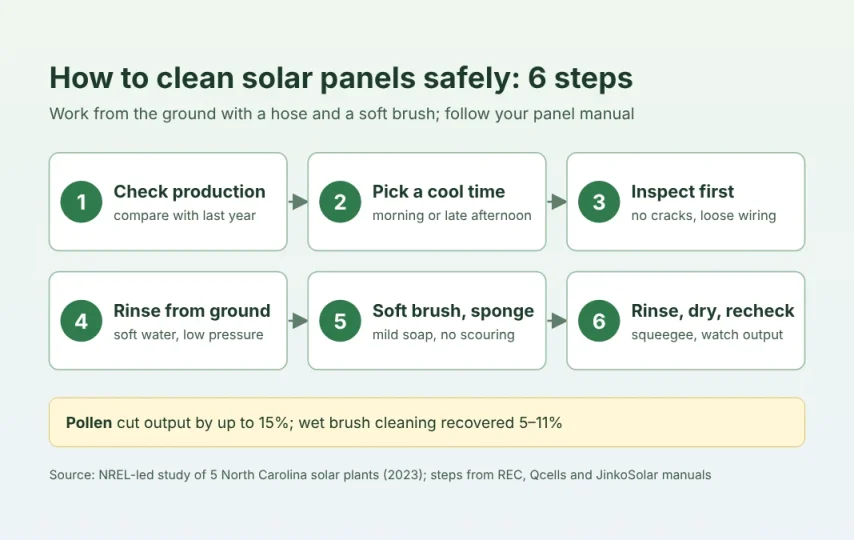

How to clean solar panels: wait until the panels are cool, rinse them from the ground with a garden hose using low-mineral or deionized water, loosen dirt with a soft brush or sponge on an extension pole, and let them dry or wipe them with a squeegee. Keep water pressure low and skip abrasive pads and harsh chemicals, in line with the cleaning rules that manufacturers such as REC and JinkoSolar publish in their installation manuals.
Whether it is worth it depends on climate and roof pitch. In a study of 186 California systems using 2010 data, dust cut output by an average of only 0.051% per day, and one wash in the middle of a dry summer added about 0.81% to a year’s production (Mejia and Kleissl, Solar Energy, 2013). Cleaning matters most for flat or low-tilt panels, dry and dusty sites, heavy pollen and spots such as bird droppings.
Before You Start
Your panel manual and warranty. Major manufacturers publish cleaning rules, and breaking them can cost you warranty coverage. Qcells says damage “caused by the cleaning or related to the cleaning tools or agents” is not covered by its product and performance warranty (Qcells Q.TRON manual, 2023). Canadian Solar’s 2020 manual for its bifacial modules states that “damages induced by inappropriate cleaning procedures will void” its warranty (Canadian Solar bifacial manual, 2020), and Maxeon (SunPower), in its international (IEC) manual, says harsh materials or “cleaning without consultation” invalidate the product warranty (Maxeon IEC manual, March 2025).
Whether cleaning is needed at all. REC recommends cleaning “when dirt can clearly be seen on the glass surface” and notes that “the lower the angle of installation, the more cleaning will be required” (REC Alpha Pure manual, 2026). Canadian Solar says modules tilted at least 15° “generally do not require cleaning” because rain does the job.
What you need: a garden hose with a gentle nozzle, a soft brush or non-abrasive sponge on an extension pole, mild biodegradable dish soap (optional) and a soft rubber squeegee. Plan to work from the ground; if you cannot reach the panels that way, hire a pro.
How to Clean Solar Panels: Step by Step
1. Check production first
Compare recent output in your monitoring app with the same weeks last year. A drop that matches visible dust, pollen or droppings is a cleaning problem; a drop with clean glass points to shading or an equipment fault, which a hose will not fix.
2. Pick a cool time of day
Clean early in the morning or late in the afternoon. REC says cleaning “must always be carried out when the panels are cool” to avoid breakage through thermal shock, and JinkoSolar recommends early morning or late afternoon, when solar irradiation is low (JinkoSolar manual A1.8, May 2026). Skip the job if frost is possible: Qcells says not to clean with water when there is a risk of frost.
3. Inspect before you touch
Look for cracked glass, scorch marks or damaged wiring. JinkoSolar warns never to clean a module with broken glass or exposed wiring, because it presents a shock hazard. If you see damage, stop and call your installer.
4. Rinse with low-mineral water, from the ground
Start with a plain rinse from the top edge down. REC recommends deionized water at ambient temperature, with rainwater or tap water as secondary options. JinkoSolar advises against water with high mineral content and recommends a pH of 6.5 to 8; Canadian Solar also asks for low-mineral, near-neutral water.
Keep the pressure low. JinkoSolar recommends keeping hose or backpack sprayer pressure below 675 kPa, about 98 psi (our conversion), and Maxeon’s international manual says normal water pressure “is more than adequate.” Manuals differ on pressure washers, so a garden hose is the safe default unless your own manual says otherwise.
5. Loosen stuck dirt with a soft brush or sponge
Wet the glass first, then wipe gently with a soft brush, sponge or microfiber cloth on a pole. Canadian Solar says not to “scrape or rub dry dirt away, as this may cause micro scratches,” and both Canadian Solar and Maxeon advise against rotating or spinning brushes.
For grime the water will not lift, REC allows a mild, biodegradable washing-up liquid and isopropyl alcohol below 10% concentration, but no acidic or alkaline detergents. Maxeon rules out scouring powder, steel wool, scrapers and blades.
6. Rinse, dry and check output again
Rinse off any soap with plenty of water, then pull a soft rubber squeegee from the top down or let the panels air-dry, as REC describes. Then check production on the next sunny day.
Does Cleaning Solar Panels Actually Increase Output?
Yes, but the gain ranges from almost nothing to double digits, depending on climate, tilt and what is on the glass.
- Rainy, temperate climates: soiling losses can be as low as 0.5% a year, while desert sites can lose up to about 30% a year, according to studies summarized by NREL (2023). For 16 sites in the U.S. Southwest, NREL’s model put average soiling losses over 1999–2018 between 4.3% and 15.5%.
- California rooftops: across 186 sites in 2010, panels lost about 0.051% of efficiency per day on average, and 7.4% over the longest dry spell of the year, which averaged 145 days. Panels tilted below 5° soiled much faster than steeper ones (Mejia and Kleissl, 2013).
- Pollen: an NREL-led study of five North Carolina solar plants found output fell by as much as 15% in peak pollen season, rain did not fully restore it, and wet brush cleaning recovered 5% to 11% (NREL, December 2023).
Globally, soiling reduces solar power production by at least 3% to 4% even with optimized cleaning, according to a peer-reviewed estimate in Joule (Ilse et al., 2019).
Does rain clean solar panels?
Mostly, on tilted panels. Qcells says dirt and grime “are usually washed away by rain,” and Maxeon notes cleaning helps most where annual precipitation is below 18.25 inches (46.3 cm). Rain does less on flat or low-tilt arrays and on sticky pollen, as the California and North Carolina studies above found. That is one reason roof pitch matters: you can check the best angle for your area with our solar panel direction and tilt tool, and panels mounted flat, such as many flexible solar panels, may need more frequent rinsing.
Example: What Dirty Panels Cost a Typical U.S. Home
The table uses the median size of U.S. home solar systems installed in 2025, 7.7 kW, from Berkeley Lab’s 2026 data update; a production ratio of about 1.5 kWh per watt per year, which EnergySage gives for sunny states such as California; and EIA’s forecast U.S. average residential electricity price of 18.17 cents per kWh for 2026 (EIA Short-Term Energy Outlook, November 2026). The arithmetic is our own calculation.
| Scenario | Lost or gained kWh per year | Value per year |
|---|---|---|
| Clean system: 7.7 kW × 1,500 kWh/kW | 11,550 kWh produced | about $2,099 |
| 1% average soiling loss | −116 kWh | about $21 |
| 5% average soiling loss | −578 kWh | about $105 |
| 10% average soiling loss | −1,155 kWh | about $210 |
| One mid-summer wash (+0.81%, California study average) | +94 kWh | about $17 |
In less sunny states every row shrinks, and the value also depends on how your utility credits solar exports. For your own number, multiply your annual production by the expected loss and your electricity rate.
For comparison, professional solar panel cleaning costs about $150 to $500 in total, or $10 to $20 per panel, according to HomeGuide, and $15 to $25 per panel according to Angi (April 2024). Both note minimum fees of about $100 or more. At a few percent of soiling, paying for a crew rarely makes sense; at 10% or more, or for a large array, it can.
Common Mistakes When Cleaning Solar Panels
- Cleaning hot panels. REC warns of breakage through thermal shock.
- Using a pressure washer or a rotating brush. Manufacturers set pressure limits and warn against spinning brushes; check your manual before using anything stronger than a garden hose.
- Scrubbing dry dust. Dust is abrasive. Qcells and Canadian Solar both warn against scraping off dirt; wet it first.
- Using household cleaners. Manufacturers rule out scouring powders, degreasers and acidic or alkaline detergents, and damage from improper cleaning can void the warranty.
- Standing or leaning on panels. REC warns against any pressure on the surface.
How to Clean Bird Droppings, Pollen and Snow
Bird droppings shade the cells beneath them; Qcells names them as an example of debris that can partially shade modules. Soak the spot with water first and wipe gently; Qcells allows isopropyl alcohol on stubborn stains, ideally within an hour of them appearing.
Pollen is sticky, and rain may not remove it, as the North Carolina study showed; rinse and brush gently after the main pollen season.
Snow should be removed only from the ground and without force; Qcells suggests “a very soft broom” and Canadian Solar “a soft brush.” Never use a metal shovel or chip at ice, and never climb onto a snowy roof.
When to Call a Professional
Call a professional if your panels are on a second-story or steep roof, if you cannot reach them from the ground, or if you see any damage. Falls are the leading cause of death in construction, according to OSHA, and roofing contractors accounted for 110 of the 423 fatal falls, slips and trips in construction in 2023 (BLS, 2025). Ladders are risky at home too: in a 2017 post, CDC’s NIOSH reported that more than 500,000 people a year in the U.S. are treated for ladder-related injuries (CPSC 2014 data) and about 300 die (CDC data for 1999–2015).
Qcells also says never to access the installation area alone, and REC says that if in doubt, “stop and obtain professional advice.” Ask your installer first, and judge any cleaning quote against the payback numbers above.
How Often Should You Clean Solar Panels?
There is no single interval, and manufacturers disagree. JinkoSolar suggests cleaning “preferably once per month, more frequently in dusty conditions.” Maxeon’s international manual calls periodic cleaning “recommended but is not required,” and REC says to clean when dirt is clearly visible. Canadian Solar says panels tilted at 15° or more generally need no cleaning at all.
A practical rule: check your panels and production data a few times a year, especially after a dry spell or pollen season, and clean when you see dirt and output is down against the same period last year. For the bigger picture, see our piece on the future of solar energy.
Frequently Asked Questions
What is the best way to clean solar panels?
The best way to clean solar panels is from the ground, early in the morning or late in the afternoon, with a garden hose, low-mineral or deionized water and a soft brush or sponge on an extension pole. Use mild soap only for stubborn grime and avoid abrasive pads, harsh chemicals and high pressure.
Can I use a pressure washer on solar panels?
It is safest not to. JinkoSolar’s manual limits hose pressure to below 675 kPa (about 98 psi, our conversion), while Maxeon’s international manual allows pressurized water up to 100 bar (about 1,450 psi) only from at least 50 cm (about 20 in). Manuals differ, so check yours; a garden hose is enough for dust and pollen.
Does cleaning solar panels void the warranty?
Cleaning itself does not, but damage from the wrong methods can. Qcells excludes damage caused by cleaning tools or agents from its warranty, and Canadian Solar and Maxeon say improper cleaning voids theirs. Follow the cleaning section of your panel’s installation manual.
How often should you clean solar panels?
Clean when you see dirt and production drops, rather than on a fixed calendar. Tilted panels in rainy areas may rarely need it; flat panels and those in dusty, dry or high-pollen areas may need cleaning several times a year.

We send one email a week. No spam. Unsubscribe anytime. See our Privacy Policy.

